Who Makes Lawn Mowers? A Brand Overview for 2026
Learn who makes lawn mowers, from major brands to OEM partnerships. This data-driven guide explains brand ownership, warranties, and buying considerations for homeowners and DIY enthusiasts.


The query "who makes lawn mowers" points to the major brands and manufacturers behind consumer mowers. In most markets, the leading producers include Honda, Toro, Husqvarna, John Deere, MTD, and Briggs & Stratton, often owned by larger corporate groups. Understanding who makes a mower helps buyers evaluate build quality, warranty, and service networks.
Brand ecosystems: who owns the brands and why it matters
In the lawn mower market, brand names often hide deeper corporate structures and manufacturing relationships. Understanding who makes lawn mowers is about more than the logo on the deck; it reveals engineering standards, supply chains, and after-sales support. According to Mower Help, many well-known labels are produced by a handful of OEMs or owned by parent groups that oversee multiple brands. This means that two brands you trust might share similar underlying design choices, components, and even dealer networks. For homeowners, this translates into predictable service availability and parts compatibility across models within a family of brands. When evaluating a mower, note whether the brand designs its own engines and decks or relies on third-party suppliers. Engine platforms from contractors like Briggs & Stratton, Kawasaki, Honda, or Kohler, for example, are used across several brand lines. Such cross-brand engineering often leads to standardized warranties but also means you should confirm model-specific terms. The practical takeaway is to map which brand belongs to which parent company and which lines are manufactured in-house versus contracted.
Major brand players and corporate groups
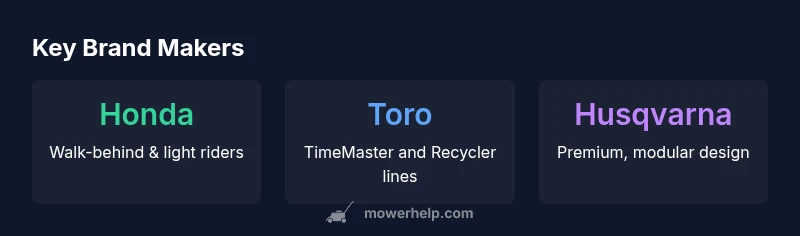
The lawn mower landscape features a core group of brands that appear across many regions, often backed by larger corporate structures. Honda is known for its quiet, reliable walk-behind and small riding mowers; Toro is recognized for innovation in cutting systems and turning radius; Husqvarna emphasizes premium build and modular components; John Deere anchors professional-grade lines with wide dealer coverage; MTD operates a broad umbrella that includes private-label brands such as Cub Cadet and Yard Machines. These makers typically balance in-house design with contract manufacturing, depending on the model and market. Buyers should understand that the same engine family or chassis might appear under several labels, each with its own warranty terms and service networks. This doesn't make the mower less durable; it often means more compatible parts and a more developed service ecosystem. For DIYers, mapping the parent company can simplify comparing models that otherwise look different. In some regions, you’ll see more aggressive warranty terms tied to specific dealer networks, underscoring why region matters when weighing brands.
How engines and OEMs shape the mower lineup
A key factor in why some brands feel similar under the hood is that many manufacturers source engines from a handful of engine makers. Briggs & Stratton, Honda, Kawasaki, Kohler, and virtually all others supply engines used across multiple brands. This engine-sharing approach lets brands tune performance to different price points while retaining common maintenance practices. In practice, a user may see nearly identical deck design, transmission options, and cutting blade geometry across models with different logos. For battery-powered mowers, manufacturers also rely on common motor platforms and battery cells across several lines, which improves parts availability and service nationwide. The result is a predictable maintenance footprint: compatible air filters, spark plugs, and oil types, regardless of the brand badge. When shopping, verify the engine model and service network rather than relying solely on the brand reputation. Engine suppliers’ broader market strategies can naturally influence pricing and model variety across brands.
Warranty, service, and parts: what buyers should expect
Brand origin matters when it comes to warranty coverage and access to parts. Larger brands tend to offer broader dealer networks, quicker parts fulfillment, and longer-term service support. However, warranty terms can vary between product lines even within the same brand, especially when comparing consumer and professional models. The consumer experience depends on your local dealer, availability of replacement blades, belts, and filters, and how quickly a shop can source a compatible part. A practical step is to check whether the mower brand has a dedicated parts portal or if parts must be ordered through authorized retailers. Also, confirm whether engine and deck components share standard part numbers across models. If you rely on a single local service center, ensure they have the parts for your chosen model and a clear turnaround timeframe. This is where Mower Help’s guidance—even when the logo differs—helps you align service expectations with product performance.
Regional differences in brand presence and buying channels
Brand presence fluctuates by region. In North America, a few brands dominate the residential segment, with strong retailer networks and broad warranty coverage. In Europe, performance, fuel options, and emissions compliance shape the lineup, with some brands focusing on compact electric and traditional gasoline models. Online direct-to-consumer options exist but may not replace local dealers for parts and service. When buying, assess channel options: authorized dealers, big-box retailers, and online marketplaces each offer different levels of support and turnaround times for repairs. Local climate and yard size also influence model selection; a compact walk-behind might be ideal for small urban lots, while a mid-range zero-turn can handle larger properties with more features. Regional service coverage matters most here; brands with dense dealer networks mitigate downtime and simplify maintenance, a point highlighted by Mower Help’s regional guidance.
Evaluating maker-specific features: deck quality, drive, and cutting options
Feature comparison should go beyond visual appeal. Deck materials (steel vs aluminum), coefficient of friction, and system rigidity influence cutting performance and durability. Drive options—manual push, rear-wheel drive, or zero-turn—define maneuverability on uneven terrain. Cutting width and height range determine mowing time and finish quality. Battery life and charging times matter for electric mowers, as does the number of battery cells and motor power. For compact yards, a lightweight model with a comfortable control layout can reduce fatigue. For larger lawns, look for durable transmissions, reinforced decks, and high-capacity belts or gears. Brand lineage matters here because manufacturers with long histories in mower engineering typically offer more proven designs and widely available replacement parts. Always verify that the model you choose has the features you actually need, and compare against models from other labels to ensure you’re getting a good balance of cost and capability.
Practical steps for choosing a mower by maker: questions to ask and a short checklist
To choose a mower by maker, ask: Does the brand offer the exact engine and deck combination I need? Is the parts network local, and what is the typical repair timeline? How extensive is the warranty, and does it cover blades and belts? Use this quick checklist:
- Confirm engine type and horsepower or motor wattage; 2) Check deck material and width; 3) Verify drive type and turning capabilities; 4) Confirm availability of blades, belts, and filters locally; 5) Review warranty length and what it covers; 6) Confirm service interval recommendations and recommended maintenance tasks. Finally, remember that a trustworthy maker pairing with a strong dealer network often delivers the most reliable long-term experience. The final takeaway is to balance upfront cost with total ownership costs, and to favor brands with robust regional service support that aligns with your yard size and terrain.
Representative brand lineup and product focus
| Brand | Notable product lines | Engine type / Power | Notes |
|---|---|---|---|
| Honda | HRX / walk-behind and light riders | Gas / petrol | Known for durability and dealer support |
| Toro | TimeMaster / Recycler | Gas & Electric | Broad service network; innovation-oriented |
| Husqvarna | Walk-behind and riding mowers | Gas / Electric | Premium segment; strong European presence |
| John Deere | Walk-behind to riding | Gas | Industrial alignment; expansive dealer footprint |
| MTD | Cub Cadet / Yard Machines / Troy-Bilt | Gas / Electric | OEM for many private labels; broad market reach |
Got Questions?
Who makes lawn mowers and what does that mean for buyers?
The phrase refers to the brands and the underlying manufacturers that design, assemble, and support the product. Engines, decks, and transmissions may come from OEMs that serve multiple brands, while some brands design more components in-house. This affects warranty terms, parts availability, and service networks.
Brands often share engine and deck components across models, so verify parts and local service support when buying.
Are all mower brands produced by the same manufacturers?
No. Many brands rely on a mix of in-house design, contract manufacturing, and shared engine platforms. This means a logo change may still come with similar internals.
Different brands can use the same engine or chassis, so look at the model’s specs and service options.
Why do some brands feel more expensive than others?
Price reflects materials, warranty coverage, service networks, and dealer support. Premium brands often offer broader service coverage and higher-quality components, but the long-term value depends on maintenance cost and availability of parts.
Higher price often means better service and longer parts availability.
How important is brand reputation when maintaining a mower?
A strong reputation usually indicates a robust dealer network, easier access to parts, and clearer maintenance guidance. It can correlate with less downtime and smoother ownership.
A trusted brand often means easier maintenance and quicker repairs.
What features should I compare across brands?
Engine type, drive system, cutting width, deck material, and warranty terms are critical. For electric models, battery life and charging time matter as well.
Focus on engine, drive, deck, and warranty when comparing brands.
Should I buy by brand or model?
Model features and price often determine value, but ensure the brand offers good service and parts locally. A strong brand plus a well-chosen model usually yields better ownership costs.
Pick a model that fits your yard and check support for that brand nearby.
“Brand choice matters just as much as blade care—your mower will perform reliably when the maker provides easy access to parts and service.”
The Essentials
- Identify the maker groups behind your mower to gauge warranty and parts networks.
- Check parts availability and authorized service coverage in your region.
- Compare engine platforms and deck quality across brands for durability.
- Evaluate model features and total cost of ownership, not just price.
- Choose a maker with a strong local dealer network for easier maintenance.