Cub Cadet Mowers for Sale: Buying Guide 2026
Discover Cub Cadet mowers for sale with a practical buying guide, price ranges, and maintenance tips. Learn to pick between walk-behind, riding, and zero-turn models for your yard and budget.


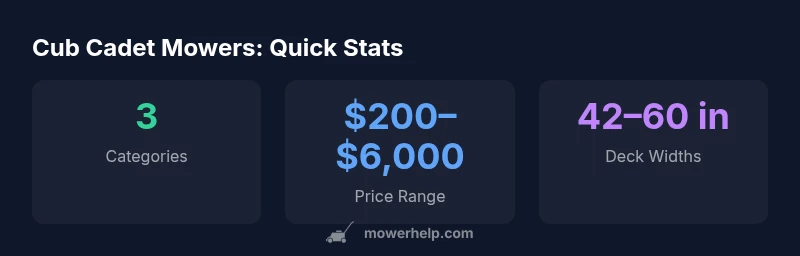
Cub Cadet mowers for sale span three main types: walk-behind, riding, and zero-turn, with price ranges typically from $200 up to $6,000 depending on features and size. For most residential yards, a 42–54 inch riding mower offers the best balance of power, deck width, and maneuverability. This framing helps homeowners map their needs to a practical, long-term solution.
Cub Cadet Mowers for Sale: An Overview
Cub Cadet mowers for sale span three core categories: walk-behind (push) models, riding lawn tractors, and zero-turn mowers. Each category targets different yard sizes, terrain, and storage realities. Walk-behind mowers are compact and nimble for small lawns; riding mowers deliver comfort and speed for larger properties; zero-turn mowers excel on tight layouts with obstacles. The buying framework starts with your yard profile: how big is the lawn, what slopes exist, and how much time you want to spend mowing. According to Mower Help analyses, aligning the category to your actual needs reduces overbuying on features you will rarely use. A practical step is to sketch your property: the dimensions of the mowing area, the height of grass during peak season, and any frequent obstacles. This article translates those insights into a structured buying plan that covers features, maintenance expectations, and long-term ownership costs across Cub Cadet mowers for sale.
Understanding the Cub Cadet Product Line
Cub Cadet offers three principal mower categories, each with distinct strengths. Walk-behind mowers suit tight spaces and quick edge work; riding mowers provide a comfortable, efficient experience for mid-to-large lawns; zero-turn mowers are best when you navigate complex layouts or tight turns. Across these categories, customers encounter variations in deck width, engine options, and drive systems. The key for buyers is to translate yard size and terrain into a recommended deck width and drive type rather than chasing the biggest model. This clarity helps you compare Cub Cadet mowers for sale against other brands with confidence. The Mower Help team emphasizes evaluating dealer support, parts availability, and service networks, which directly affect long-term reliability.
Key Buying Considerations
When selecting a Cub Cadet mower, start with the yard rather than the tool. Key considerations include:
- Yard size and mowing frequency: Large, flat lawns tolerate larger decks and faster cut rates; small, irregular lots may benefit from nimble, compact models.
- Deck width and cutting height range: Deck width determines coverage per pass; adjustable cutting heights adapt to seasonal growth.
- Transmission and drive type: Hydrostatic or geared transmissions affect ease of operation and maintenance.
- Engine options and reliability: Common engine families offer different lifespans and service intervals; verify manufacturer support in your area.
- Maintenance access and spare parts: Check access to blades, filters, and oil drain plugs; verify availability of parts locally.
- Warranty and service network: Confirm what is covered and where service is available locally, especially for major components.
These considerations help you choose Cub Cadet mowers for sale that fit your workload and your budget, while avoiding common buying mistakes.
Price Ranges and What to Expect
Price ranges for Cub Cadet mowers reflect performance, size, and the inclusion of premium features. Entry-level walk-behind options and electric push mowers are typically at the lower end of the range, while mid-range riding mowers and zero-turn models push higher into premium territory. The most common tiers look like this:
- Walk-behind (push) mowers: modest budgets; compact yards; basic features.
- Riding mowers: suitable for average to larger lawns; balanced deck width and power.
- Zero-turn mowers: best for irregular layouts, fast mowing, and professional-grade results; higher upfront cost.
From the buyer’s perspective, it’s important to factor in ongoing maintenance costs, parts availability, and expected resale value when budgeting. The Mower Help analysis notes that while sticker price varies widely, total ownership cost often correlates with the scale of use, frequency of maintenance, and how well you align the model with your property.
Dealers, Warranties, and After-Sales Support
Where you buy matters almost as much as what you buy. Authorized Cub Cadet dealers typically offer better access to parts, service, and warranty coverage than off-brand retailers. When evaluating dealers, ask about:
- Availability of parts and service centers within your region
- Clarity of warranty terms for major components and any model-specific exclusions
- Turnaround time for maintenance or repairs and loaner options during service
- Availability of training or demonstrations to help you use the mower safely and efficiently
Warranty terms vary by model and region, so it’s essential to read the fine print at purchase. A reliable dealer will help you register your mower, explain maintenance milestones, and keep you informed about any recalls or service campaigns. This support is a meaningful part of the long-term value of Cub Cadet mowers for sale.
Maintenance and Long-Term Care
A disciplined maintenance routine extends the life of any mower. For Cub Cadet mowers, focus on regular checks that align with manufacturer recommendations:
- Check and change oil as advised for your engine family; replace filters when needed.
- Inspect blades for sharpness and balance; replace if damaged.
- Clean the chassis after mowing to prevent grass clippings from corroding parts.
- Air filters and cooling systems should be cleaned or replaced per the schedule, especially in dusty environments.
- Battery or charging systems require attention for battery-powered or electric models; maintain proper charging cycles.
Keeping a maintenance log helps you anticipate service needs and budgets for parts. The goal is to minimize downtime and keep the mower performing at peak efficiency across its life cycle.
Used Mowers and Resale Value
Buying a used Cub Cadet mower can offer significant upfront savings, but it requires careful assessment. Inspect the age and condition of the engine, the integrity of the deck, blade quality, and the drive system. Request service records and any maintenance history. A well-maintained used mower from Cub Cadet often holds value well, especially if it has been stored indoors and covered during off-seasons. If you’re evaluating multiple used options, compare them against a current new model’s feature set and warranty coverage to determine true value. Always test-drive if possible to verify that the transmission and blades operate smoothly.
Safety, Storage, and Sustainability
Safety features and proper storage practices are essential when buying Cub Cadet mowers for sale. Prioritize models with reliable blade engagement controls, effective braking systems, and clear operator manuals. Store the mower on a clean, dry surface and perform seasonal maintenance before long-term storage to prevent corrosion or fuel-related damage. For sustainability-minded buyers, consider models with efficient engines, low emissions, and battery-powered options where appropriate for your yard. Regular maintenance and responsible storage dramatically extend the life of your mower and support a safer mowing environment.
Final Guidance for 2026 Buyers
In 2026, the buying landscape for Cub Cadet mowers for sale remains broad, with options to fit nearly any yard size and budget. Start with a precise yard profile, compare decks and drive types, and select a dealer you trust for service and support. Use a structured checklist to evaluate price, warranty, and maintenance commitments. Most homeowners benefit from prioritizing a mid-range riding mower with a deck width in the 42–54 inch range, paired with a solid service network. This approach balances upfront costs with long-term reliability and ease of maintenance. The Mower Help team recommends a careful, rule-based selection process to ensure your investment provides consistent mowing performance for years to come.
Cub Cadet mower categories by deck size and price range
| Category | Deck Width | Approx. Price Range | Ideal Yard Size |
|---|---|---|---|
| Walk-behind | 20-22 in | $200-$900 | Small yards (≤0.25 acre) |
| Riding Mower | 38-54 in | $1,400-$3,000 | Medium yards (0.25–0.75 acre) |
| Zero-Turn | 42-60 in | $2,500-$4,800 | Large/irregular yards |
Got Questions?
What are the main Cub Cadet mower types available for sale?
The three core categories are walk-behind (push) mowers, riding mowers, and zero-turn models. Each category targets different yard sizes and terrain. Walk-behind is compact and suitable for tight spaces, riding mowers deliver comfort for larger lawns, and zero-turns excel on complex layouts. When buying, map your yard characteristics to a category to avoid overbuying.
Cub Cadet offers walk-behind, riding, and zero-turn mowers. Choose based on your yard size and terrain.
What yard size is best suited for Cub Cadet riding mowers?
Riding mowers are generally ideal for medium to large yards with relatively open spaces. They balance deck width and speed for efficient mowing, while preserving maneuverability on gently sloped sections. If your lawn is under a quarter acre, a smaller riding mower may suffice, but for 0.25–0.75 acre, a mid-sized riding model often delivers the best value.
Riding mowers fit medium to large yards. If your lawn is about a quarter to three-quarters of an acre, a mid-sized model is usually a good fit.
How do I choose between a riding mower and a zero-turn?
Choose riding mowers for straightforward lawns with long, even stretches and a preference for a comfortable, stable ride. Zero-turns excel when the yard has tight turns, obstacles, or irregular boundaries and you want faster mowing. Consider storage space and weight, since zero-turns are heavier and require more space to maneuver in tight spots.
Riding mowers are comfortable for regular lawns, while zero-turns win on tight layouts and obstacles.
Are Cub Cadet mowers easy to maintain?
Maintenance ease depends on the model and engine family, but Cub Cadet designs commonly emphasize accessible blade areas, straightforward oil changes, and replaceable filters. Regular maintenance reduces downtime and extends life. Always follow the owner’s manual and keep a spare parts checklist on hand.
Maintenance is typically straightforward if you follow the manual and keep parts stocked.
Where can I find authorized Cub Cadet dealers and service centers?
Authorized Cub Cadet dealers are listed through the official Cub Cadet network and major retailers. Check the local dealer locator, confirm service availability, and inquire about financing or test drives. For service, use certified centers to ensure proper maintenance and warranty support.
Use the official dealer locator to find Cub Cadet dealers near you for purchase and service.
Do Cub Cadet mowers come with strong warranty coverage?
Warranty terms vary by model and region. When buying, verify what components are covered, the duration, and what is required for eligibility, such as regular maintenance records. Keep receipts and registration information to simplify warranty claims.
Warranty terms depend on the model and location; check specifics at purchase.
“Cub Cadet mowers for sale offer solid reliability when you select a model that fits your yard profile and maintenance readiness.”
The Essentials
- Define yard size to pick the category
- Choose deck width that covers your mowing area efficiently
- Prioritize dealer network and warranty for long-term value
- Balance upfront cost with maintenance and parts availability
- Test-drive at a local dealer before buying