Does a Good Lawn Mower Make a Difference? A Comprehensive Comparison
Explore how mower quality, power, and maintenance affect performance. A balanced, data-informed comparison to help homeowners choose the right mower.


Does a good lawn mower make a difference in lawn care?
The question does not have a single universal answer, but it is one worth asking seriously for homeowners and DIY enthusiasts. The notion that a good lawn mower makes a difference gains ground when you consider how blade quality, deck rigidity, and drive systems translate to real-world results. According to Mower Help, the core drivers of performance are blade geometry, deck strength, engine reliability, and ease of starting and maneuverability. When these systems work in harmony, you experience a more uniform cut, fewer pass-throughs to achieve the same result, and less fatigue during longer sessions. The keyword does not exist in a vacuum: it ties to yard size, grass type, and local conditions. For a small, flat lawn, a mid-range model may suffice, while larger properties with hills or tall grass often justify more robust builds and better part availability. The practical takeaway is clear: the difference a good mower makes emerges when it aligns with the task at hand and the user’s maintenance discipline. This article dissects the factors, tests common configurations, and offers actionable guidance for selecting a mower that balances upfront cost with ongoing value.
Performance factors that shape mowing results
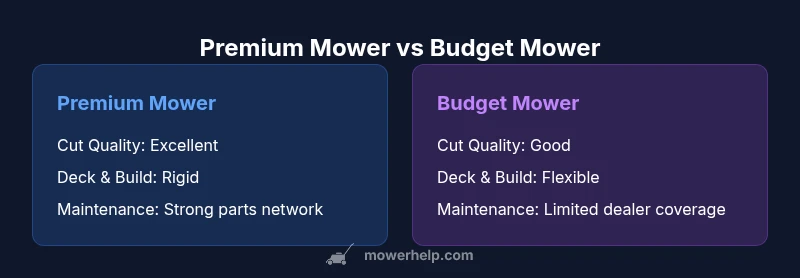
Performance hinges on several integrated factors. Blade quality and sharpness determine how cleanly grass is cut and how much scalping or tearing occurs at different heights. Deck rigidity and design influence vibration and evenness of cut, especially on uneven terrain. Engine type, horsepower or equivalent power delivery, and the efficiency of the drive system affect ease of use and cutting speed. Mulching versus bagging capability interacts with grass moisture and mowing height, shaping post-cut appearance and clumping tendencies. Finally, ergonomics—handle design, weight, balance, and ease of adjustment—determine how consistently you can achieve the desired result. In aggregate, these features define how a mower handles common lawn scenarios: flat, undulating, or rocky patches; damp grass; and varied growth cycles. A robust mower reduces the number of pass-throughs needed and minimizes the frustration associated with temperamental starts or frequent maintenance stops.
Maintenance vs upfront cost: understanding the value proposition
The trade-off between upfront cost and long-term maintenance is central to any buying decision. A cheaper mower may save cash upfront but often incurs higher maintenance costs later, more frequent blade replacements, and shorter overall life. Conversely, a higher-quality unit typically offers durable components, better parts availability, and longer service intervals. The real value lies in maintenance readiness: availability of spare parts, accessibility of service, and the ease with which you can perform routine tasks like oil changes, air-filter cleaning, and blade sharpening. Homeowners who commit to a regular maintenance schedule tend to extract more years of service from their investment, while those who neglect upkeep often experience a disproportionate drop in performance, regardless of initial price. In this sense, “does a good lawn mower make a difference” is partly about design quality and partly about the owner’s willingness to sustain it through the mowing season.
Gas, electric, and battery: how power sources influence outcomes
Power sources shape performance profiles in meaningful but context-dependent ways. Gas mowers generally offer sustained cutting power for larger or tougher jobs and can handle hills better, but they require fuel management, routine maintenance, and emissions considerations. Electric and battery-powered models have rapidly closed the gap on cut quality and speed, with advantages like lower noise, reduced maintenance, and simpler starting procedures. The best choice depends on yard size, terrain, and usage patterns. For small to medium lawns, electric or battery mowers often provide adequate power with lower total ownership costs. For large properties, hilly terrain, or dense, tall grass, a gas mower may still be preferable due to longer runtime and more consistent power delivery. When evaluating power sources, consider runtime per charge, recharge time, battery life, and the availability of service networks in your area.
Real-world scenarios: tailoring the choice to yard size and terrain
Consider three typical cases. Case A: a small, flat suburban lawn that requires quick, quiet operation and easy maneuverability. Here, a mid-range electric or compact gas model can deliver excellent value with minimal maintenance. Case B: a medium-sized lawn with slopes and mixed grass—this scenario benefits from a mower with a sturdy deck, good weight distribution, and reliable starting performance. Case C: a large, uneven lawn with tall grasses—this calls for a robust gas mower or a high-capacity battery model with long runtime and strong cutting power. These scenarios illustrate why the same mower is not ideal for every yard. The take-home message is that you should select a mower that aligns with the yard’s size, terrain, and the operator’s willingness to manage ongoing care.
Measurement and evaluation: how to test performance before you buy
A structured test plan helps you compare options objectively. Start with cut quality at your typical mowing height on common grass types in your yard. Check for scalping, clumping, and evenness across slopes or uneven areas. Assess starting reliability in different temperatures, choke settings, and after storage. Evaluate debris handling—whether mulching clippings or bagging is preferred—and observe how vibrations affect comfort over a 20–30 minute run. Finally, examine maintenance demands: the ease of blade removal or sharpening, oil and air-filter access, and the availability of replacement parts. Document your findings and compare them against manufacturer claims. A disciplined approach makes the final choice clearer and reduces post-purchase regret.
Common myths about lawn mowers debunked
Myth 1: More horsepower always means a better mower. Reality: torque delivery, blade design, and deck buildup matter more for most residential lawns. Myth 2: The most expensive mower is always the best. Reality: value comes from fit to your yard and maintenance discipline, not price alone. Myth 3: Electric mowers cannot handle tall grass. Reality: modern electric models can manage typical suburban growth when chosen for runtime and torque. Myth 4: You should sharpen blades every mowing. Reality: blade sharpness depends on grass health and mowing frequency; frequent sharpening can shorten blade life if not done properly. Understanding these myths helps homeowners make smarter choices.
Choosing the right mower: a practical checklist
Use this checklist to guide your decision:
- Define yard size, terrain, and typical grass type.
- Decide between gas, electric, or battery based on runtime and maintenance willingness.
- Prioritize blade quality, deck rigidity, and reliable starting mechanisms.
- Assess parts availability, warranty length, and dealer support.
- Plan for ongoing maintenance, including blade sharpening, oil changes, and air-filter cleaning.
- Test-drive candidates or watch performance demos to verify cut quality and maneuverability.
By following this checklist, you can move from general preferences to a specific model that truly aligns with your needs. This alignment is where the difference between a good lawn mower and an adequate one becomes most apparent, particularly for homeowners who mow weekly during peak growing seasons.
After-purchase care: extending mower life and value
A maintenance routine that fits your mowing schedule prolongs the mower’s life and preserves performance. Establish a simple calendar for blade sharpening, deck cleaning, oil checks, and air-filter maintenance. Store the mower in a dry, sheltered space to prevent rust and corrosion. Keep fuel and oil fresh and follow the manufacturer’s service intervals for spark plugs or carburetor adjustments. Regularly inspect belts, tires, wheels, and blade bolts to catch wear early. A well-cared-for mower not only performs better but also retains higher resale value. The bottom line is that upkeep matters as much as initial quality, and a thoughtful maintenance plan is essential to preserving the benefits of a good mower over several mowing seasons.