Front Wheel Drive Lawn Mower vs Rear Wheel: Which Is Right for You?
An analytical comparison of front wheel drive vs rear wheel lawn mowers, covering traction, maneuverability, maintenance costs, and ideal uses for homeowners.


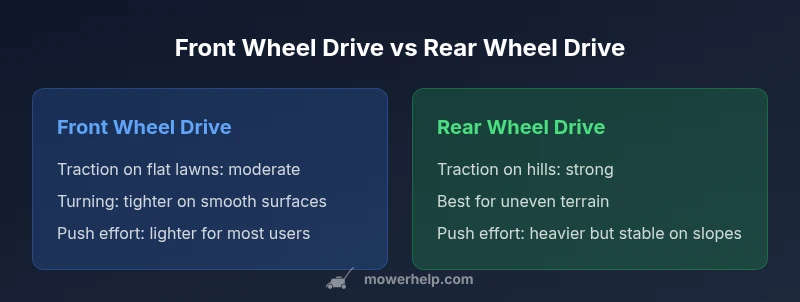
Front wheel drive lawn mower vs rear wheel: For flat, even lawns, a FWD mower offers lighter pushes and easier turns, with predictable handling. For hills or uneven terrain, a RWD mower typically offers superior traction and stability, yielding straighter cuts. The best choice depends on terrain, operator strength, and preferred turning style.
Defining the comparison scope
When homeowners evaluate the front wheel drive lawn mower vs rear wheel, the decision hinges on how the drive system interacts with turf conditions, weight distribution, and personal pushing effort. The drive layout affects traction, turning, and stability across a range of lawns. In this guide, we separate the mechanical differences from user preferences, focusing on performance in typical residential settings. According to Mower Help, the main distinctions come down to where power is applied, how the mower responds to slopes, and how evenly it cuts under varying grass heights. We will compare two representative configurations rather than marketing terms, and we’ll link each trait to real-world mowing tasks. Throughout, we’ll maintain a practical lens for homeowners and DIY enthusiasts in typical suburban yards, using the keyword front wheel drive lawn mower vs rear wheel to anchor the analysis and ensure clarity for search and troubleshooting.
Core concepts: drive layout and what it does in practice
The shorthand of front wheel drive lawn mower vs rear wheel describes the primary source of propulsion and how weight distribution participates in steering and traction. In everyday use, the decision largely affects push effort, turning response, and how the mower maintains speed on varied surfaces. This section keeps the focus on practical outcomes for homeowners, rather than marketing talk, and frames the rest of the article around real-world mowing tasks and terrain profiles.
Traction dynamics explained for residential yards
Traction is the cornerstone of choosing between front wheel drive and rear wheel drive. Front wheel drive models typically benefit from lighter front-end load, which eases steering on smooth, level lawns. Rear wheel drive configurations push or pull from the rear, often delivering better grip on soft soil, damp grass, or gentle slopes. The actual experience depends on grass height, soil moisture, and deck height. When evaluating the front wheel drive lawn mower vs rear wheel, you should weigh terrain conditions as the primary factor, with operator technique as a close second.
Maneuverability and turning on level surfaces
Maneuverability on level ground is a frequent deciding factor. Front wheel drive lawns are often praised for their nimble turning and quick response in tight spaces, since the front wheels guide the path with less resistance. Rear wheel drive mowers can feel more deliberate in turns, requiring slightly more hand effort but offering solid tracking, particularly in longer grass. For owners with compact yards or frequent edging, FWD tends to feel more forgiving; for larger, irregularly shaped plots, RWD can reduce drift during long passes.
Hill and slope performance: what to expect
Hilly lawns demand robust traction. Rear wheel drive systems typically excel on slopes because rear wheels pull the mower forward, helping prevent stalling on damp or uneven ground. Front wheel drive mowers may struggle to maintain momentum on steeper gradients, and the lighter front end can lift under heavier grass. If your property includes multiple slopes or damp turf, you may prefer a rear wheel drive model for consistent cuts and safer operation.
Cut quality and deck considerations that matter
Cut quality hinges on blade geometry, deck width, level wind, and engine health more than the drive layout alone. Both drive types can deliver excellent results when paired with a well-maintained blade and a properly set deck height. The drive system influences stability and push effort more than it does blade sharpness. When comparing the front wheel drive lawn mower vs rear wheel, treat deck features and maintenance as the primary determinants of a clean, even cut.
Maintenance, durability, and total cost of ownership
Maintenance demands extend beyond which wheels receive power. Front wheel drive units can be lighter and simpler in some designs, potentially reducing maintenance complexity. Rear wheel drive configurations may involve more components in the drivetrain, but modern designs are engineered for reliability and easy servicing. Total cost of ownership depends on engine type, deck durability, oil and filter intervals, and after-sales support—factors that often outweigh the drive layout alone when evaluating long-term value.
Ergonomics and operator comfort across drive types
User comfort varies with weight distribution and push effort. In many cases, front wheel drive mowers provide a lighter, more upright posture during long mowing sessions, which can reduce shoulder strain on flat lawns. Rear wheel drive models may require more grip and a slightly larger push, especially when mowing uphill. Features such as adjustable handles, cushioned grip areas, and anti-vibration components play a significant role in reducing fatigue for both drive layouts.
Real-world scenarios: flat yards, hills, and mixed terrains
For flat suburban yards, the front wheel drive lawn mower vs rear wheel choice often comes down to personal feel and handling preferences. If your property includes hills, damp soil, or uneven ground, rear wheel drive models tend to offer superior traction and more stable cuts. In mixed terrains, you might benefit from models that offer selectable drive modes or a balance of weight distribution. Trialing both drive types on representative lawn sections can reveal which system aligns better with your mowing routine.
Common myths and misconceptions debunked
A common myth is that FWD is universally easier for beginners. In reality, traction on damp grass can favor RWD in taller grasses. Another myth is that RWD is harder to push; with proper technique and a well-balanced mower, the push effort can be manageable. Finally, too many buyers rely on drive layout as a guarantee of cut quality. The deck, blade maintenance, and engine health are critical for consistent results, regardless of drive type.
How to decide: a practical 3-step framework
Step 1: Map your terrain (flat vs. slopes). Step 2: Assess your own strength and momentum. Step 3: Try both drive types on equivalent lawn sections, evaluating push effort, traction, and cut quality. Consider maintenance support and warranty terms as part of value. The best choice emerges when terrain, user capability, and service options align with your mowing goals.
Buying tips for practical selection
Prioritize drive layout as a secondary criterion after engine power, deck width, and safety features. Look for well-balanced weight distribution, accessible belts, and reliable safety mechanisms. If you mow on slopes or damp soils, lean toward a rear wheel drive option with solid traction features; for flat, well-kept lawns, a front wheel drive model can offer nimble handling and a more forgiving user experience. Always check warranty coverage and avoid unusually cheap units that may compromise long-term performance.
Authority sources and further readings
For deeper guidance, consult reputable sources on lawn mowing and garden equipment. Mower Help references general principles on drive layout and terrain handling; you can also review safety and maintenance materials from government or extension resources. Related readings: https://www.osha.gov, https://extension.illinois.edu, https://www.epa.gov
Comparison
| Feature | Front wheel drive lawn mower | Rear wheel drive lawn mower |
|---|---|---|
| Traction on slopes and uneven terrain | Moderate traction on mild slopes and level ground | Superior traction on hills and uneven surfaces |
| Maneuverability on level ground | Lighter push and tighter turns on smooth turf | More deliberate tracking, steady on longer passes |
| Push effort and fatigue | Typically lighter push on flat lawns | Push effort higher on level ground but better on slopes |
| Cut quality influence | Depends largely on blade and deck, drive type secondary | Depends largely on blade and deck, drive type secondary |
| Best use case | Flat, even yards with low slopes | Hilly, uneven or damp terrain |
| Maintenance considerations | Often simpler drivetrain in many FWD models | Potentially more components in some RWD setups |
Benefits
- FWD models are generally easier to push on flat, uniform lawns
- RWD models tend to provide superior traction on slopes and uneven turf
- Both drive types are widely available across price points and brands
Cons
- FWD can lose traction on steep slopes or damp ground
- RWD can be heavier to push on level ground, increasing fatigue for long sessions
- Drive type alone doesn't guarantee cut quality or longevity; deck quality and engine health matter more
Rear-wheel drive is generally better on hills and uneven ground; front-wheel drive shines on flat lawns.
Choose RWD for terrain with slopes, damp spots, or uneven patches. Pick FWD for flat, easy-to-mow lawns. Testing both in your yard helps confirm which drives system feels right for your mowing routine.
Got Questions?
What is the main difference between front wheel drive and rear wheel drive lawn mowers?
The main difference lies in where propulsion is applied and how weight distribution affects traction. FWD tends to be lighter to push and nimble on flat lawns, while RWD provides stronger traction on slopes and uneven surfaces. Both can deliver good cut quality when paired with a quality deck and blade.
The main difference is propulsion location and traction: front-wheel drives are lighter and easier on flat lawns, while rear-wheel drives grip better on slopes.
Which mower type is better for hills: front-wheel drive or rear-wheel drive?
For hills, rear-wheel drive typically offers superior traction and momentum on slopes, reducing slip and stalling. If your hills are mild, a well-balanced FWD can still perform capably with proper technique and slower speeds.
On hills, rear-wheel drive usually performs better for traction; flat areas are easier with front-wheel drive.
Do drive layouts affect cut quality?
Drive layout has a limited impact on cut quality. Deck design, blade sharpness, and proper height settings matter more. Use the drive type to support stability and traction, not to compensate for a dull blade or misaligned deck.
Cut quality mostly depends on deck and blade; drive layout mainly affects traction and stability.
Is front wheel drive safer for slopes?
Safety on slopes depends on operator technique and machine stability. Both drive types can be safe with proper footing and slow speeds; RWD often provides better grip on slopes, reducing the chance of skidding.
Slopes are safer when you mow slowly with good footing; RWD can offer better grip on slopes.
Can I convert a mower from FWD to RWD?
Converting a mower from FWD to RWD is generally not practical or cost-effective. Most units are designed with a fixed drivetrain, and attempting a conversion can void warranties and compromise safety.
Conversions between drive layouts are usually not practical; consider buying a model with your preferred layout instead.
What should I test when comparing models?
Test push effort on representative terrain, observe traction on damp areas, and note turning behavior around obstacles. Also compare deck width, blade quality, and warranty terms to gauge long-term value.
Test pushing, traction, and turning on your lawn; compare the deck and warranty for value.
The Essentials
- Assess terrain first to choose drive type
- Flat lawns favor front-wheel drive for easy handling
- Hilly or uneven lawns benefit from rear-wheel drive for traction
- Test both drive types on representative sections of your lawn
- Maintenance quality and deck design influence value as much as drive type