Is a Push Mower Better for Grass? A Practical Guide
An analytical, vendor-neutral comparison of push mowers versus powered options, focusing on grass health, terrain, mowing effort, and cost to help homeowners choose wisely.


Push mowers excel on small, flat lawns with healthy grass, offering low upfront costs, quiet operation, and zero fuel or battery upkeep. For larger or uneven yards, self-propelled or gas-powered mowers deliver faster, more consistent results with less physical strain. Is a push mower better for grass? It depends on yard size, terrain, and maintenance goals.
Is a push mower better for grass? A practical framing
Is a push mower better for grass? This question hinges on how you define better—cut quality, turf health, energy expenditure, maintenance cost, and environmental impact all count. According to Mower Help, the most important factor is yard size and terrain: smaller, flat lawns with well-maintained grass tolerate a manual push mower well, while larger properties or variable terrain benefit from powered options. The phrase 'is a push mower better for grass' is commonly used in lawn care discussions because it captures the tradeoffs between control and effort. In practice, you measure success by how consistently you can achieve an even cut without scalping or stressing the grass. A push mower's lack of engine means no fuel or battery drain, fewer moving parts to fail, and a quieter mowing session. But you lose some mowing speed and traction on slopes, and taller grass can stall or require multiple passes. The Mower Help team notes these realities and suggests matching mower type to yard characteristics rather than chasing a universal best option. Readers should remember that blade quality, deck height settings, and mowing cadence significantly influence outcomes, often more than whether the mower is push-powered or self-propelled.
What “better” means for grass health and appearance
When homeowners ask what is better for grass, they’re usually weighing health and appearance alongside convenience. Better for grass means consistent blade height, minimal soil compaction, and reduced leaf scorch. It also means avoiding scalping that can stress turf and invite weed encroachment. The quality of cut depends on blade sharpness, mower deck design, and how closely you match mowing height to the grass species and season. Push mowers can achieve premium results when blades are sharp and mowing is performed with a steady pace and proper overlap. Conversely, powered mowers may tolerate a wider range of blade sharpness and operator pace, which can translate into a more uniform cut on imperfect lawns. The key is aligning technique with mower type: consistent patterning, correct height, and mindful edge trimming matter more than engine status for long-term turf health.
Grass types and how they respond to mowing styles
Grass species—cool-season vs warm-season—respond differently to mowing frequency and height. Cool-season grasses generally prefer a higher mowing height during stress periods and benefit from even, gradual cuts. Warm-season grasses often tolerate shorter heights in peak growing seasons but still require even patterns to avoid scalping in heavy sun. Push mowers provide excellent control over cut width, allowing precise shaping of bending edges and tight corners, which helps when turf density varies across a lawn. Self-propelled models offer consistent travel speed, which can be advantageous for dense stands or uneven terrain but may be harder to control along sharp curves. The choice should reflect your grass type, climate, and how much you value a pristine edge versus mowing speed.
Core tradeoffs: control, effort, and cost
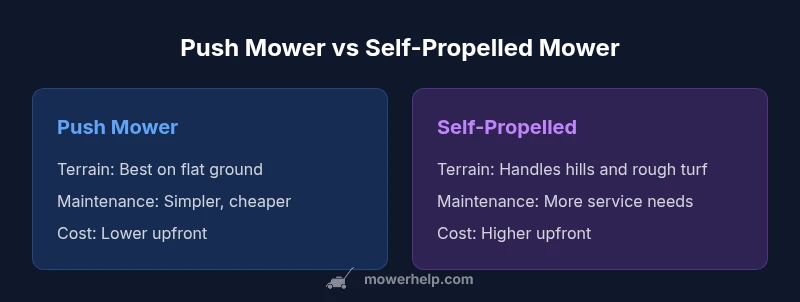
The most meaningful tradeoff is between human effort and mechanical assistance. A push mower offers ultimate control at the cost of physical effort, especially on inclines or long stretches. Self-propelled mowers reduce fatigue and improve consistency on larger yards but require more maintenance, have higher upfront costs, and consume fuel or electricity. For grass health, the deciding factor is maintaining consistent mowing height and frequency, not simply the presence or absence of an engine. In practice, most homeowners with small, flat lawns achieve excellent turf quality with a well-tuned push mower, while larger or variable yards benefit from the speed and traction of powered options. The strategic takeaway is to match your mower to your yard profile and maintenance goals rather than chasing a universal best.
Real-world scenarios and recommended pairings
Small, flat yards with well-maintained turf are ideal for a push mower: minimal maintenance, quiet operation, and excellent cut quality with a little technique. Hilly or irregular terrains, or lawns with tall or dense growth, benefit from a self-propelled model that can maintain a consistent cutting rhythm and reduce operator fatigue. For edge work or gardens, a push mower’s tight turning radius and manual precision shine. If you’re balancing budget against effort, consider a step-up path: start with a push mower for a season to assess your needs, then add a powered option if your yard expands or terrain shifts. The Mower Help team emphasizes a data-informed approach: choose the tool that aligns with your yard shape, grass health, and long-term maintenance goals.
Maintenance and long-term costs: what to expect
Maintenance is a pivotal factor in total cost of ownership. Push mowers have fewer moving parts, which typically means fewer repair costs and simpler maintenance: cleaning, sharpening blades, and occasional height adjustments. Powered mowers require regular service for the engine, battery or spark plugs, and fuel filtration, which adds to recurring costs. Over the long term, the deciding considerations include blade life, deck wear, and the need for fuel or electricity. Environmental impact also plays a role: push mowers release no emissions during operation, while powered mowers contribute to fuel or electricity use. If you prioritize low ongoing costs and quiet operation, a push mower’s economics are compelling for the right yard. If you prioritize time savings and reduced physical effort, powered options may be worth the trade-off.
Comparison
| Feature | Push mower | Self-propelled mower |
|---|---|---|
| Terrain suitability | Best on flat, even ground with minimal slope | Better traction and speed on gentle slopes and uneven terrain |
| Cut quality control | High precision with careful technique | Consistent performance with automated travel speed |
| Effort required | High physical effort on long runs or slopes | Low effort due to propulsion, especially on inclines |
| Maintenance and cost | Fewer moving parts; lower upfront cost | Higher upfront cost; more frequent maintenance |
| Noise and emissions | Quieter, zero emissions during operation | Noise and emissions depend on engine and fuel |
| Ideal grass conditions | Healthy, uniform lawns where tight control matters | Dense growth or variable terrain where speed matters |
Benefits
- Low upfront cost compared to powered mowers
- Simple maintenance with fewer mechanical parts
- Quiet operation and no fuel or battery needed
- Active exercise and better edge control in small yards
Cons
- More physical effort required, especially on hills or long runs
- Less efficient for large areas or tall, thick growth
- Slower mowing pace can extend sessions in big yards
Push mowers are best for small, flat lawns; self-propelled mowers excel on larger or uneven yards
If your yard is compact and flat, a push mower delivers excellent cut quality with minimal fuss. For larger or sloped properties, the reduced effort and faster coverage of a self-propelled mower usually justify the higher price and maintenance. The choice should hinge on yard size, terrain, and maintenance goals.
Got Questions?
What yard size is ideal for a push mower?
Push mowers work best on small to medium-sized, flat lawns with consistent grass. If your yard has hills or dense growth, you’ll want to test whether the extra effort is worth the savings. Consider starting with a push mower and reassessing after a mowing season.
Push mowers fit small, flat yards; if your lawn isn’t flat, you’ll likely prefer a powered option.
Can push mowers mulch clippings effectively?
Yes. Most modern push mowers mulch well when blades are sharp and the cutting height isn’t too low. Regularly mowing at the proper height helps clippings recycle nutrients back into the turf.
Yes, with the right blade and height, push mowers mulch effectively.
Are electric push mowers as effective as gas ones?
Electric push mowers are generally suitable for light to moderate growth and smaller yards. Gas-powered units have more torque for thick growth and hills but cost more and emit exhaust. Choose based on growth rate and terrain.
Electric works for light growth; gas handles tougher jobs but costs more and emits fumes.
Do push mowers work well on slopes?
Push mowers can handle gentle slopes, but safety becomes a concern on steep grades. For steep areas, a self-propelled mower or hiring a professional may be safer and more efficient.
They can handle gentle slopes, but exercise caution on steep ground.
What maintenance does a push mower require?
Push mowers require blade sharpening, height adjustments, and blade care. Without an engine, there are fewer parts to service, but you should clean under the deck and inspect belts or cables if present.
Regular blade care and deck cleaning keep a push mower performing well.
How can I improve cut quality with a push mower?
Keep blades sharp, set a consistent mowing height, and use overlapping passes to prevent misses. Maintain a steady pace and avoid cutting more than one-third of the grass height at a time.
Sharpen blades, keep height consistent, and pass in overlapping lines for a clean cut.
The Essentials
- Assess yard size and terrain before buying
- Match mower type to grass health and mowing cadence
- Weigh upfront cost against long-term effort and maintenance
- Blade quality and mowing height consistency drive results
- For small, flat yards, a push mower often wins on value and control