Is Ego Lawn Mower Better Than Ryobi? In-Depth Comparison for 2026
A detailed, analytical comparison of Ego vs Ryobi cordless lawn mowers, covering power platforms, cutting performance, runtime, maintenance, price, and who each brand suits best for 2026.


Is Ego lawn mower better than Ryobi? The quick takeaway is that both brands offer strong cordless options, but Ego tends to push higher power and longer runtimes on larger lawns, while Ryobi emphasizes broad battery ecosystems and value across a wider range of tools. Your yard size, need for power, and willingness to trade upfront cost for flexibility will determine the winner.
Market Context and Design Philosophies
Homeowners increasingly favor cordless mowers for their zero-emission operation and low maintenance. When evaluating whether Ego lawn mowers are better than Ryobi, it helps to start with how each brand approaches design and ecosystem. According to Mower Help analyses, Ego tends to emphasize high-power battery platforms and aggressive cutting performance in mid- to large-yard models, while Ryobi focuses on versatility across its One+ and 60V/40V families, offering a wide ecosystem of tools that share batteries. This difference shapes not just raw power but how you plan to use the mower as part of a broader toolkit. The takeaway is that the best choice aligns with how you want to pair your mower with other tools and how much value you place on power versus ecosystem breadth.
Power Platforms and Battery Ecosystems
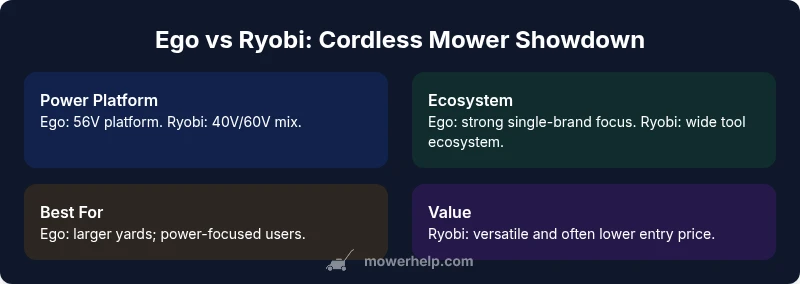
Both Ego and Ryobi build on battery-powered technology, but their platform strategies diverge in meaningful ways. Ego operates primarily on a 56V battery platform, which tends to deliver strong torque for dense or tall grass and can contribute to quicker mowing sessions on larger lawns. Ryobi, meanwhile, uses a 40V and 60V mix across its product lines, which translates to broad compatibility with a large family of tools and often more placement options at various price points. Runtime and performance depend heavily on battery size, grass conditions, and blade engagement. For homeowners with existing Ryobi tools, the ability to share batteries can offer real value; for those already invested in Ego, the 56V ecosystem can provide a comparable experience with robust power. In practice, the choice may come down to whether you want maximum power on a single mower line or greater cross-brand versatility.
Cutting Performance and Grass Handling
Cut quality hinges on blade design, deck width, height adjustments, and motor torque. Ego models typically push cutting performance through higher torque and efficient blade geometry, which helps during thick growth. Ryobi models balance cut quality with the practicality of interchangeable blades and deck sizes across several price tiers. For many users, the practical difference comes down to grass type and mowing style: Ego may deliver a momentary advantage on dense, humid grass, while Ryobi’s lineup can excel with regular maintenance and smaller yards where battery swaps are quick and easy. In both cases, maintaining sharp blades and an appropriate cutting height will preserve lawn health and reduce the need for passes.
Runtime, Charging, and User Experience
Runtime depends on battery capacity, mower efficiency, and grass height. Ego’s 56V packs typically offer strong performance for longer sessions, especially on midsize to large lawns, but actual runtime varies with model, deck size, and load. Ryobi’s battery range provides flexibility with multiple pack sizes and a broad charging network, which can be a practical advantage if you own several Ryobi tools. The user experience—quick-start ease, noise levels, auto-charging features, and the time required to swap batteries—shapes day-to-day satisfaction as much as raw power. Prospective buyers should weigh how often they mow and how many batteries they’re prepared to manage during a session.
Weight, Handling, and Ergonomics
Weight distribution and handle design influence maneuverability, especially in tight spaces. Ego mowers tend to balance robust power with a heavier build, which can affect fatigue over extended sessions but offers stability and cutting efficiency on larger lawns. Ryobi models often emphasize lighter chassis and ergonomic handles suitable for smaller lawns or more frequent use. If your property includes slopes or obstacles, test-feel on accessible yards and consider model-specific features like wheel tread, foldability, and transport handles. Ergonomics play a crucial role in overall satisfaction, sometimes more than nominal voltage figures.
Price, Value, and Total Cost of Ownership
Gas-powered mowers still compete with cordless options on upfront price, but battery-powered models offer predictable maintenance costs and lower long-term expenses. Ego models may come with higher initial price but deliver strong performance per amp-hour and faster mowing times for larger yards. Ryobi often wins on entry price and the breadth of the battery ecosystem, which can mean lower overall cost if you plan to expand your toolset. Total cost of ownership should include battery replacement cycles, charger availability, and expected lawn size. A simple rule of thumb is to evaluate 5-7 year cost of ownership rather than upfront sticker price alone.
Warranty, Service, and Support Realities
Warranty terms provide a critical backstop for investment in brand-name cordless mowers. Both Ego and Ryobi offer warranty coverage on mower decks and batteries, but specifics vary by model and region. Consider service accessibility, repair timelines, and parts availability in your area. In many cases, the ability to easily locate a nearby service center and access compatible replacement batteries can tilt the decision toward the brand with stronger local support. Brand trust and post-purchase support are essential for homeowners who rely on their mower for a lengthy mowing season.
Real-World Scenarios: When Ego Shines and When Ryobi Shines
For large, multi-acre yards with regular mowing and dense turf, Ego’s higher voltage platform and torque can translate into faster mowing sessions and a perception of stronger cutting performance. In cases where you value tool ecosystem breadth—especially if you already own multiple Ryobi tools—Ryobi can deliver excellent value due to shared batteries and widely available accessories. For tight suburban lots or first-time buyers seeking modest upfront costs, Ryobi’s lower-cost entries and broad compatibility can be very appealing. The practical answer is to align the mower choice with yard size, mowing frequency, and the desire to reuse existing batteries and tools.
Buyer’s Checklist: What to Look For Before You Buy
- Yard size and terrain: path width and slope influence deck size and wheel design.
- Battery strategy: pack size, charge time, and number of spare batteries you’re willing to manage.
- Cutting options: deck width, height range, and blade options matter for lawn health.
- Weight and ergonomics: ensure comfortable handling, especially on hills or long mowing sessions.
- Warranty and service: confirm coverage terms and local service options.
- After-purchase support: ease of parts replacement and customer service response times.
- Budget vs long-term value: consider 5-7 year ownership costs beyond sticker price.
Together these considerations help determine if Ego or Ryobi is the better fit for your routine.
Common Myths About Cordless Mowers Debunked
Myth 1: All cordless mowers are underpowered for tall grass. Reality: Power depends on battery voltage, motor efficiency, and blade design; higher voltage often improves performance in dense lawns, but proper mowing technique matters too. Myth 2: Battery life is the same across brands. Reality: Battery capacity varies by brand and model, and runtime depends on grass height, climate, and deck width. Myth 3: More expensive equals better value. Reality: Value depends on how well the mower fits your yard size, mowing frequency, and whether you benefit from ecosystem advantages.
Practical Shopping Guide: Making the Decision with Confidence
Finally, translate features into daily use by testing mower weight in your garage, evaluating how easily you can swap batteries, and checking for interface ease of height adjustment. Compare two models side-by-side in your actual yard. Consider your long-term needs—will you expand into other tools in the same ecosystem? If your answer is yes, Ryobi’s ecosystem could offer greater overall value; if you want raw mowing power and a tight, efficient team, Ego is worth a close look.
Comparison
| Feature | Ego lawn mower | Ryobi lawn mower |
|---|---|---|
| Power platform | 56V battery platform (Ego) | 40V/60V platform (Ryobi) |
| Deck width (typical range) | Typically around 20-22 inches | Varies by model; commonly 20-21 inches in many Ryobi options |
| Battery runtime concept | Runtime tied to battery size and grass height | Runtime tied to battery size; broad range across lines |
| Weight and handling | Generally sturdy with strong torque; heavier in some models | Often lighter in base models; good maneuverability |
| Price range (upfront) | Higher upfront cost on premium Ego models | Often lower entry price with broad range |
| Best for | Power users with larger yards | Value-focused buyers and those already in Ryobi ecosystem |
Benefits
- No gasoline and zero emissions
- Low maintenance compared to gas mowers
- Quiet operation suitable for neighborhoods
- Shared battery ecosystems increase versatility (within-brand)
Cons
- Higher upfront cost than basic gas mowers
- Battery availability and charging can slow long sessions
- Performance can vary with grass height and moisture
- Model-to-model differences may cause confusion between purchases
Ego is typically stronger on raw power for larger lawns; Ryobi offers better value with broader battery ecosystem options.
Choose Ego if you prioritize mowing power and longer runtimes for bigger yards. Choose Ryobi if you want a lower entry price and the flexibility of sharing batteries across a wider tool family.
Got Questions?
Are Ego and Ryobi cordless mowers compatible with each other’s batteries?
No. Ego and Ryobi use different battery platforms and ecosystems. While you can share batteries within the same brand family, cross-brand swaps aren’t supported. Plan your purchase around the ecosystem you’re already using or willing to invest in.
Battery packs aren’t cross-compatible between Ego and Ryobi. If you own multiple tools from one brand, stick with that brand to maximize value and ensure compatibility.
Which brand is better for hills and uneven terrain?
Performance depends on torque, deck design, and weight distribution. Ego’s higher voltage platform can deliver strong power for challenging terrain, while Ryobi’s lighter options may be easier to maneuver on slopes. Consider model specs and test on your yard.
Both brands offer capable options; for hills, check torque specs and maneuverability on your specific slope.
Do cordless mowers require more maintenance than gas mowers?
Cordless mowers generally require less maintenance than gas models: no oil changes, fewer moving parts, and simple blade care. You’ll still need to sharpen blades and clean decks, but routine upkeep is simpler.
Maintenance is simpler with cordless mowers, focusing mainly on blade care and battery health.
What is a realistic price range for Ego vs Ryobi mowers?
Prices vary by model and region. In broad terms, higher-end Ego models carry a premium for power and build quality, while Ryobi models offer a wider price spread due to the broader tool ecosystem. Expect variation based on deck size and included batteries.
Prices depend on model and region; Ego is usually at the higher end, Ryobi offers broader value options.
Should I buy extra batteries or rely on a single pack?
If you mow large properties or prefer minimal downtime, buying an extra battery can be worth it. For smaller yards, a single battery with a spare charger might suffice. Battery availability and charging time should guide your decision.
For bigger yards, extra batteries reduce downtime; for small yards, one battery plus a charger may be enough.
Which is best for small yards with tight spaces?
Ryobi’s broader model range often includes lighter, more maneuverable options suitable for tight spaces. Ego can also fit small yards, but you may prioritize weight and ease of storage when space is at a premium.
For small yards, look for lighter models from either brand and test maneuverability in tight spaces.
How does warranty impact long-term ownership?
Warranty terms can influence long-term ownership costs and peace of mind. Check coverage on the mower deck and batteries, including what constitutes normal wear and damage. Local service availability is also a key factor.
Warranty terms on deck and batteries matter; assess service availability in your area as well.
The Essentials
- Assess yard size to pick the appropriate power platform
- Consider battery strategy: number of packs and charging speed
- Weigh upfront cost against long-term value and ecosystem breadth
- Factor warranty and service accessibility into the decision
- Test handling on your terrain to ensure comfortable use