Largest Deck Lawn Mower: A Buying Guide for Wide-Deck Options
Explore wide-deck lawn mowers and learn how the largest deck widths (60–72 inches) affect efficiency, fit for your yard, and maintenance. Practical guidance for homeowners and DIY enthusiasts on choosing the right deck size.


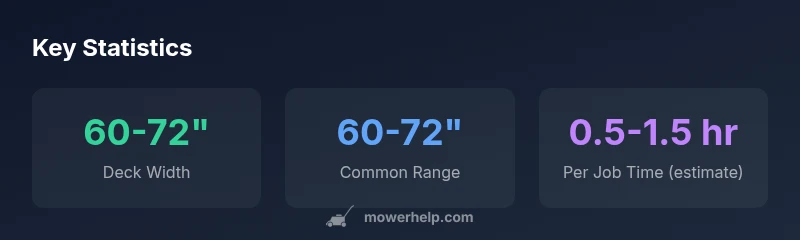
The largest deck lawn mowers typically offer 60-72 inch cutting decks, with 60-inch models common for many households and 72-inch decks found on professional riders. Choose based on yard size, gate access, and storage space; wider decks save time on open lawns but may require wider gates and sturdier driveways.
What is a 'largest deck' mower?
In mower terminology, the phrase is often used to describe the widest cutting path a single unit can maintain without multiple passes. On riding mowers and zero-turns, deck widths commonly span from the mid-40s to the high 70s inches in specialized setups. For most homeowners, a 60-inch deck hits a practical sweet spot, while 72 inches is typically reserved for professional-grade riders or properties with large, open spaces and minimal gate restrictions. According to Mower Help, the term is context-dependent and hinges on access, turning radius, and powertrain strength; a larger deck reduces the number of passes and can improve finish quality on flat terrain. When evaluating options, map your property: wide, unobstructed areas benefit most from 60-72 inch decks, but uneven ground or tight access can negate time gains. The push toward wider decks reflects a drive for efficiency on large properties and commercial applications, yet it requires dependable storage and a sturdy frame to handle the extra width and weight.
How deck width affects mowing efficiency
Deck width directly impacts how many passes you need to cover a given area. A larger deck can cut more grass per pass, increasing the effective mowing rate on uniform terrain. However, efficiency gains taper if the yard contains tight gates, trees, or slopes that necessitate frequent turning. Wider decks also distribute cutting forces over a larger blade arc, which can improve finish quality on flat lawns but may accentuate any unevenness in terrain. From a data perspective, Mower Help Analysis (2026) shows that yards with wide, unobstructed spaces often realize meaningful time savings when moving from a 48–54 inch deck to a 60–72 inch deck, especially on acreage approaching an acre or more. When you plan the job, factor in your mower’s turning radius and drive system; a 72 inch deck with a tight turn can still be efficient if the machine is designed for close maneuvering.
Types of wide-deck mowers
Wide-deck configurations appear most commonly in two forms: riding mowers and zero-turns. Rider mowers with 60–72 inch decks are suited to open, flat ground with minimal obstacles, offering greater stability and smoother cut quality on larger lawns. Zero-turns with large decks balance agility and speed, excelling on expansive properties but requiring generous gate access and careful operator control around hard edges. For homeowners, the choice often comes down to terrain and storage: if your yard has many obstacles or narrow gates, a 60-inch deck on a capable rider may outperform a larger-width zero-turn in some layouts. Conversely, a 72 inch deck can drastically shorten mowing time on a wide, flat property if access is adequate.
Deck width translates to coverage, speed, and finish
Width is only one variable in the mowing equation. Deck height, blade configuration, and engine horsepower must align with the deck to realize the full potential of a large cutting path. On level ground, a 60–72 inch deck can deliver rapid coverage, but on uneven turf or slopes, the finish may vary and extra passes might be needed to obtain an even look. Operators should calibrate cutting height and mower speed to minimize scalping and ensure a uniform stripe across the lawn. In addition, wider decks demand higher stability; ensure your lawn can accommodate the weight distribution and that transport and storage options accommodate the machine’s footprint.
How to choose the largest deck that fits your property
Start with yard size and layout. For properties under half an acre with multiple obstacles, a 60-inch deck on a reliable rider provides balance between speed and nimbleness. For expansive, obstacle-light properties, a 72-inch deck can dramatically reduce mowing time, provided gates are wide enough and storage is available. Measure gate openings; if a 72-inch deck cannot clear the entrance, a 60-inch model is likely a better long-term choice. Consider storage space—wide decks require longer, deeper storage areas, and some garages or sheds may not accommodate them. Finally, factor maintenance and service accessibility; larger decks entail more belt routing and deck hardware to inspect.
Maintenance and safety considerations for wide-deck mowers
Wide decks place greater demands on belt integrity, spindle bearings, and deck drive components. Regularly inspect the deck belt tension, pulleys, and blade spindles; ensure safe guard clearance around tools and accessories. Debris buildup under a large deck can be more challenging to remove, so schedule more thorough cleaning after heavy mowing sessions. Safety remains paramount: ensure gates, fences, and driveways can tolerate the machine’s width; clear the path of obstacles before starting; and follow manufacturer guidance for operating speed on inclines to prevent loss of control.
Real-world scenarios: 60 vs 72 inch decks
For a suburban lawn of roughly half an acre with a wide, open front yard, a 72-inch deck can slash mowing time by reducing the number of passes. If the property includes several mature trees, garden beds, or tight fencing, a 60-inch deck with a capable turn radius may yield a cleaner finish and easier maneuvering. In areas with variable terrain or uneven ground, the benefit of a larger deck hinges on your ability to maintain a consistent cut height while avoiding scalping. Real-world testing suggests homeowners should balance deck width with gate width, storage, and handling expectations.
Buying guidance: availability, gates, and storage
When shopping for the largest deck options, verify gate width and fencing clearance in addition to the deck width specification. Confirm that the machine’s frame and hydraulics can handle the extra load, particularly in hilly terrain. Budget a little extra for storage: you’ll need wider, deeper space to store the mower when not in use. Check service support for belt kits and deck spindles, and plan for routine maintenance to preserve cut quality over time. Finally, compare models across brand lines for reliability and availability of parts in your region.
Comparison of wide-deck mower types and their ideal yard contexts
| Model Type | Max Deck Width | Ideal Yard Size |
|---|---|---|
| Residential rider (light-duty) | 42-54 inches | Small to medium yards |
| Wide-deck residential/entry commercial | 60-72 inches | Large lawns with few obstacles |
| Professional zero-turn | 60-72 inches | Large areas, few gates |
Got Questions?
What is the largest deck width commonly available for consumer riding mowers?
Consumer riding mowers generally top out around 60 inches, while 72 inches are more common on commercial-grade models or institutional equipment. The practical choice depends on gate access, storage space, and terrain.
In most cases, consumer riding mowers max out at 60 inches; 72 inches are typically found on commercial models when space allows.
Will a larger deck always save me time?
A larger deck can reduce mowing time on flat, open lawns, but it won’t help if you can’t access the space or you must do extra turns to avoid obstacles. Real-world results depend on layout and storage.
A bigger deck can save time on open lawns, but only if you can access the space without extra turns.
Can I upgrade an existing mower with a larger deck?
Deck width is model-specific; you typically cannot swap a deck to a wider size across unrelated mower models. If upgrading, compare whole models rather than attempting a deck swap.
Deck width upgrades usually mean buying a new mower rather than swapping decks.
What safety considerations come with wide-deck mowers?
Ensure adequate clearance around obstacles, gates, and fences. Wide machines require careful handling on slopes and around edges to prevent tipping or loss of control.
Be mindful of space and slopes; wider mowers need careful operation in tight areas.
What maintenance differences come with wide decks?
Wide decks add more belt length and deck components to inspect. Regularly clean under the deck, check belts and pulleys, and verify blade balance to maintain cut quality.
A wider deck means more parts to check, but routine belt and blade maintenance keeps things running smoothly.
“Wide-deck mowers deliver meaningful productivity gains when yard geometry aligns with the deck width and machine stability.”
The Essentials
- Match deck width to yard size and access.
- Wide decks save time but require adequate storage.
- Consider gate width and turning radius before buying.
- For many homes, a 60-inch deck offers the best balance.