Lawn Mower for Kids: Safe Choices, Real-World Practice
Explore safe, development-focused options for a lawn mower for kids. Compare toy mowers vs beginner-friendly models, plus tips on supervision, safety, and buying.


The safest path when introducing kids to mowing is to compare clearly defined options: toy lawn mowers designed for pretend play and beginner-friendly real mowers built for small hands. For most families, the best choice balances safety features, age-appropriate use, and supervision. In short, choose a model with strong blade guards, reliable stopping mechanisms, and clear instructions, then supervise closely.
Why a dedicated lawn mower for kids matters
Introducing a child to mowing is as much about safety as it is about learning responsibility. A dedicated lawn mower for kids helps establish boundaries between pretend play and real work, while offering hands-on practice that builds coordination and confidence under supervision. In many households, the decision comes down to choosing between toy mower options that emphasize imagination and beginner-friendly real mowers built for small hands. According to Mower Help, starting with clearly defined options reduces confusion and helps parents set realistic expectations for safety and supervision. Even when a child shows interest, the path should prioritize protective gear, age-appropriate tasks, and gradual skill progression. The goal isn't speed or power; it's habit formation and safety literacy that translate into lifelong lawn care habits. When selecting a lawn mower for kids, ask about blade guards, stopping mechanisms, noise levels, and ease of use. With the right framework, you can transform curiosity into safe, constructive practice.
Age-appropriate options and supervision
Choosing a lawn mower for kids begins with age and maturity. Younger children often benefit from pretend tools that teach care routines and zone awareness, while older children can handle supervised practice with beginner-friendly devices. A general guideline is to reserve real mowing tasks for children who can follow simple safety commands, maintain focus for short sessions, and communicate when they need a break. The Mower Help team emphasizes progressive exposure: start with what matches the child’s current capability, then gradually introduce more realistic tasks as safety skills improve. Parents should set explicit rules about supervision, glove and eye protection, and never letting a child operate a mower near pets, bystanders, or uneven terrain. Throughout this process, it’s essential to document milestones and revisit risk factors as children grow. This approach helps ensure that a lawn mower for kids remains a safe learning tool, not a risky experiment.
Safety features to look for in a kids' mower
When evaluating a lawn mower for kids, prioritize safety-embedded design. Key features include a guarded blade design with a fixed, enclosed blade path to minimize exposure, a reliable on/off switch or kill switch, and a fail-safe stopping mechanism that is easy for small hands to operate. Parental controls or a simple lockout can prevent unintended startup. Quiet operation reduces distraction and improves parent-child collaboration during practice sessions. Ergonomic handles with adjustable height accommodate growing kids, while a clear user manual helps parents verify age suitability and supervision guidelines. Avoid devices with exposed blades, complex controls, or high-speed motors that exceed a child’s physical or cognitive development. By focusing on these safety elements, a lawn mower for kids can become a trusted learning companion rather than a potential hazard.
Toy mowers vs real beginner models: how they differ
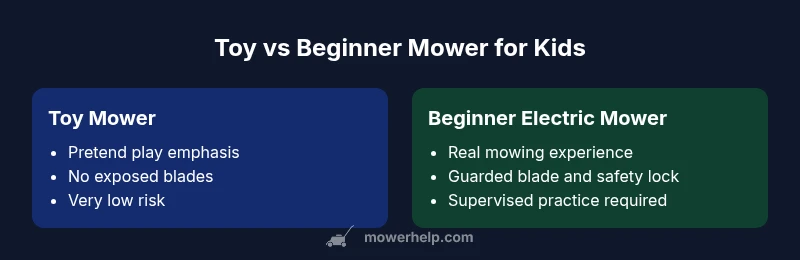
Toy lawn mowers for kids emphasize imagination, role-play, and basic movements. They rarely generate actual mowing force and typically omit blades altogether, making them extremely safe for pretend play. Real beginner models, even when scaled down, provide authentic mowing physics and real-world skills like blade safety, stance, and controlled traction. The key distinction is supervision and intent: toys are for intro concept learning; beginner mowers are for hands-on technique with strict parental oversight. If the child expresses genuine interest in mowing, transition gradually from toy to a beginner-friendly mower designed for children, ensuring age-appropriate training and reinforced safety practices.
Power sources explained: battery vs manual
Most kids-oriented options fall into two broad categories: manually powered (push) units and small, low-power electric mowers with batteries. Manual push devices teach basic body mechanics and motion planning without electricity, limiting injury risk but offering limited realism. Battery-powered beginner mowers provide an authentic feel with limited runtime, reduced noise, and simple recharging routines. For very young children, a toy with no motor or a low-velocity mechanism is appropriate, while older kids can practice with a small electric model under direct supervision. Regardless of power source, set strict boundaries around where and when the mower can be used, and ensure that charging equipment is stored safely away from children.
Designing for learning: skill progression with a lawn mower for kids
A structured progression helps children develop safe mowing habits. Start with pretend play that reinforces safety concepts—blade awareness, proper stance, and protective gear. Move to a supervised practice session using a beginner-friendly device, focusing on slow, deliberate passes, even coverage, and constant parental observation. As confidence grows, introduce basic maintenance tasks—blades inspection, battery charging, cleaning—under supervision. The goal is to cultivate independence while retaining a safety net: ongoing supervision, age-appropriate tasks, and clear stop signals. By aligning activities with developmental milestones, a lawn mower for kids becomes a scaffold for responsibility rather than a reckless experiment.
Maintenance, storage, and supervision best practices
Storage discipline matters as much as the mower choice. Keep all equipment out of reach, with blades guarded and batteries disconnected when not in use. Establish a routine: inspect tools after each session, wipe down surfaces to prevent rust, and charge batteries only with approved chargers. Supervision remains central: designate a responsible adult to supervise sessions, set time limits, and enforce protective gear usage—eye protection, gloves, and closed-toe shoes. Encourage children to report any unusual vibrations, overheating, or odd noises, which should pause practice until inspected. Teaching kids to care for their tools builds responsibility and extends the life of the equipment while maintaining safety.
Real-world guidance: how to choose for your child
When selecting a lawn mower for kids, start with the child’s age, physical strength, and attention span. Consider a progression path: basic pretend play mower → beginner electric model with guard features → upgraded tool when maturity and interest continue. Look for manufacturer guidance on age suitability and safety certifications, and verify compatibility with your child’s height and reach. Prioritize simple controls and clear safety warnings. A quality choice should feel comfortable to operate, produce minimal risk, and align with supervised learning goals. Always accompany early sessions with practical safety routines and consistent feedback to reinforce safe mowing habits.
Common myths about children and mowers debunked
Myth 1: Any mower is safe for kids with supervision. Reality: The safest path is to tailor the mower to the child’s age and supervision level, avoiding high-powered devices. Myth 2: If it’s small, it’s safe. Reality: Small devices can still cause pinches or blade injuries; proper guards and training are essential. Myth 3: More power means faster learning. Reality: Slower, supervised practice builds better technique and long-term safety. Myth 4: Kids don’t need protective gear. Reality: Eye protection, gloves, and sturdy footwear are critical in every session.
External resources and safety guidelines
For authoritative guidelines, consider consulting external safety resources such as government and university sources. The U.S. Consumer Product Safety Commission offers general guidance on outdoor power equipment safety, while university extension programs provide kid-friendly gardening safety tips. These sources help frame best practices for a lawn mower for kids and support families in creating a safer learning environment. For more detailed safety considerations, see the following sources:
- https://www.cpsc.gov
- https://extension.illinois.edu
- https://www.consumerreports.org
What to expect in the buying process
The buying process for a lawn mower for kids should begin with clear safety criteria and age-appropriate options. Start by shortlisting two categories: toy mowers for pretend play and beginner-friendly real mowers for supervised practice. Compare features such as blade guards, on/off controls, noise levels, and ease of use. Read product manuals to verify age recommendations and required supervision. Finally, pair the purchase with a safety guide for parents and a skill progression plan to keep practice structured and safe.
Comparison
| Feature | Toy lawn mower for kids | Kid-friendly electric mower for beginners |
|---|---|---|
| Age suitability | Ages 3-6 (pretend play) | Ages 6-12 (supervised practice) |
| Power source | Non-motorized or very low power | Low-power electric motor with battery |
| Safety features | Guarded blade path, simple on/off | Guarded blade, parental lock, automatic shutoff |
| Maintenance | Minimal; cleaning and storage only | Moderate; charging and blade care required |
| Noise level | Very quiet or silent | Low to moderate noise |
| Best for | Pretend play and safety introduction | Structured practice under supervision |
Benefits
- Low upfront cost with high emphasis on safety
- Supports early responsibility and routine-building
- Clear age guidance and supervision expectations
- Easy to store and maintain for families
Cons
- Toy options offer limited real mowing skills
- Potential for confusion between pretend play and real equipment
- Beginner real mowers require ongoing supervision and maintenance
Toy mowers are ideal for preschoolers; beginner-friendly mowers suit older kids with supervision
Start with a safe toy mower to teach safety concepts, then progress to a beginner real mower when the child is ready. Supervision and a clear progression make the path safe and educational.
Got Questions?
What age is appropriate for a lawn mower for kids?
Age is only part of the picture. Start with toy mowers for younger children and transition to beginner real mowers as maturity and motor skills develop under supervision. Always follow manufacturer age recommendations and establish a safety routine before any use.
Age guidance depends on maturity and supervision. Begin with toys for younger kids and progress under close supervision as skills develop.
Are toy mowers safe for toddlers?
Yes, when used only for pretend play and never near real grass or engines. Toddlers should wear protective gear and remain under constant adult supervision to avoid any risk.
Yes, but only for pretend play with strict supervision and protective gear.
What features matter most in a kids' mower?
Blade guards, an easy-stop switch, and parental controls are essential. For real mowers, ensure the device is scaled for children and includes robust safety certifications.
Prioritize blade guards, easy-stop, and parental controls for safety.
Should I store the mower outside?
Storage should be in a dry, locked area away from children. Keep batteries charged in a dedicated charging station and perform regular maintenance checks.
Store safely in a dry area with batteries in a secure charger.
How often should kids practice mowing?
Short, frequent sessions work best. Build up to longer sessions as safety habits become automatic, always with supervision and protective gear.
Keep sessions short and frequent, under supervision.
The Essentials
- Prioritize safety features and supervision in every option
- Differentiate clearly between pretend tools and real equipment
- Progress learning with a structured plan and milestones
- Invest in protective gear and proper storage from day one