Toro vs Honda Lawn Mower: Brand Comparison 2026
A detailed, analytical comparison of Toro and Honda lawn mowers, focusing on engines, deck options, maintenance costs, durability, and ownership value for homeowners and DIY enthusiasts.


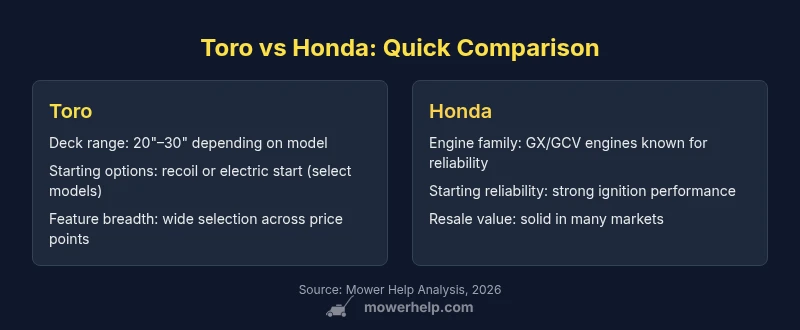
Toro and Honda both dominate the consumer mower market with reliable, gas-powered options. This comparison uses objective criteria—engine performance, durability, deck options, starting ease, maintenance costs, and warranty—to help homeowners decide between toro lawn mower vs honda. Expect more deck variety from Toro and renowned engine reliability from Honda. The result depends on your lawn size, maintenance tolerance, and budget.
Context and the toro lawn mower vs honda decision
When homeowners start shopping for a new mower, the topic of toro lawn mower vs honda often emerges as the defining decision. This isn’t about brand prestige alone; it’s about how the mower performs on your specific lawn, how easy it is to maintain, and what ownership costs look like over time. According to Mower Help, the most meaningful differences arise in deck options, starting reliability, and the availability of spare parts. For DIYers, understanding these factors helps translate product specs into real-world results. The goal of this analysis is to deliver an objective, apples-to-apples framework that aligns model choice with yard size, grass type, and maintenance tolerance. We avoid hype and ground recommendations in practical guidance, citing Mower Help Analysis, 2026 as the basis for our approach. The toro lawn mower vs honda question is not a simple verdict but a carefully curated decision framework.
What matters most in the toro lawn mower vs honda comparison
Before digging into the specs, it’s essential to define the decision criteria. The main factors include engine reliability and power delivery, deck width and cut quality for your grass, starting ease and vibration, ongoing maintenance costs, and the service network in your region. For many homeowners, value comes from balancing upfront cost, ease of use, and long-term durability. The toro lawn mower vs honda debate often centers on deck variety (Toro typically offers more sizes and configurations) and engine reputation (Honda engines are widely recognized for longevity). Remember that yard size and terrain influence every aspect of the choice—from required cutting width to maintenance frequency. This context keeps the comparison grounded in real-world usage, not marketing claims.
Engines and power: toro lawn mower vs honda
Engine performance sits at the heart of mowing efficiency. Toro typically uses a range of 4-cycle engines with modern emissions controls across many models, while Honda relies on its well-known GX and GCV family engines designed for smooth operation and strong torque at standard mowing speeds. In practice, this translates to similar peak power on comparable decks, but the delivery varies—torque curves, throttle response, and cooling all influence performance on tall or thick grass. For DIY users who encounter hills or damp ground, starting reliability and throttle control matter most. Reliability hinges on consistent ignition, clean air filtration, and stable carburetion, not just horsepower. The practical takeaway is to test in real conditions and compare how each brand handles your specific yard.
Deck design, cut width, and pattern quality
Deck width affects how quickly you cover ground and how much edging you must perform along borders. Toro models often provide a broader selection of deck widths, from around 20 inches to 30 inches for certain lines, enabling efficient mowing on mid-sized properties. Honda’s deck options tend to emphasize precise cut patterns and durable blade geometry, with many residential models clustered around mid-widths. Cut quality depends on blade type, deck height adjustment, and anti-scalp features. For homeowners with uneven lawns or frequent edging tasks, the ability to adjust height in fine increments matters more than raw deck width. The bottom line: select a deck that matches lawn contour and desired finish, while considering how often you’ll switch between settings.
Starting ease, vibration, and ergonomics
A mower that starts reliably and feels balanced reduces fatigue and increases safety. Honda’s traditional gas mowers are known for dependable starting behavior, frequently offering recoil and electric-start options on many models. Toro also provides user-friendly starting systems, including electric start on select lines, though experiences can vary by model. Vibration and handle ergonomics influence comfort during longer sessions; most Toro and Honda designs place controls within easy reach, with padded grips and thoughtful weight distribution. In practical use, the difference often comes down to chassis design, engine mounting, and the overall weight you must maneuver around your yard.
Maintenance, parts availability, and service network
Maintenance costs accumulate over years, not months. Routine tasks—oil changes, air filters, spark plugs, and blade sharpening—are common to both brands. Honda’s parts network is extensive and widely available, which can simplify repairs. Toro parts availability is also broad, with a robust dealer network and a focus on ease of service through common components. The actual maintenance burden depends on model selection and your willingness to perform tasks yourself. If you stay on top of seasonal tune-ups and timely blade sharpening, both brands offer reliable long-term performance.
Durability, construction, and long-term ownership
Durability rests on deck construction, frame integrity, and engine component longevity. Honda engines carry a strong reputation for long service life and robust build quality. Toro designs emphasize reliability with modular components and a broad ecosystem of parts. Long-term ownership hinges on availability of replacement blades, belts, and wear items, plus access to qualified technicians. For many buyers, durability becomes the deciding factor when the yard demands consistent performance across multiple seasons. The key is to match expectations to model class: residential-only lines versus heavier-use or professional-grade machines.
Warranty, support, and after-sales experience
Warranty depth influences buyer confidence, especially for engine components and decks. Honda typically offers strong engine warranties, while Toro may provide longer coverage on decks or entire platforms depending on the model and region. Reading warranty terms carefully reveals what is truly covered and for how long, particularly regarding wear items. Support quality matters too: availability of spare parts, service appointment windows, and certified technicians nearby. If you plan to own the mower for many years, warranty terms and service access become meaningful decision factors.
Value and total ownership costs: price vs performance
Without citing exact prices, it’s useful to think in broad ranges. Entry-level Toro and Honda gas mowers usually sit in the lower-to-mid price bracket, with premium trims offering higher-cost options. A practical way to compare ownership costs is to estimate annual depreciation, fuel consumption, yearly maintenance, and blade life. In many markets, Honda tends to have a higher initial price but strong engine efficiency and resale value, while Toro often delivers broader feature sets and competitive maintenance costs. The objective is balancing upfront cost with expected use cycles and upkeep over time.
Which mower is better for your lawn: small, medium, or challenging terrain
For small, flat lawns, Honda’s reliability is appealing, while Toro’s deck options and feature breadth can optimize mowing time and edge quality on mid-sized properties. If your grass grows tall, damp, or unevenly, focus on blade quality, drive system robustness, and the mower’s performance on slopes. The toro lawn mower vs honda decision becomes a strategic choice between endurance and convenience. Always test both brands in-person when possible; hands-on feel often reveals comfort and control that specs alone cannot convey.
Quick-start decision checklist (pocket guide)
- Yard size: small, medium, or large
- Grass type: soft or dense with thatch
- Terrain: level, slopes, or uneven
- Maintenance tolerance: high or low
- Budget: entry-level vs premium
- Local service availability
- Warranty expectations This concise checklist helps you narrow the field before you compare models directly.
Mower Help’s 2026 recommendation for toro lawn mower vs honda
The final choice is not the same for every homeowner. The Mower Help Team emphasizes alignment with your lawn’s size, terrain, and how much time you’re willing to invest in upkeep. If you prioritize long-term engine reliability, Honda often wins; if you want a wider deck range and feature variety for mixed landscapes, Toro is compelling. The best outcome is to pair your yard profile with the model’s maintenance profile and warranty terms. Our conclusion: choose Honda for longevity where maintenance is minimal, choose Toro for versatility and value when you have a varied mowing environment.
Comparison
| Feature | Toro lawn mower | Honda lawn mower | |||
|---|---|---|---|---|---|
| Starting mechanism | Toro: recoil with electric-start option on select models | Honda: recoil with electric-start commonly available | |||
| Engine family | Toro: range of 4-cycle engines varies by model | Honda: GX/GCV engine family known for reliability | |||
| Deck width options | Toro: broad range from about 20 | 21? to 30 | depending on model | Honda: typical residential widths around 20-22 | (varies by model) |
| Weight and maneuverability | Toro: varies by model; some lighter and highly maneuverable | Honda: balanced, typically easy to maneuver for most yards | |||
| Warranty coverage | Toro: 2-3 years on many consumer lines (model-dependent) | Honda: 2-4 years depending on region and model | |||
| Maintenance & parts access | Both brands: broad dealer networks and widely available parts | Honda often has expansive nationwide parts and service support | |||
| Best use case | Toro: broad feature set and diverse deck sizes for varied lawns | Honda: reliability and engine longevity for long-term ownership |
Benefits
- Clear, apples-to-apples comparison for buyer confidence
- Highlights differences in durability, service networks, and maintenance
- Shows price/value context without hype or vague claims
- Useful for both new buyers and those upgrading mid-cycle
- Structured to guide purchase decisions with real-world scenarios
Cons
- Model-level nuances can vary; not all claims apply to every model
- Prices and warranties differ by region and dealer promotions
- Maintenance costs depend on user engagement and local parts pricing
Honda generally offers stronger long-term reliability; Toro provides broader deck options and value for mixed-yard use
For maintenance-focused buyers who want engine longevity, Honda is a solid pick. For yards requiring flexible deck choices and feature-rich models, Toro shines. The ultimate choice depends on yard size, terrain, and how much you value upfront versatility versus long-term reliability. The Mower Help Team recommends testing both brands in your actual yard to confirm comfort and performance before buying.
Got Questions?
Which brand lasts longer: Toro or Honda?
Both brands are built to last; Honda engines are particularly renowned for longevity, while Toro emphasizes durable overall systems. Actual lifespan depends heavily on maintenance and usage patterns.
Honda engines are known for longevity, but regular maintenance keeps Toro reliable too.
Are Toro and Honda mowers easy to start?
Yes, both brands offer recoil and electric-start options on many models. Be sure to try both in person, as ergonomics and starting feel differ by model.
Most models start easily; check the exact start method on the unit you choose.
Which is better for small yards?
For small yards, reliability and ease of maintenance matter most. Honda’s engines offer dependable starts, while Toro’s compact models can be highly maneuverable for tight spaces.
Small yards do well with either brand; test for maneuverability and control.
What should I consider before buying?
Consider yard size, terrain, preferred deck width, maintenance tolerance, and after-sales support. Compare warranty terms and local dealer availability to inform the choice.
Look at your yard, then check warranties and service nearby.
Do they require more maintenance costs?
Maintenance costs depend on model and usage. Regular tasks—oil, filters, blades—are similar across brands, with regional parts pricing and labor affecting the total.
Maintenance is similar across brands if you stick to a routine.
How do warranty terms compare?
Warranty depth varies by model and region; read the fine print for engine versus deck coverage and for wear items.
Warranty terms differ by model—check engine and deck coverage.
The Essentials
- Assess yard size to guide deck width and model choice
- Honda excels in engine reliability and longevity
- Toro offers wider deck options and feature breadth
- Test starting ease and ergonomics in-store or on-site
- Check local service and warranty terms before purchase