Reel Mower vs Lawn Mower: A Practical Comparison for Homeowners
Compare reel mowers and rotary lawn mowers: how they work, performance by yard size and grass type, maintenance needs, costs, and long-term value for homeowners. An analytical guide to help you choose the right tool for your turf.


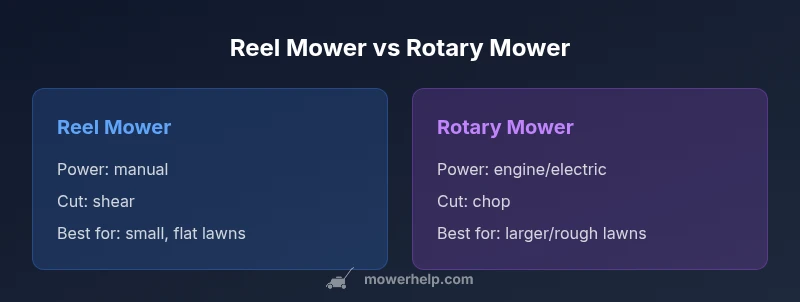
Reel mowers are manual cutting devices with a scissor-like action, while traditional rotary lawn mowers are powered (gas or electric) and rely on a rapidly spinning blade. Reel mowers excel on small, flat lawns with fine grass, offering quiet operation and zero emissions, but require more physical effort. Rotary mowers handle thicker growth and larger areas with less labor, though they consume fuel or electricity and generate more noise. Your choice hinges on yard size, terrain, and maintenance willingness.
How reel mowers work
A reel mower uses a set of cylindrical blades mounted on a rotating reel that passes over a stationary bed knife. As you push or pull the mower, the reel spins and shears grass against the bed knife in a scissor-like action. Height is usually adjustable, and the cutting action is clean and precise when blades are sharp. Because there’s no engine or motor, the mower relies entirely on user force, which means physical engagement is a part of the mowing process. Reel mowers are typically lightweight, compact, and require minimal consumables beyond blade sharpening and occasional lubrication. For homeowners seeking a quiet, emission-free cut, a well-tuned reel mower can offer an enjoyable, almost meditative experience while delivering very consistent results on well-kept turf. However, the performance depends on grass type, moisture, and the user’s stamina; on thick or tall growth, the effort required increases substantially. According to Mower Help, the best outcomes come from keeping blades sharp and adjusting the height to avoid scalping while leaving a uniform leaf surface. Consider your willingness to invest time in maintenance when you weigh this option for your landscape.
How traditional rotary lawn mowers work
Rotary mowers rely on one or more fast-spinning blades mounted on a central rotating hub. When powered by gasoline engines or electric motors, the blades slice grass with a chopping motion rather than a shear cut. The design typically includes a bag or chute for clippings, adjustable cutting heights, and various add-ons such as mulch capabilities. Rotary mowers excel on uneven terrain and tall or thick growth, as the motor provides the necessary power to propel the blade through resistance. They are ideal for medium to large yards and for users who prefer less physical exertion. The trade-off is higher noise levels, fuel or electricity costs, and ongoing maintenance like spark plugs, air filters, and oil changes for gas models. Maintenance frequency and costs tend to be higher than for reel mowers, but the convenience and scalability can be decisive for many homeowners, especially those with demanding mowing schedules. In practice, most homeowners weigh engine reliability, maintenance intervals, and noise tolerance when choosing between these two classes.
Key design differences and what they mean for performance
- Cutting action: reel mowers perform a shear cut, which can yield a cleaner, healthier-looking lawn with less tearing, while rotary mowers cut by chopping; this can affect turf health and leaf texture.
- Blade geometry: reel blades are long cylindrical knives, bed knife is flat; rotary blades are flat and broader, designed for rapid rotation and quick cuts. The shear action of reels works best on fine, even turf when blades are sharp.
- Height adjustment: reel mowers usually offer precise, fixed increments (e.g., 1/8 to 1/4 inch), requiring careful setup; rotary mowers provide broader, easier height control via levers or wheels, suitable for varying conditions.
- Weight and maneuverability: reel mowers tend to be lighter and more nimble on smooth, even lawns; rotary mowers often weigh more but can handle uneven ground and taller grass with engine-assisted power.
- Maintenance implications: reels require blade sharpening and occasional alignment, with minimal consumables; rotaries require periodic maintenance like spark plugs, oil, air filters, and blade balancing when needed. These differences influence long-term costs and downtime. These distinctions translate into real-world performance: reels emphasize striping, finesse, and quiet operation, while rotaries prioritize speed, versatility, and power for challenging turf.
Performance in different yard sizes and grass types
For small, well-kept lawns (under 1/4 acre) with uniformly soft, fine-bladed grass, a reel mower can deliver outstanding results with minimal environmental impact. On damp or tall grass, the force required may become prohibitive, and you’ll see a drop in cut quality if the grass is not pre-trimmed or the blades aren’t maintained. For larger yards or tougher turf—coarse fescues, tall fescue blends, or grasses with thick thatch—a rotary mower provides consistent power and speed. In hilly or uneven yards, the maneuverability and powered drive of rotaries reduce fatigue and improve streak-free coverage. In drought-prone regions, reel mowers can also reduce soil compaction by relying on manual propulsion, but you must adjust expectations for growth rates and mowing frequency based on climate.
Deciding factors include slope, moisture, and the frequency of mowing; homeowners often choose reels for manicured, low-growth lawns and rotaries for multi-species lawns or variable terrain. The Mower Help team notes that the best approach is to evaluate yard size, grass health, and typical growth cycles before purchasing. If you anticipate aggressive weed growth or heavy thatch, rotary models with mulching capabilities may offer practical advantages.
Maintenance, cost of ownership, and labor considerations
Maintenance expectations differ sharply between reel and rotary mowers. Reel mowers demand minimal ongoing purchases beyond a sharpening kit and lubrication; blades must be kept sharp for an even cut, and occasional adjustment ensures the reel meets the bed knife consistently. The labor cost is time-based rather than monetary, with an emphasis on physical effort and technique. Rotary mowers, especially gas-powered units, incur ongoing fuel costs, oil changes, filter replacements, spark plugs, and possible carburetor cleaning. Electric models reduce emissions and fuel costs but require an electrical outlet or battery management, plus periodic charger maintenance. Initial purchase costs vary, with reel mowers typically at the lower end of the price spectrum (though high-end models exist) and rotary mowers spanning a wider range depending on power source and features. Long-term cost of ownership includes not just the purchase price but maintenance frequency, energy costs, and the mower’s expected lifespan. Homeowners should weigh the value of quiet operation and low maintenance against the effort required and the volume of mowing needed each season. The decision hinges on how much time you’re willing to invest in sharpening, blade alignment, and manual propulsion versus running a powered tool.
Practical decision framework: how to choose in 6 steps
- Measure your yard size and grade. If you’re under 0.25 acres with a flat, well-kept lawn, reel mowers often shine. 2) Assess grass type and health. Fine-grass lawns respond well to a clean shear cut. 3) Consider your tolerance for physical effort. Reel mowers demand more manual work, especially on thicker growth. 4) Evaluate noise and emissions. Reel mowers are silent and emission-free, while rotaries produce noise and exhaust. 5) Review maintenance willingness. Reels require sharpening and occasional alignment; rotaries require oil changes and occasional part replacements. 6) Factor in future needs. If you anticipate variable terrain or expansion of mowing areas, a rotary mower may be more adaptable. By walking through this checklist, you can identify your priority factors and narrow down the best option for your home.
- Practical tip: Try a local rental or borrow a reel model to test the feel before committing. This hands-on approach helps you assess whether the manual effort aligns with your lifestyle and yard, reducing the risk of buyer’s remorse.
Common myths and misconceptions
- Myth: Reel mowers cannot handle tall grass. Reality: they excel on properly maintained lawns; tall or thick growth requires more effort and possibly mowing at lower cutting heights or in multiple passes.
- Myth: Rotary mowers always cut faster. Reality: reel mowers can mow at a comfortable pace on small, clean lawns, but on large, tough yards, rotaries often outperform overall due to power and speed.
- Myth: Reel mowers aren’t durable. Reality: quality reels with proper maintenance are robust and have long lifespans, especially when blades are kept sharp and properly aligned.
Quick-start checklist for choosing between reel and rotary
- Yard size and shape: small, flat spaces favor reels; larger or uneven landscapes favor rotaries.
- Grass health and type: fine lawns benefit from shear cuts; tougher grass tolerates rotary cutting.
- Maintenance willingness: sharpen and adjust reels versus service rotaries.
- Noise and emissions: if quiet operation matters, reels win.
- Budget and long-term value: weigh upfront costs against ongoing maintenance and energy costs.
Final note on integration with gardening tools
For many homeowners, the best approach is not a hard either/or choice but a hybrid strategy. Maintain a compact reel mower for the regularly trimmed front yard and a rotary mower for rougher backyards or seasonal changes. This combination can maximize efficiency, minimize environmental impact, and extend the lifespan of both tools. The Mower Help team encourages testing both options in real settings to confirm long-term fit with your landscape management goals.
Comparison
| Feature | Reel mower | Rotary mower |
|---|---|---|
| Power source | manual (no fuel) | gas or electric motor |
| Cutting action | shear cut via reel and bed knife | rotary chop cut via spinning blade |
| Best for | small, flat, well-maintained lawns | medium to large yards or uneven turf |
| Noise and emissions | quiet, zero emissions | noise, fuel or electricity use |
| Maintenance | blade sharpening, adjustable alignment | oil changes, air filters, spark plugs (gas) or battery upkeep (electric) |
| Initial cost range | $60–$350 | $150–$700 |
| Suitability for hills | more effort on slopes | engine-assisted or heavier models handle hills better |
Benefits
- Silent operation and zero emissions
- Low ongoing fuel or electrical costs
- Excellent for small, manicured lawns when blades are sharp
- Simple, compact design with minimal parts
Cons
- Physically demanding on larger or tougher lawns
- Requires regular blade sharpening and alignment
- Limited performance on tall, thick growth or uneven terrain
- Potentially slower mowing in large landscapes
Reel mower is best for small, flat, well-kept lawns; rotary mower wins for larger or tougher yards
If your yard is compact and your grass is fine, reel mowing offers quiet operation with great results. For larger or rougher properties, a rotary mower provides power and speed, even on challenging turf.
Got Questions?
What is a reel mower?
A reel mower uses a rotating helical blade to shave grass against a bed knife, delivering a clean cut without electricity or fuel. It relies on manual propulsion and requires blade care for best results.
A reel mower uses spinning blades to shear grass against a fixed knife, and you push it manually for mowing.
Do reel mowers work well on tall or thick grass?
Reel mowers perform best on well-maintained lawns with fine to medium grass. Tall, thick growth can be challenging and requires more effort, multiple passes, or pre-trimming.
They work best on well-kept lawns; tall or thick grass can be tougher and may require more effort.
Are reel mowers more environmentally friendly?
Yes. Reel mowers have no fuel or emissions and produce very little noise, which reduces environmental impact and aligns with eco-conscious landscaping goals.
Yes—reel mowers don’t use fuel or emit pollutants, and they’re quiet.
What maintenance does a reel mower require?
Reels require blade sharpening, alignment checks, and occasional lubrication. Regular maintenance keeps the cut even and prevents blade dulling.
Keep the blades sharp, check alignment, and lubricate as needed.
Can a reel mower replace a rotary mower entirely?
For many small, flat lawns with fine grass, yes. For larger yards, uneven turf, or thick growth, a rotary mower is typically more practical.
It can replace a rotary mower in small, flat lawns, but not always for larger or tougher yards.
What should I consider when choosing between reel and rotary?
Compare yard size, grass type, terrain, desired maintenance, noise tolerance, and budget. Use a quick test by borrowing or renting a reel mower to assess suitability.
Think about your yard, grass, and how much work you want to put in, then test a reel mower if possible.
The Essentials
- Assess yard size and terrain before buying
- Choose reel for quiet, emissions-free mowing with precise cuts
- Choose rotary for larger or tougher lawns and easier mowing
- Plan maintenance: reels require sharpening; rotaries require regular engine service