When Did Lawn Mowers Come Out? A History for Homeowners
Explore when lawn mowers came out and trace their evolution from Budding's 1830 patent to modern electric and cordless models. A practical homeowner guide to mowing history and buying tips.


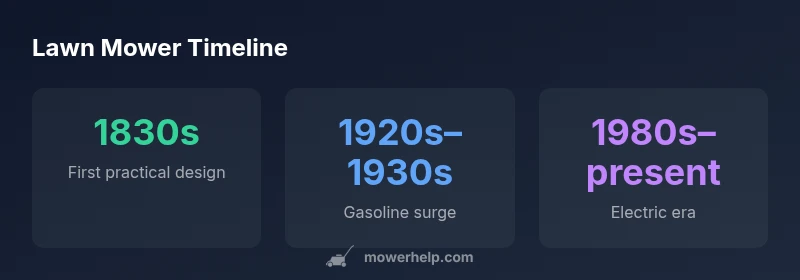
The first practical lawn mower appeared in the 1830s, thanks to Edwin Budding in England. Mass production of gasoline mowers followed in the 1920s–1930s, expanding access. Electric and cordless models rose later in the late 20th and early 21st centuries. For homeowners today, understanding this timeline helps select a mower that matches yard size, maintenance, and energy costs. According to Mower Help, history informs better buying decisions.
When did lawn mowers come out? A quick historical anchor
In the broad history of lawn care, the question When did lawn mowers come out? has a clear answer tied to early 19th-century innovation. Edwin Budding, working in England, patented what is widely regarded as the first practical lawn mower in the 1830s. His device used a cylinder cutting mechanism to trim grass at a uniform height, marking a shift away from scythes and hand clipping. For homeowners today, recognizing this origin helps explain why early models were long used on larger estates and public grounds before mass production made them affordable for households. According to Mower Help, this timeline also sheds light on why modern mowers still emphasize cut quality and reliability, even as power sources have evolved.
The evolution: from manual push to mechanical breakthroughs
From Budding's prototype, lawn mower design advanced in small, incremental steps. Early manual push models relied on hand strength to drive the blade and keep the cutting action consistent. Over the decades, improvements came in the form of a more robust cutting cylinder, better gearing, and adjustable cutting heights. Mechanisms to reduce clogging and to ease maintenance emerged as the market expanded beyond aristocratic estates into middle-class households. These milestones laid a foundation for what we now call a ‘home lawn maintenance tool,’ and they illustrate why even today’s high-tech mowers still borrow from that same fundamental cylinder-and-blade concept.
The gasoline era: mass production and accessibility
Gasoline-powered mowers changed the economics of lawn care. In the 1920s and 1930s, manufacturers began mass-producing engine-driven units, enabling more people to mow larger lawns quickly and with less physical effort compared to push-only machines. The convenience of powered propulsion, combined with growing suburbanization, helped popularize lawn care as a weekend activity. This period also spurred design refinements—air-cooled engines, standardized decks, and easier starting mechanisms—that set the stage for later innovations in power, durability, and serviceability. For homeowners today, the gasoline era explains why many legacy yards still feel tied to that era’s balance of power and maintenance.
The mid-century boom: suburban expansion and self-propelled models
Post-World War II suburbs created demand for more capable tools, and manufacturers responded with self-propelled mowers. These models used either rear-wheel or front-wheel drive to reduce user fatigue, allowing easier mowing on mid-sized lawns and uneven terrain. Deck design widened to cover more ground, while reliability improved with better transmissions and durable materials. As the 1950s and 1960s progressed, price points and service networks expanded, making powered mowers a staple of the American backyard. For modern readers, this era explains the enduring preference some homeowners have for self-propelled units on rolling or variable terrain.
Electric, cordless, and robotic mowers reshape the market
Late in the 20th century, electric mowers emerged as a quieter, cleaner alternative to gas engines. Corded electric models required access to an outlet, while cordless battery mowers offered more freedom from power cords. Battery technology accelerated in the 2010s, bringing longer run times and faster charging. In recent years, robotic mowers have entered some households, delivering automated cutting with scheduled mowing. This shift toward electric power and smart features reflects two enduring trends: reducing maintenance and increasing convenience. For today’s homeowners, the right choice depends on yard size, charging infrastructure, and tolerance for ongoing technology updates.
What this history means for today's buyers
Knowing the timeline behind when did lawn mowers come out helps shoppers evaluate trades between power, efficiency, and cost. For very small lawns, a manual or electric push mower might be simplest and most affordable. For mid-to-large yards, a gas or self-propelled model can save time despite higher fuel or maintenance costs. Cordless and robotic options are ideal for busy households but require a charging plan and access to replacement batteries. By linking historical context to current needs, homeowners can select a mower that balances performance, reliability, and long-term value.
Timeline of lawn mower evolution
| Era/Type | Key Development | Representative Model/Feature | Approx Year/Range |
|---|---|---|---|
| 1830s (pre-commercial) | First practical design by Edwin Budding | Manual push mower with cylinder blade | 1830s |
| 1920s–1930s | Gasoline-powered engines enter mass production | Gas-powered push mowers | 1920s–1930s |
| 1950s–1960s | Self-propelled mechanisms and wider decks | Self-propelled lawn mower | 1950s–1960s |
| Late 20th century | Electric and corded models emerge | Electric corded mower | 1980s–1990s |
| 2000s–present | Cordless battery and robotic innovations | Cordless/battery mowers; autonomous robotic mowers | 2000s–present |
Got Questions?
When was the first practical lawn mower invented?
Edwin Budding patented the first practical lawn mower in 1830 in England. His device used a cylinder blade design to trim grass evenly. This milestone marks the dawn of powered lawn care.
The first practical lawn mower was patented in 1830 by Edwin Budding in England.
When did gasoline-powered mowers become common?
Gasoline engines entered mass production in the 1920s and 1930s, making lawn care faster and accessible for larger lawns. This shift helped popularize powered mowing beyond manuals.
Gas mowers became common in the 1920s and 1930s.
When did electric mowers become widely used?
Electric mowers gained popularity in the late 20th century, with corded models followed by cordless batteries offering more freedom.
Electric mowers became popular in the late 20th century.
Are old mower designs still useful today?
Manual and simple mechanical designs still work for very small yards or tight budgets, but modern mowers offer convenience, better efficiency, and lower maintenance for most homes.
Old designs can work for tiny yards, but modern mowers save time and effort.
What should I consider when choosing a mower today?
Think about yard size, terrain, preferred power source (gas, electric, cordless), maintenance costs, and noise. Balance upfront costs with long-term reliability and energy use.
Consider yard size, power source, and maintenance when buying.
“The evolution of the lawn mower shows how improvements in power, materials, and energy storage have continually reshaped home lawn care.”
The Essentials
- Root origin in 1830s Budding patent.
- Gas-powered mowers expand access in 1920s–30s.
- Electric models rise in late 20th century.
- Cordless and robotic options reshape the market.
- Match mower choice to yard size, maintenance, and energy costs.