Cordless Lawn Mower vs Corded: A Comprehensive Buying Guide
An expert, balanced comparison of cordless vs corded lawn mowers, covering runtime, cost, maintenance, noise, and yard-size suitability to help you decide.


Core differences in practice
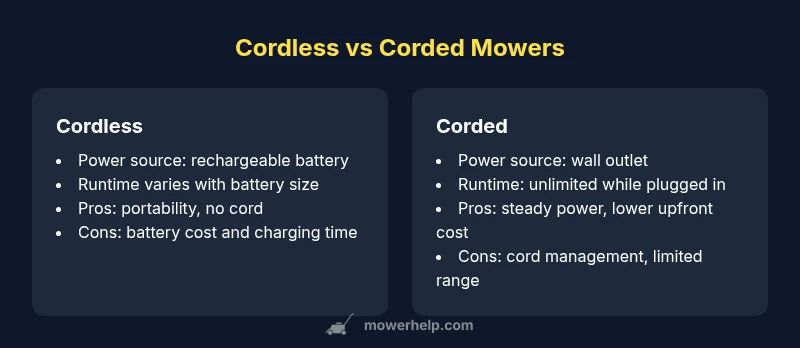
Cordless lawn mower vs corded is often framed as a trade-off between freedom of movement and consistent power. In practice, the cordless option relies on a rechargeable battery pack that delivers power through an electric motor, while a corded mower taps energy directly from a household outlet. The implication for homeowners is straightforward: cordless machines provide complete freedom to roam your yard without searching for an extension cord, but you must manage battery life and charging time. Corded models, by contrast, maintain constant power as long as you can reach a power source, at the price of cord management and limited range. When evaluating your yard, consider how far you typically push the mower, how often you encounter obstacles, and whether you can reliably reach your outlet with a safe cord route.
Why this matters for your property: a larger or irregularly shaped yard benefits from the flexibility of cordless, while a small, well-defined space near an outlet can work well with corded models. If you live in an area with frequent power outages or if you prefer a lower upfront cost, corded options can be attractive. The key takeaway is to map your yard’s geometry and accessibility before deciding, keeping in mind your tolerance for charging cycles and cord management. According to Mower Help, understanding these practical constraints helps homeowners pick a mower that truly fits their day-to-day mowing routine.
Battery technology and power delivery
Cordless lawn mowers rely on rechargeable lithium-ion battery packs that power the motor through a direct drive system. The exact voltage and capacity vary by model, but the core concept is clear: more energy storage equates to longer runtime. Battery technology has improved dramatically over the past decade, with higher energy density, faster charging, and longer cycle life. Corded mowers, by comparison, draw continuous electricity from the mains, delivering steady torque as long as you’re within range. This fundamental difference affects performance in real-world use: a cordless mower excels when you need to roam far from a power outlet, whereas a corded mower provides reliable power for consistent cutting along a defined route. For most homeowners, battery management—charging schedules, spare batteries, and knowing your yard’s cutting time per charge—becomes a central part of planning. Mower Help analyses show that battery life remains a consideration for frequent, long sessions, but advances in cell chemistry are reducing this concern over time.
Range and runtime realities
Runtime for cordless mowers is not a fixed value; it depends on battery capacity, grass thickness, and user technique. A typical mid-range cordless mower offers enough power for a standard suburban lawn within a single charge, with a spare battery extending the session. In dense or damp grass, cut speed may drop to protect the battery and motor, increasing total mowing time. Corded mowers, on the other hand, provide uninterrupted power until your yard is finished, assuming you can manage the cord safely. The trade-off is clear: cordless provides flexibility, while corded guarantees power continuity. Planning around your yard layout—distance from the outlet, fencing, and obstacles—helps you estimate how many passes you’ll complete per session. Mower Help’s analysis indicates that most homeowners optimize their setup by pairing the mower type with the typical mowing task at hand rather than chasing maximum continuous runtime.
Initial cost and maintenance costs
Upfront cost often favors corded mowers, which typically require no battery or charger investment and have simpler electronics. Cordless mowers usually cost more at purchase due to the battery pack and associated electronics, but the advantage is the absence of a cord and greater maneuverability. Over the life of the tool, cordless models entail ongoing battery maintenance: charging cycles, storage conditions, and eventual battery replacement. Corded models incur maintenance primarily around the cord, switches, and motor brushes, which tend to be less frequent and less costly than battery replacements. A practical approach is to compare long-term ownership costs, including expected battery replacement intervals for cordless options, against the stability of maintenance costs for corded tools. Mower Help recommends calculating total cost of ownership over 5–7 years to understand the real value.
Performance in different yard sizes and shapes
Yard size and shape are major determinants of which mower type earns the best score. For small, flat lawns near a power outlet, corded mowers can be the most straightforward and cost-effective choice, especially if you don’t mind cord management. Medium to larger properties often benefit from cordless machines, offering edge-to-edge mowing without constantly adjusting a cord. Irregular borders, tight corners, and tall grass can challenge a corded setup if the cord frequently traps the mower. In contrast, cordless mowers may require more deliberate planning to ensure a full charge covers the entire job. The decision should balance yard geometry, the typical cutting time per session, and the ease of switching between multiple battery packs if you own more than one. Mower Help notes that a well-matched pair of yard size and mower type yields the smoothest mowing experience.
Noise, emissions, and user experience
Electric mowers—both cordless and corded—are substantially quieter than gas-powered equivalents and emit no exhaust while operating. Cordless models, with their built-in battery, add the layer of battery-recharging behavior into the user experience: you may need to plan recharge breaks into a mowing session. Corded models avoid battery cycle considerations entirely, but their usability is tied to cord handling, which can introduce tangles, snagging hazards, and range anxiety in larger spaces. For most homeowners, the user experience hinges on how often you stop to adjust the cord or swap batteries and how important uninterrupted cutting time is to your routine. From a safety and ergonomics perspective, both categories reduce the risk of fuel fumes and heavy engine noise, making them preferable for residential use over gas-powered tools.
Safety and ergonomics
Safety is central to mower selection. Corded models reduce the risk of battery malfunctions or thermal runaway, but cord management introduces tripping hazards and cord damage risk if you operate near water or metal edges. Cordless mowers require careful battery handling, charging safety, and periodic battery health checks. Ergonomically, many cordless mowers have balanced weight distribution that makes them comfortable to push, though the battery adds some heft compared with corded designs. Always follow manufacturer guidelines for blade safety, handle design, and stopping procedures. Regular blade maintenance, safe storage, and dry operation conditions maximize both safety and performance.
Choosing the right mower: yard-size and budget decision guide
To choose wisely, start by listing yard size, typical mowing time, and tolerance for cord management or battery charging. If your yard is compact and consistently near a power outlet, a corded mower provides affordability and simplicity. If you have a medium-to-large yard with obstacles and distance to outlets, cordless may be the better long-term fit despite higher upfront costs. Consider future needs such as potential yard expansion or storage space for spare batteries. Finally, compare the total cost of ownership, including battery life cycles and possible replacement batteries, against the corded option’s predictable maintenance costs. A thoughtful approach—mapping yard layout to power source—helps ensure you select a mower that suits your actual mowing routine for years to come.
Authority sources
- https://www.cpsc.gov (U.S. Consumer Product Safety Commission) – safety guidelines for lawn mowers and cord management.
- https://extension.umaine.edu (University of Maine Extension) – considerations for choosing electric lawn equipment.
- https://www.energy.gov (U.S. Department of Energy) – general guidance on energy use and electrical safety in home tools.
Common pitfalls to avoid
- Assuming higher voltage automatically means better performance; real-world efficiency depends on battery health and mower design.
- Ignoring battery replacement costs in cordless models; batteries can be a sizable long-term expense.
- Overlooking cord management in corded models; a long cord can limit maneuverability more than you expect.
- Not checking model compatibility with your yard’s shape, slope, or humidity conditions; some mowers perform better in dry grass than wet.
- Skipping blade maintenance; a dull blade reduces cutting efficiency and increases cut risk for all mower types.