Is a Battery Lawn Mower Good? A Thorough Review
An analytical review of battery-powered lawn mowers, covering runtime, power, maintenance, and buying tips to help homeowners choose the best quiet, emission-free mower for small to mid-sized lawns.


Is battery lawn mower good? For most homeowners, yes—battery-powered mowers deliver quiet operation, low maintenance, and zero emissions for small to mid-sized lawns. They shine in urban settings where noise restrictions and air quality matter, though runtimes and initial power can lag behind gas models for very large or tall grass. With the right capacity and a fast charger, they offer a practical, cost-effective alternative to gas mowers.
Is Battery Lawn Mower Good? An At-a-Glance Assessment
For many homeowners, the question is simple: is battery lawn mower good? The short answer is that battery-powered mowers excel where quiet operation, low upkeep, and zero emissions are valued—typically in small-to-mid-sized suburban yards. According to Mower Help, these machines perform best on well-maintained lawns and in areas with noise restrictions or air-quality concerns. The longer answer weighs runtime, charging convenience, and cutting power against gas and reel options. When you assess a mower, focus on yard size, typical grass height, and how often you mow. This contextual lens helps determine whether a single-charge cycle meets your needs or if you should budget for an extra battery or faster charger. The takeaway: is battery lawn mower good for you largely depends on your yard and your tolerance for downtime between charges.
Benefits
- Low emissions and quiet operation suitable for noise-sensitive neighborhoods
- Low maintenance compared with gas-powered mowers (no oil, spark plugs, or air filters)
- Simple start-up and easy maneuverability for beginners
- Smaller upkeep and storage footprint makes them convenient for urban homeowners
- Interchangeable batteries and fast chargers can minimize downtime
Cons
- Limited runtime per charge for larger lawns or tall grass
- Battery replacement costs can add up over time
- Charging times can create downtime between mowing sessions
- Performance can drop in extreme heat or very damp conditions
Best for small to mid-sized suburban lawns where quiet operation and ease of use matter most
Battery lawn mowers deliver reliable performance with low maintenance and minimal fumes for most homes. They may struggle with large, thick lawns due to runtime constraints and charging downtime. The Mower Help team confirms they are a smart choice for many households, especially when paired with the right battery size and charging plan.
Got Questions?
Is a battery lawn mower suitable for large, tall or heavily wooded yards?
Battery mowers work best on small to mid-sized lawns with manageable grass. For very large or thick grass, gas or reel options may offer longer runtimes and more consistent power. If you have a larger property, consider models with two batteries or a fast charger to reduce downtime.
They’re great for small to mid-sized lawns, but very large or thick lawns may need more power or longer runtimes.
How long do the batteries typically last, and can they be replaced easily?
Most mower batteries are rated for a few hundred charge cycles, depending on usage and care. Replacing a worn-out pack is common over several seasons. Look for models with user-replaceable packs and a solid warranty on the battery.
Battery packs usually last several seasons with good care, and many models let you replace them yourself.
Are there safety concerns with charging and storing battery mowers?
Charge in a dry, ventilated area away from flammable materials. Avoid extreme temperatures, which can degrade batteries. Use the manufacturer’s charger and never leave charging units unattended for long periods in high-risk environments.
Charge in a safe spot, keep it cool and dry, and use the charger that came with the mower.
How does a battery mower compare to a gas mower in terms of cost of ownership?
Battery mowers typically cost less to operate day-to-day due to no fuel, fewer parts, and reduced maintenance. However, upfront costs and battery replacements can affect total cost. Over several seasons, many homeowners find battery mowers cost competitive or cheaper overall.
If you’re thinking long-term, battery mowers can be cheaper to maintain, but you’ll want to consider battery replacement costs.
What should I look for when buying a battery mower?
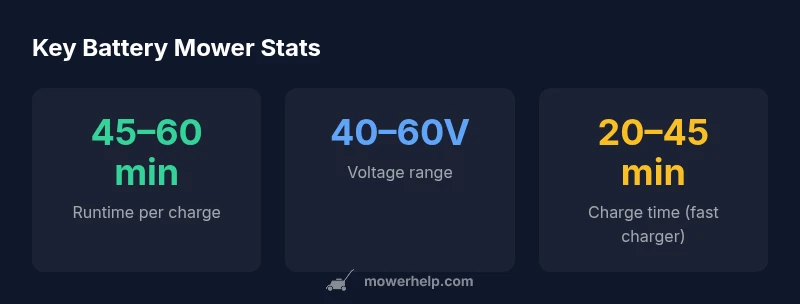
Prioritize runtime per charge, battery voltage, deck width, weight, and warranty. Check if batteries are interchangeable across models and whether a fast charger is included. Reading reviews and comparing TCO will help identify the best fit for your yard.
Look for good runtimes, enough power, and a solid battery warranty, plus interchangeability and a good charger.
The Essentials
- Assess yard size to match battery capacity
- Expect lower maintenance vs gas mowers
- Plan for charging downtime with spare batteries
- Choose models with interchangeable batteries for flexibility
- Check warranty and service options before buying