Craftsman Warranty for Lawn Mowers: A Homeowner's Guide
Understand Craftsman lawn mower warranty coverage, eligibility, claim steps, and tips to maximize protection. A practical guide for homeowners and DIY enthusiasts from Mower Help.


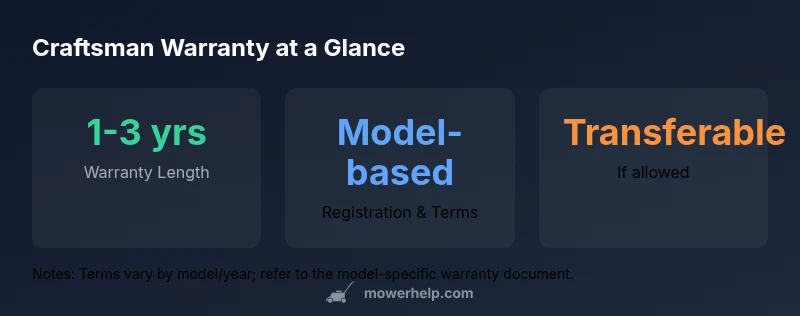
Craftsman lawn mower warranties typically provide limited coverage for homeowner use, with a model-dependent term ranging from 1 to 3 years. Coverage includes major components like the engine and chassis, but excludes consumables and routine maintenance. Activation often requires registration and proof of purchase. Always review the model-specific warranty document to confirm exact terms and exclusions.
Understanding Craftsman warranty coverage for lawn mowers
When you purchase a Craftsman lawn mower, the warranty is your first line of defense against unexpected failures on a home-use machine. According to Mower Help, warranty terms are highly model-specific and can vary by year, retailer, and the exact product line. In general, homeowner warranties tend to cover major components such as the engine, chassis, and drive system for a limited period. Consumables like blades, batteries, filters, and spark plugs are commonly excluded or treated as wear items. The emphasis is on protecting you from manufacturing defects rather than routine wear or improper use. To maximize clarity, always review the warranty document that accompanies your mower and confirm what counts as a defect, what maintenance actions are required, and how to initiate a claim.
This section provides a framework to interpret those terms and aligns your expectations with typical practices observed in 2026. The coverage is tied to model year and whether the mower is used in a residential setting, which is the intended context for most Craftsman warranties. If you intend to use the mower commercially or for heavy-duty tasks, you should anticipate stricter terms or additional warranty options.
Eligibility and activation: who qualifies and how to enroll
Most Craftsman warranties for lawn mowers presume residential use and require original proof of purchase, the model number, and a valid serial. Registration is often recommended or required to activate coverage and streamline claim processing. The activation process typically involves creating an account with the retailer or manufacturer and linking the serial to your contact details. Ownership transfer can complicate terms; some warranties remain active under new ownership, others require re-registration or may be voided if the previous owner initiated a claim. The key takeaway is to verify model-specific activation steps and keep all receipts, as they serve as the foundation for eligibility and future service.
Common exclusions and conditions you should know
Every warranty carries caveats designed to protect the seller from misuse. Common exclusions include wear items (blades, air filters, tires), damage from neglect or improper storage, unauthorized alterations, and use of non-recommended fuels or lubricants. Conditions often require regular maintenance per the operator’s manual, including oil changes, air filter replacements, and spark plug inspection. Neglect or making modifications can void coverage, so maintaining documented logs helps support a claim. Understanding these restrictions ahead of time reduces the risk of denial when you actually need service.
How to file a warranty claim: step-by-step guidance
When a defect occurs, start by collecting your documentation: purchase receipt, model and serial numbers, and any photos of the issue. Contact the retailer or Craftsman customer support to initiate a claim, following their prescribed process. Expect to provide a description of the problem, proof of maintenance, and possibly an inspection. Some claims require you to ship the mower to a service center or authorize a local technician to diagnose the problem. Maintain copies of all communications, dates, and service estimates. Prompt, organized documentation helps speed the resolution.
Maximizing warranty value: maintenance, registration, and proactive care
Regular maintenance is not just about performance; it helps ensure warranty eligibility. Follow the manufacturer’s maintenance schedule, use recommended fluids, and keep maintenance records organized. Registration and timely updates protect your rights if the mower is sold or repaired, and some retailers offer extended warranty options that can be added at purchase or within a grace period after registration. Keeping a detailed service log supports any future claim and reduces the risk of disputes over neglect versus manufacturing defect.
Repair vs replacement: what to expect under the Craftsman warranty
The warranty framework often presents a choice between repair and replacement based on the defect’s nature, availability of parts, and feasibility of repair. Labor coverage and parts availability impact this decision. In many cases, a damaged component is repaired or replaced under warranty without cost to the owner, but there can be limits on labor hours and the scope of what constitutes a covered repair. If a replacement is offered, it may be a refurbished unit or a newer model within the same product line, depending on stock and policy.
Buying a Craftsman lawn mower with warranty: what to look for
When shopping, compare model-year terms, coverage length, and whether the model requires registration for activation. Look for clarity on what constitutes a “defect” versus “wear,” and check if there are any exclusions for certain terrains or usage scenarios. If possible, opt for models with transferable warranties and documented maintenance requirements. Reading the warranty terms before purchase helps you align expectations with your intended use and plan for future service needs.
Craftsman lawn mower warranty overview
| Warranty Element | Typical Coverage Range | Notes |
|---|---|---|
| Length of Coverage | 1-3 years | Depends on model and year; verify model-specific terms |
| What is Covered | Engine, chassis, drive system | Excludes consumables and routine wear items |
| Maintenance Requirements | Regular service per manual | Proof of service may be required for claims |
| Transferability | Model-dependent | Check if transferable and any fees involved |
Got Questions?
What does the Craftsman warranty typically cover on a lawn mower?
Most homeowner warranties cover major components like the engine, chassis, and drive system for a limited period. Consumables and maintenance items are usually excluded. Always check the model-specific warranty document for precise terms.
Warranty generally covers the big parts for a limited time, but not blades or filters. Verify your model’s details.
Is the Craftsman warranty transferable if I sell the mower?
Warranty transfer policies vary by model and retailer; some permit transfer with conditions or fees, while others require re-registration by the new owner.
Yes, you can often transfer, but check the exact terms and any fees.
Do I need to register my Craftsman lawn mower warranty?
Registration activates coverage in many cases and streamlines claims; locate your model and serial numbers and follow the registration steps.
Most models need registration to activate the warranty.
What voids Craftsman warranty on a lawn mower?
Improper maintenance, unauthorized repairs, or using non-recommended fuels commonly void coverage. Always follow the manual and authorized service guidelines.
If you don’t follow maintenance or tamper with it, the warranty can be voided.
How long does a warranty claim take?
Processing timelines vary; expect documentation review, potential inspection, and parts availability. Delays can occur if parts are back-ordered.
It depends, but it can take days to weeks depending on the issue.
Can I get an extended warranty on a Craftsman mower?
Extended or optional warranties may be available through the retailer or third parties; terms vary and should be reviewed carefully.
Yes, there are extended options, but read the fine print.
“Warranty terms become reliable when you review the exact model language and maintain the mower per the manual.”
The Essentials
- Review model-specific warranty terms before purchase
- Keep receipts and register the mower to activate coverage
- Understand common exclusions to avoid denial
- Document issues with photos and logs for faster claims
- Consider extended warranty options where available