Lawn Mower Battery Charger: Safe & Efficient Charging
Learn to safely charge a lawn mower battery with the right charger. This guide covers compatibility, connection, monitoring, and maintenance to extend battery life.


With this guide you will learn how to safely charge a lawn mower battery, select the right charger, and maintain charging habits that extend battery life. You will understand voltage compatibility, correct connection methods, and practical charging routines that minimize sulfation and maximize overall mower readiness. Safety precautions and common mistakes are covered to keep you protected.
Choosing the Right Lawn Mower Battery Charger
Selecting a lawn mower battery charger starts with understanding your mower’s battery chemistry and the charger’s capabilities. According to Mower Help, compatibility and safety are the foundation of a reliable charging setup. Start by identifying whether your battery is flooded lead-acid, AGM, or lithium-based. Each chemistry has its own charging profile, and using a charger that matches that profile helps prevent damage, sulfation, and overheating.
Next, assess voltage and current. Most lawn mower systems operate in the low to mid 12-volt range, but newer models may have different requirements. Look for a charger that clearly lists the supported voltage and includes a mode for automatic shutoff or maintenance charging. An auto-stop feature reduces the risk of overcharging and helps extend battery life. If you have multiple batteries, consider a charger with multiple ports or swappable cables to simplify maintenance.
Finally, consider connector options and the charger’s form factor. A model with sturdy clamps, wide-grip handles, and flexible leads is easier to use in tight sheds or on uneven ground. If you rotate between tools, a universal charger with interchangeable cables can be a smart investment. In short, a well-suited lawn mower battery charger protects your investment and keeps equipment ready for action.
Tools & Materials
- Lawn Mower Battery Charger(Select a charger compatible with your battery type (12V lead-acid or lithium) and with automatic shutoff.)
- Multimeter (optional)(Useful to verify voltage before and after charging.)
- Safety gear(Gloves and safety glasses for protection.)
- Clean, dry workspace(Keep area free of flammables and moisture.)
- Battery terminal cleaners(Brushes or cloth to remove corrosion.)
Steps
Estimated time: 60-90 minutes
- 1
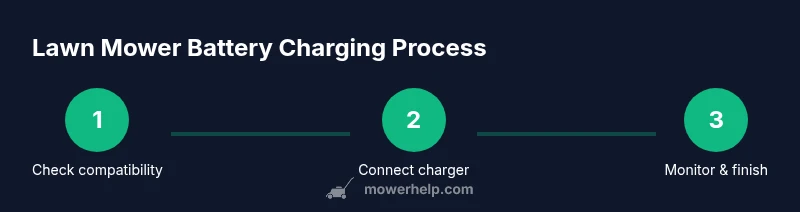
Verify compatibility
Check the battery type and voltage on both the battery and the charger. Confirm that the charger's chemistry support matches the battery's chemistry. This prevents damage and ensures a proper charging profile.
Tip: Read labels carefully and consult the manual if in doubt. - 2
Prepare charging area
Move to a dry, well-ventilated space. Remove any clutter, and verify there are no flammable materials nearby. This reduces fire risk and improves airflow around the battery.
Tip: Never charge near solvents or gasoline fumes. - 3
Connect charger to battery
Attach the charger's positive lead to the battery's positive terminal, then connect the negative lead to the negative terminal or a suitable ground point on the mower. Ensure clamps are clean and secure.
Tip: Ensure clamps do not touch each other during connection. - 4
Set mode and start charging
If your charger has a maintenance or auto-stop mode, select it to prevent overcharging. Plug the charger into power and watch for the steady charging indication on the display.
Tip: If your charger lacks auto-stop, monitor periodically. - 5
Monitor during charging
Periodically check for excessive heat, unusual odors, or swelling. If any warning signs appear, stop charging safely and disconnect.
Tip: Short pauses or cool-down breaks can help with larger packs. - 6
Finish and test
When charging completes, disconnect and test the battery with a voltmeter to confirm full charge. Store or reinstall the battery as appropriate and wipe any corrosion from terminals.
Tip: Keep a log of charge cycles for maintenance.
Got Questions?
What voltage should my lawn mower battery charger output?
Most lawn mower batteries are 12V; check the battery label and the charger specifications to ensure compatibility.
Most lawn mower batteries are 12 volts. Check the label on your battery and the charger to be sure.
Can I use a car battery charger to charge a lawn mower battery?
Car chargers are not recommended for lawn mower batteries because they use different charging profiles. Use a charger designed for lawn mowers.
No, use a dedicated lawn mower charger designed for your battery.
What happens if I overcharge the battery?
Overcharging can cause overheating, gas release, and faster degradation. An automatic shutoff charger helps prevent this.
Overcharging can lead to overheating and damage; use an auto-stop charger to prevent it.
How long does charging usually take?
Charging time depends on battery capacity and charger current. Typical sessions can range from about one to several hours.
Charging times vary; expect from about one to several hours depending on the battery.
Is indoor charging safe?
Yes, in a well-ventilated area away from flammables. Ensure the space is dry and stable.
Yes, but keep it in a ventilated, dry area away from flammables.
What maintenance helps extend battery life?
Keep terminals clean, avoid deep discharges, and store the battery properly when not in use.
Keep terminals clean, avoid deep discharges, and store correctly.
Watch Video
The Essentials
- Choose a charger that matches voltage and chemistry.
- Charge in a well-ventilated area.
- Monitor heat and signs of damage during charging.
- Use auto-stop charging to prevent overcharging.
- Test and store the battery after charging.