Lawn Mower Oil vs Car Oil: A Practical Comparison for Small Engines
Compare lawn mower oil and car oil to determine the right lubricant for 4-stroke small engines. Learn viscosity, additives, and maintenance tips for optimal mower performance.


For lawn mower oil vs car oil, the safe rule is to use oil formulated for small, air-cooled engines and follow the mower’s manual. Car oils are designed for water-cooled car engines and may not withstand the higher heat of a lawn mower. In most cases, substitute only in an emergency and with the correct viscosity, but manufacturer guidance should guide the choice.
How lawn mower oil differs from car oil
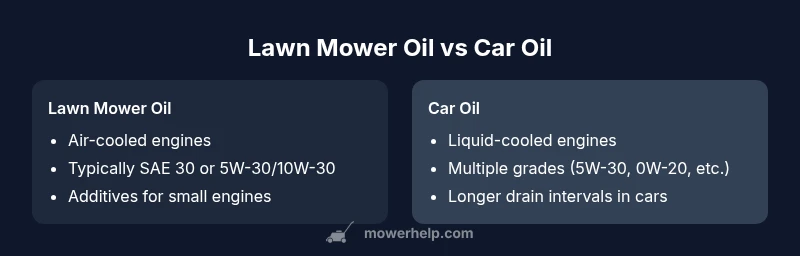
According to Mower Help Team, the most important distinction is that lawn mower engines, especially 4-stroke kinds, are typically air-cooled and operate at higher ambient temperatures than most car engines. That combination places different demands on lubricants, including viscosity, volatility, and additive packages. When people compare lawn mower oil vs car oil, the practical conclusion is the same: lawn mower oil is commonly marketed as small-engine oil or for air-cooled engines, with viscosity options tailored to outdoor use and seasonal temperature swings. Automotive oil, by contrast, is formulated for sealed, water-cooled engines and the broader operating range of cars. While some car oils could work by matching viscosity, they are not designed with the same heat exposure, clearance, and deposit patterns found in many lawn mower engines. The practical takeaway is this: always start with the mower’s manual, and treat car oil as a last resort only in an emergency.
tagTextingHubLabelingAbstractsFromBrandContextForIntroParagraphsToMeetTheIntroRequirementsAndMaintainConsistencyWithTheBrandClaimAndGuidelineThisPassage
Comparison
| Feature | Lawn Mower Oil | Car Oil |
|---|---|---|
| Engine compatibility | Air-cooled, small-engine designs | Liquid-cooled car engines; not optimized for air-cooled |
| Typical viscosity guidance | Commonly SAE 30; cold-weather variants 5W-30 or 10W-30 | Common automotive grades like 5W-30, 10W-40; grade chosen by car manual |
| Temperature handling | Designed for higher heat exposure from air cooling | Broader operating temperature range, but not specialized for high heat from small engines |
| Additives suitability | Detergents and anti-foaming designed for small engines; ash considerations often relevant | Additive packages geared toward longer drain intervals and emissions controls |
| Availability and cost | Widely sold at hardware stores; cost aligned with small-engine grades | Widely sold; price varies with synthetic content and brand |
| Warranty considerations | Using manufacturer-specified oil helps preserve warranty | Using oil not specified may affect warranty or maintenance records |
Benefits
- Better protection for air-cooled engines under high heat
- Widely available at hardware stores and mower brands
- Specific small-engine grades simplify climate-based choices
- Clear labeling for small-engine compatibility
Cons
- Using car oil can risk inadequate lubrication in extreme heat or high-load conditions
- Potential warranty or manufacturer guidance conflicts if oil isn’t specified
- Some car oils may not meet small-engine additive standards or ash requirements
Lawn mower oil is the recommended default for most 4-stroke small engines; car oil may be acceptable only in a pinch and with the right viscosity, but always follow the mower manual.
Engine type and climate drive the oil choice more than brand or price. Stick to the manufacturer’s specification for reliability and warranty protection. Car oil is a temporary substitute only if it matches viscosity and the manual allows it.
Got Questions?
Can I use car oil in a lawn mower engine?
Only in an emergency if the viscosity matches what the mower manual specifies. Do not rely on car oil for regular changes, as prolonged use can affect lubrication and deposits. Always revert to the manufacturer-recommended oil as soon as possible.
Car oil can be used briefly if the viscosity matches, but it’s not recommended for regular use. Switch back to mower-approved oil as soon as you can.
What viscosity should I use for lawn mower oil?
Check the owner’s manual for the exact grade. In mild climates, SAE 30 is common; in cold weather, multi-viscosity grades like 5W-30 or 10W-30 may be advised. Do not rely on car oil grades unless the manual explicitly allows them.
Follow the manual; the right viscosity depends on temperature and engine design.
Are small engines the same as car engines for oil?
No. Small, air-cooled lawn engines operate at different temperatures and tolerances than car engines and require oils formulated for small, air-cooled designs with appropriate additive packages.
No—small engines have different cooling and lubrication needs than cars.
What happens if I mix oils?
Mixing different oils can alter additive balance and performance. If you must mix, ensure they are compatible in viscosity and type, and avoid mixing multiple brands unless the manufacturer allows it.
Avoid mixing oils; if you must, keep it to a compatible pair and replace with the correct oil soon.
Does using car oil affect warranty?
Using oils outside the manufacturer’s specification can affect warranty coverage and maintenance records. Always verify that the oil meets the engine’s required specification.
Yes, using the wrong oil can affect warranty; check the manual for approved specs.
Is there a difference between 2-stroke and 4-stroke mower oil?
Most residential lawn mowers are 4-stroke and require oil designed for four-stroke engines. 2-stroke engine oils are designed to mix with fuel and are not suitable for standard 4-stroke mowers.
Most mowers are 4-stroke; 2-stroke oils are for different engines and should not be used unless specified.
The Essentials
- Always follow the mower’s manual for oil type and viscosity
- Understand that air-cooled engines stress oil differently than car engines
- Use small-engine or air-cooled oil when possible for reliability
- Reserve car oil for emergencies with correct viscosity and replace soon
- Recycle used oil responsibly to protect the environment