Comparison of Riding Lawn Mowers: A Practical Guide
An analytical comparison of traditional riding mowers and zero-turn models, covering deck width, turning radius, transmission, maintenance, and buying considerations for different yard sizes.


TL;DR: When choosing between traditional riding mowers and zero-turn models, prioritize turning radius, deck width, drive system, and terrain needs. If your lawn has lots of edges and obstacles, a zero-turn offers agility and faster edge work; for small, sloped, or tight spaces, a traditional riding mower can be more cost‑effective and easier to service. This comparison of riding lawn mowers guides the decision.
The Comparison of Riding Lawn Mowers: What to Compare
In this section, we explore the comparison of riding lawn mowers, focusing on how yard size, terrain, and budget influence model choice. According to Mower Help, the right riding mower balances comfort, reliability, and efficiency. A few foundational questions guide the decision: deck width you actually need, how terrain affects transmission and steering, and what maintenance costs you should expect over the machine’s life. The goal is to map options against real-use scenarios rather than tech specs alone. By framing the decision around practical outcomes—mowing speed, edge control, fuel efficiency, and serviceability—you avoid over-investing in features you won’t use. As you read, consider your property’s boundaries, trees, slopes, and the time you want to spend mowing weekly. This first step sets expectations and keeps the guide anchored to real-world performance, which matters for every property from small suburbs to larger lots.
Key Criteria in a Riding Mower Decision
Choosing a riding mower hinges on a handful of core criteria. Deck width should match your typical mowing footprint so you don’t over- or under-cover the lawn with passes. Turning radius is critical if your yard has fences, landscaping, or trees that require tight maneuvers. Transmission type—typically hydrostatic versus belt-drive—shapes how smoothly and quickly you can change speeds and direction. Drive system affects maintenance needs and availability of parts. Terrain considerations—slopes, bumps, and wet areas—will dictate whether you favor a lighter, more agile machine or a heavier model with traction controls. Fuel type, exhaust emissions, and noise also matter for residential use. Finally, operator comfort (seat support, control placement, and ride quality) translates to mowing time and fatigue. The Mower Help team emphasizes matching these criteria to real-world usage, not just spec sheets.
Traditional Riding Mower vs Zero-Turn: Where They Shine
The traditional riding mower and the zero-turn mower are the two main archetypes in this space. This piece continues the comparison of riding lawn mowers by outlining where each type shines. Traditional riding mowers excel in smaller, irregularly-shaped yards with slopes or tight corners where long straight passes dominate and turning space is limited. They tend to be easier to service with familiar parts and tend to have simpler maintenance routines. Zero-turn mowers, by contrast, shine in open areas with many edges, long straight runs, and landscapes that require rapid edge trimming. Their independent rear-wheel drive allows for extremely tight turns and fast mowing across expansive turf. However, they can be more complex, require more storage space, and may demand more specialized parts and service. Price can also reflect this complexity, so buyers should weigh upfront costs against expected lifetime use.
Performance under Different Yard Sizes and Terrains
yard size and terrain dictate performance expectations. For small to medium properties with many obstacles, a traditional riding mower offers predictable handling and sufficient speed without overcomplicating maintenance. Larger lawns with open expanses and frequent edge work benefit from a zero-turn mower’s superior maneuverability and higher mowing velocity. Sloped or uneven terrain tests traction and cut quality; hydrostatic transmissions in many traditional mowers provide smooth control on gentle slopes, while some zero-turns implement enhanced rear-wheel drive for challenging surfaces. Wet conditions, tall grass, and debris also influence choice: traditional models often handle mixed conditions with straightforward blades and deck heights, whereas zero-turns can adapt with adjustable cutting heights and aggressive traction. Across both types, routine maintenance—air filters, blade sharpness, belt tension, and oil changes—remains the key to long-term performance and reliability.
Long-Term Costs: Maintenance, Repairs, and Ownership
Maintenance costs are a key consideration in a long-term ownership plan. Traditional riding mowers generally have simpler transmissions and widely available parts, which can translate to lower maintenance costs and easier repairs for homeowners who DIY on weekends. Zero-turn mowers may incur higher maintenance costs over time due to hydraulic systems, belt-driven components, and more complex steering mechanisms. Parts availability is typically good, but the service interval for hydrostatic transmissions can be longer but more expensive when it’s required. Fuel efficiency varies by model and engine type, but both categories reward regular blade care, proper deck maintenance, and clean fuel practices. When evaluating cost, consider depreciation, resale value, parts availability in your area, and the expected lifespan of the drive system and deck. A well-chosen model with proper maintenance often yields lower total ownership costs than buying based solely on initial price.
How to Measure Fit: Practical Buying Scenarios
A practical buying method starts with real-world yard measurements and activity patterns. Step 1: estimate your lawn size in acres or square feet and note common mowing patterns. Step 2: identify obstacles, fence lines, trees, and slopes. Step 3: decide on a preferred pace of mowing and how much time you want to spend on maintenance. Step 4: compare models by deck width relative to your average mowing path width, turning radius to fit around obstacles, and transmission type to match your comfort with speed changes. Step 5: consider storage space and trailer or vehicle compatibility. Two common scenarios illustrate the decision: a compact suburban lot with tight edges favors a traditional mower; a large, open property with plenty of obstacles and long straight runs favors a zero-turn model. In both cases, a test ride and dealer demonstrations can reveal subtle differences in comfort and control that specs alone cannot convey.
Safety, Ergonomics, and Longevity
Safety and ergonomics influence both short-term comfort and long-term durability. Look for seat support, steering controls that match your hand position, and foot well space to reduce fatigue during long sessions. A stable deck with anti-scalp rollers and adequate blade guards protects both the user and property. Transmission reliability matters for longevity; hydrostatic systems offer smooth operation but require attentive maintenance. Regular blade sharpening, proper tire pressure where applicable, and clean air intake help extend the life of the mower. For households with children or pets, consider protective guards and safe storage to prevent accidental starts. The long-term value of a mower is tied not only to initial price but to consistency of performance and cost-effectiveness of ongoing maintenance.
Authoritative Sources and Safety Considerations
For readers seeking external validation and safety guidelines, consult reputable sources on mower safety and maintenance. Professional extension resources offer practical tips on selecting equipment, safe operation practices, and maintenance routines. Government and university materials emphasize safe operation, blade handling, and injury prevention. By cross-referencing these sources, you can align your purchase with best practices and local requirements. Future maintenance plans and safety upgrades should also be considered to protect both your investment and your family.
Authoritative Sources
- https://extension.illinois.edu/ - Lawn mower safety and maintenance guidelines from a land-grant university extension
- https://extension.oregonstate.edu/ - Practical guidance on choosing and maintaining riding mowers
- https://www.osha.gov/ - General safety standards and best practices for powered lawn equipment
Safety and Operational Guidelines
Always wear protective gear, inspect the machine before use, and follow the manufacturer’s maintenance schedule. Keep children and pets away from mowing areas, and store fuel and blades safely. Regularly check belts, blades, and guards to prevent injury and ensure consistent performance.
Comparison
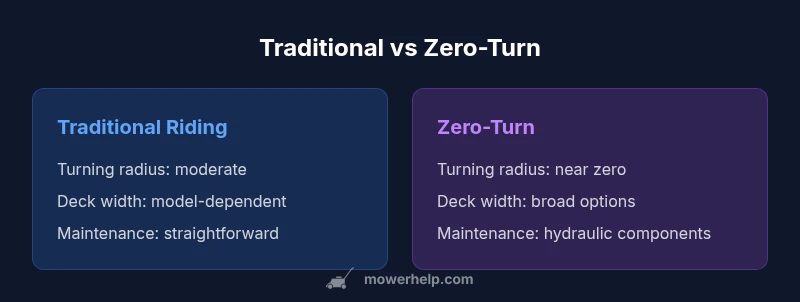
| Feature | Traditional riding mower | Zero-turn mower |
|---|---|---|
| Turning radius | Moderate-to-wide turns; requires space for pivoting | Very tight turning radius; agile around obstacles |
| Deck width options | Varies by model; generally broad range with solid cut quality | Wide range, often optimized for speed in open areas |
| Drive/transmission | Typically belt-driven or hydrostatic; smooth but heavier to control on slopes | Independent rear wheels; excellent maneuverability but more complex maintenance |
| Mowing speed and productivity | Steady pace suitable for smaller or irregular lots | Higher potential mowing velocity in large open spaces |
| Terrain handling | Good stability on gentle slopes; edge control depends on turning capability | Best on flat to moderately uneven ground; terrain grip varies by model |
| Maintenance cost and availability | Widely available parts; straightforward maintenance on many models | Hydraulic systems and belts can increase maintenance cost |
| Best for | Small to medium lawns with obstacles and tight spaces | Large, open lawns with frequent edge work and minimal tight turns |
Benefits
- Widely available service and parts support
- Predictable maintenance across common models
- Lower upfront cost on many traditional models
- Good balance of comfort and reliability for compact yards
Cons
- Zero-turns offer faster mowing in open areas but may require more space to maneuver
- Hydrostatic and belt-driven systems in some models increase maintenance costs
- Specialized parts for zero-turns can be harder to find in remote areas
Zero-turns excel on large, open lawns; traditional riding mowers suit small-to-medium yards with obstacles
For expansive properties with edge work, a zero-turn saves time. For compact yards, a traditional riding mower delivers reliable performance with simpler maintenance.
Got Questions?
What is the main difference between traditional riding mowers and zero-turn mowers?
The main difference lies in turning and maneuverability: traditional riding mowers use conventional steering with a larger turning radius, while zero-turn mowers pivot on independent rear wheels for near-zero turning radii. Maintenance and upfront costs also tend to differ, influencing long-term value.
Traditional mowers steer with a wheel; zero-turns turn on independent wheels for tight corners. Consider yard size and obstacles when choosing.
Which mower is best for a yard with many obstacles?
For yards with many obstacles, a traditional riding mower often provides predictable handling and easier navigation through tight spaces. A zero-turn can still work if you have the space to maneuver and can manage its higher maintenance needs.
If you have lots of obstacles, a traditional mower usually handles tight turns more comfortably.
Are riding mowers more expensive to maintain than a basic lawn mower?
Maintenance costs depend on the model and drive system. Traditional riding mowers typically have simpler maintenance, while zero-turns with hydraulic or complex transmissions can incur higher upkeep and repair costs over time.
Maintenance varies; hydrostatic systems in some models cost more to service.
What yard size benefits most from a riding mower?
Riding mowers are most beneficial for properties where walking behind a push mower becomes impractical but where space does not justify a heavy industrial machine. Large, open lawns with occasional edges are ideal for zero-turns, while neat, irregular plots fit traditional riding mowers.
Larger, open lawns gain most from riding mowers that balance speed and control.
Do riding mowers require professional service for the drive system?
Some riding mowers use hydrostatic transmissions that benefit from professional service at intervals; others with simpler belt drives can be maintained by a diligent homeowner. Always follow the manufacturer’s service schedule to prevent costly repairs.
Hydrostatic drives may need professional attention; simpler belts are easier to DIY.
The Essentials
- Prioritize yard size before choosing a mower type
- Zero-turns speed up open-area mowing and edge work
- Traditional riding mowers are typically easier to service
- Evaluate terrain and obstacles to judge turning requirements
- Plan for maintenance costs alongside upfront price