How to Ride a Riding Mower: Essential Guide for Homeowners
A comprehensive, beginner-friendly guide to riding mower operation, safety, maintenance, and tips for homeowners learning how to riding mower in 2026. Learn step-by-step, with practical examples and safety-first practices.


Goal: Learn how to ride a mower safely and confidently. You’ll verify safety checks, start and operate a riding mower, and perform basic maneuvers like turning and reversing in open space. Before you begin, gather PPE, inspect the mower, clear the work area, and follow recommended operating speeds for smooth, controlled mowing.
Why Riding Mowers Require Special Care
According to Mower Help, riding mowers are larger, more powerful, and more complex than push mowers, and they demand respect for safety and maintenance. The seated operator gains speed and mobility, but also faces increased risk if guards, belts, or blades are neglected. Understanding the underlying design—engine type, transmission, and cutting deck—helps you plan safer mowing sessions. This guide clarifies the key differences and why a routine maintenance mindset pays dividends in performance and longevity. You’ll learn how to tailor your approach to a riding mower’s systems, from deck clearance to drive controls, so you can mow efficiently without compromising safety. If you’re exploring how to riding mower, this section sets the foundation for confident operation.
Safety Essentials for Riding Mower Use
Safety comes first when you learn how to riding mower. Wear eye protection, hearing protection, gloves, and sturdy footwear. Clear the mowing area of people, pets, and debris, and inspect the mower for loose guards or damaged parts before starting. Check that all safety interlocks function and that the seat or operator presence switch engages properly. Use slow speeds in unfamiliar terrain, and never operate a riding mower in wet or slippery conditions. Keep hands away from the blades and never carry passengers. Regular maintenance reinforces safety by ensuring predictable responses from controls and reliable stopping power.
Pre-Operation Inspection Checklist
Before you start, perform a thorough check of fluid levels, fuel condition, and battery charge if applicable. Inspect blades for nicks or dull edges, belts for wear, safety guards for proper mounting, tires for correct pressure, and the PTO engagement. Verify that the control levers move freely and return to neutral. Ensure the seat and any safety belt are secure. Finally, review the mowing area for hidden hazards and identify your escape routes in case you need to stop quickly. A solid pre-check reduces surprises in the middle of a cut.
Basic Operating Techniques
Mount the mower with a stable stance, adjust the seat for comfortable reach to controls, and fasten any safety belt if equipped. Start according to the owner’s manual, allow the engine to warm, and select a gentle speed. Begin mowing with straight passes, overlapping slightly to ensure full coverage. Use smooth steering and avoid abrupt throttle changes. When finished, slow to a stop, disengage blades, and turn off the engine before exiting.
Maneuvering on Slopes and Uneven Terrain
Riding mowers handle mild slopes but require careful technique. Always approach slopes slowly, with even weight distribution, and avoid sharp turns while the machine is on a slope. If the ground is uneven, reduce speed and use a wider turning radius to maintain stability. If you must go over a bump or hole, slow down, stop, and back away if necessary. Keep bystanders clear and never attempt to drive across deep depressions. This is where understanding how to riding mower translates into safer navigation.
Maintenance Between Uses
After mowing, clean debris off the deck, blades, and cooling fins to prevent corrosion and overheating. Check blade sharpness and balance; replace or sharpen as needed. Inspect oil level and fuel condition, and top up as required. Store the mower in a dry, ventilated area away from flame sources, and use a fuel stabilizer if you expect a long storage period. Periodic checks of tires, belts, and safety guards help keep performance consistent and extend service life.
Troubleshooting Common Issues
If the mower won’t start, confirm fuel, battery charge, and safety interlocks. If the engine stalls after a few minutes, check for fouled plugs, dirty air filters, or a clogged cutting deck. Loss of power may indicate restricted airflow, a dirty fuel system, or an overheating condition. Unusual noises or vibrations warrant stopping the engine and inspecting the blades, pulleys, and mounting hardware. Address issues promptly to avoid cascading damage and downtime.
How to Riding Mower: Quick Setup Checklist
If you are new to operating a riding mower, use this quick setup to establish a safe baseline. Confirm personal protective equipment is on, and the mowing area is clear. Verify fuel level and battery charge, then inspect safety guards, blades, belts, and the seat. Mount the machine with a stable stance and adjust the controls to reach without strain. Start the engine at idle and test forward, reverse, and brake functions in an open space. Finally, set a conservative mowing speed and begin with a short test pass to gauge throttle response, steering, and cut quality. You can then proceed to full passes, maintaining a steady rhythm and frequent observation for obstacles.
Authoritative Resources
For safety and maintenance best practices, consult authoritative sources:
- OSHA: https://www.osha.gov
- Extension services (University of Minnesota): https://extension.umn.edu
- USDA NIFA: https://www.nifa.usda.gov
Tools & Materials
- Eye protection(Impact-resistant goggles or safety glasses)
- Hearing protection(Ear muffs or plugs)
- Sturdy footwear(Closed-toe boots with good grip)
- Gloves(Grip-friendly gloves)
- Appropriate clothing(Avoid loose sleeves; tuck in long hair)
- Riding mower owner's manual(Keep nearby; reference for model-specific steps)
- First aid kit(In case of minor injuries)
- Clear, level area(Pre-mark the mowing zone with cones or markers)
- Fuel stabilizer(Optional for storage or long intervals)
Steps
Estimated time: 60-90 minutes
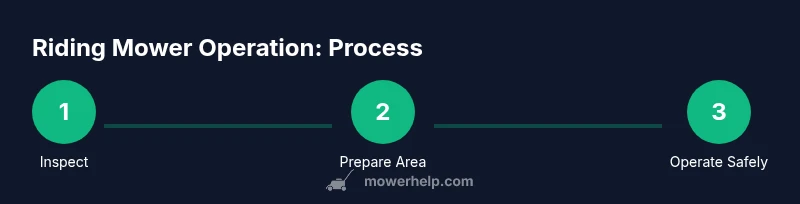
- 1
Inspect the mower and safety gear
Conduct a visual check of lights, guards, blades, belts, and interlocks. Verify PPE is ready and seat belt (if present) is functional. This prevents surprises once you start.
Tip: Check safety switches, blade condition, and fuel level. - 2
Prepare the mowing area
Clear toys, rocks, and debris from the path. Mark boundaries and ensure bystanders are away from the work zone. Decide on mower pattern (straight passes or offset rows) before you begin.
Tip: Remove debris and map boundaries to minimize stops. - 3
Mount the seat and set controls
Get a stable, balanced stance. Adjust your seating position so that you can comfortably reach levers, pedals, and switches without leaning. If your model uses a seat belt, secure it.
Tip: Ensure proper reach to controls for quick, safe responses. - 4
Start the engine and test controls at idle
Start per the manual and allow the engine to warm. Test forward and reverse controls in a clear space at slow speed. Check that the brake and blade engagement work as intended.
Tip: Test forward/reverse controls slowly to confirm smooth response. - 5
Begin mowing with straight passes
Move in long, straight passes with overlap to cover missed areas. Maintain a light grip on controls and avoid sudden steering inputs. Monitor cut height and pattern as you go.
Tip: Overlap each pass by a few inches for complete coverage. - 6
Turn and edge safely
Use wide, gradual turns at row ends. When edging, lower speed and stay away from drop-offs or soft ground. Always keep all body parts inside the operator area.
Tip: Slow down before turning, especially near borders. - 7
Pause to check and adjust as needed
Periodically stop to inspect blades, deck, and guards. Listen for unusual noises. Address any issues before resuming mowing.
Tip: If anything feels off, stop and inspect immediately. - 8
Shut down and park properly
Reduce speed, disengage blades, and idle to cool before turning off. Remove the key or switch off the ignition, and engage parking brake if equipped. Allow blades to come to a complete rest before dismounting.
Tip: Let blades stop completely and remove key before exiting.
Got Questions?
What safety gear should I wear when riding a mower?
Wear eye protection, hearing protection, gloves, and sturdy footwear every time you ride a mower. Avoid loose clothing.
Always wear eye and hearing protection, gloves, and sturdy footwear before operating a riding mower.
Can I ride a mower on slopes?
Riding mowers can operate on gentle slopes, but you should avoid steep inclines and uneven ground. Take slow, deliberate turns and keep weight balanced.
Avoid steep slopes and use slow, steady turns with balanced weight when on uneven ground.
How often should I inspect the mower before use?
Do a quick safety and mechanical inspection before every use, focusing on guards, blades, belts, and fluid levels.
Check guards, blades, belts, and fluids before every use.
What maintenance should I perform after mowing?
Clean the deck, inspect blades, check oil and fuel, and store the mower properly to prevent corrosion and degradation.
Clean, inspect, and store the mower after mowing to keep it in good condition.
Is it necessary to read the owner's manual?
Yes. The manual provides model-specific startup, safety, and maintenance procedures that optimize performance and safety.
Always refer to the owner's manual for model-specific instructions.
What should I do if the mower loses power during use?
Check fuel and air filters first, then inspect belts and the engine for overheating or obstructions.
Check fuel, air filters, and belts if power drops; stop and inspect before continuing.
Watch Video
The Essentials
- Inspect your mower and area before use
- Mow with controlled, deliberate passes
- Follow a pre-use maintenance routine
- Park safely and store equipment properly