Difference Between Lawn Mower Blades: A Comprehensive Guide
Explore the differences between common lawn mower blades—straight, high-lift, mulching, and Gator—and how blade design affects cut quality, bagging, mulching, and maintenance.


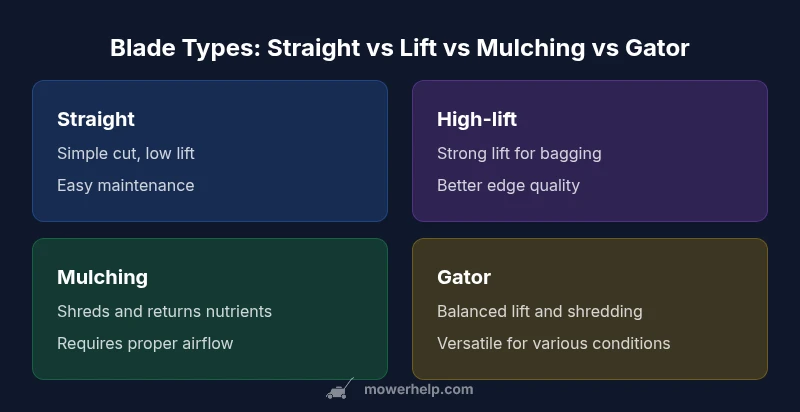
According to Mower Help, the difference between lawn mower blades boils down to design goals: lifting, mulching, or both. In practice, straight blades deliver a clean, simple cut; high-lift blades maximize grass lift for bagging; mulching blades shred clippings and return them to the lawn; Gator blades blend lift with rugged cutting action. From a maintenance angle, the blade you choose should align with your mowing goals and mower model.
Understanding the difference between lawn mower blades
The phrase difference between lawn mower blades should guide your decision when you pick a replacement. Blade design determines how the grass is cut, how clippings are handled, and how the mower interacts with the deck and housing. You’ll notice three core outcomes from a blade choice: how clean the cut looks, how well clippings are bagged or returned, and how much effort is required to maintain sharpness and balance. The Mower Help team emphasizes that blade selection is not purely about power or speed—it's about aligning blade geometry with your mowing goals (bagging, mulching, or simple cutting) and your local lawn conditions. By starting with your primary objective—do you bag, mulch, or leave clippings on the lawn—you can narrow down to a practical blade family and avoid needless experimentation.
Blade design 101: how shape affects performance
Blade geometry defines how it cuts, lifts, and handles debris. The primary design elements are edge shape, blade width, and the number of cutting faces. A wider blade shares more surface area with the grass, which can translate to faster mowing at the same speed. The edge angle influences cutting aggressiveness and how material is lifted. Lift is not a single variable—it's affected by curvature, deck position, and the overall mower geometry. Two blades with identical length can behave very differently in tall grass versus a manicured lawn. According to Mower Help, blade design choices should prioritize height management, clipping type, and bagging needs rather than chasing a single “best” blade.
Straight blades: the baseline option
Straight blades are the most common and least dramatic option. They deliver a straightforward cut, are easy to sharpen, and tend to be cheaper than specialty blades. Because they create less lift, they work well on traditional lawn setups where clippings are either left on the lawn or bagged with a compatible system. Straight blades excel for basic mowing tasks, especially on smaller yards with uniform grass height. The trade-off is reduced lift and edge crispness on bagging-heavy or tall-grass scenarios, where mulch-friendly or lift-focused designs usually outperform a plain straight blade.
High-lift blades: lift, bagging, and edge quality
High-lift blades feature a pronounced curvature that grabs more grass and directs it upward into the bagging system. They improve bagging efficiency and edge performance, particularly on taller grass or damp mornings when clippings tend to lay flat. The lift also influences the cutting angle, often yielding a more noticeable curb-to-center cut. However, high-lift blades can be less effective at mulching since much of the material is propelled toward the bag rather than shredded and returned. When your primary goal is clean bagging rather than nutrient return, a high-lift blade is typically the better choice.
Mulching blades: shredding and returning nutrients
Mulching blades are designed with multiple cutting faces and sharper edges to shred clippings into finer pieces. The goal is to return broken-down material to the soil, which can improve lawn nutrition and reduce bagging needs. Mulching blades require adequate air flow and deck clearance to function properly; without sufficient clearance, clogs can occur, especially in tall or dense lawns. The blade geometry supports thorough shredding at moderate mowing heights, but it may not perform as well for bagging-heavy tasks. If your lawn benefits from recycling nutrients and you don’t mind occasional extra maintenance, mulching blades offer meaningful advantages.
Gator blades: versatility and strength
Gator blades blend the lift of high-lift designs with enhanced chip-breaking action. They’re known for strong airflow and aggressive cutting performance, making them a versatile option for mixed mowing tasks. Gator blades can provide effective mulching with decent bagging compatibility on many mower models, though they may require careful selection to match deck geometry. The trade-off is that some users experience more noise and vibration with these blades, particularly on older or lighter-duty decks. When you need a blade that handles varied conditions and clippings types, Gator blades offer a practical middle ground.
Grass type and height: which blade matches your lawn?
Your lawn’s grass species, typical height, and growth rate should drive blade choice. Fine fescue or Bermuda at standard mowing heights may respond well to straight or mulching blades, while tall or thick turf in warm seasons benefits from the lift and bagging efficiency of high-lift blades. If you frequently mulch or return nutrients, mulching blades shine in nutrient cycling. For properties with mixed mowing conditions or uneven terrain, a flexible option like a Gator blade may reduce the number of blade changes you perform over a season.
Maintenance implications: sharpening and balancing
Blade maintenance is a critical factor in performance. Regardless of blade type, you should regularly inspect for nicks, balance vibration (blades should spin evenly without wobble), and sharpen blades to a consistent edge. After sharpening, recheck balance and re-tighten the blade mounting hardware to specification. If you’re switching blade types, verify compatibility with your mower’s deck and guards. Proper maintenance not only sustains cut quality but also reduces engine and deck wear over time, aligning with practical maintenance practices recommended by Mower Help.
Installation safety and balancing checks
Always disconnect the spark plug wire or remove the battery before handling mower blades. Use proper gloves and tool torque recommendations when removing and installing blades. Check for cracked guards or loose mounting hardware, which can compromise safety and performance. After installation, run the mower briefly to listen for unusual noises or vibrations, and inspect the blade for proper alignment. A well-balanced blade minimizes vibration and extends blade life, while a poorly balanced blade can cause uneven cuts and deck wear.
OEM vs aftermarket blades: costs and compatibility
OEM blades are designed to match your mower model’s exact specifications and guardian clearances. Aftermarket blades can offer cost savings and sometimes enhanced performance, but compatibility varies by deck design and mounting hardware. When choosing aftermarket blades, verify the correct length, mounting hole pattern, and the number of cutting faces. If you own a unique or older mower, sticking with OEM blades may reduce risk of misfit and warranty concerns. Balancing remains a universal step after any blade change.
Decision framework: picking the right blade for you
Start with your primary mowing objective: bagging, mulching, or simple mowing. Then check your deck compatibility, the mower height you typically maintain, and local grass growth patterns. Compare the blade families—straight for simplicity, high-lift for bagging, mulching for nutrient return, and Gator for versatility—and align your choice with climate, yard size, and maintenance willingness. A methodical approach minimizes trial-and-error and preserves blade life.
Table stakes: blade care schedule and budget planning
Establish a blade care cadence that fits your mowing season. Schedule regular inspections for nicks and balance, sharpen as needed, and replace blades when edges degrade or the blade shows structural wear. Budget planning should account for OEM vs aftermarket costs, potential adapters, and occasional deck maintenance. By anticipating blade lifecycle needs, you can avoid performance dips and keep your mower running smoothly throughout the year.
Feature Comparison
| Feature | Standard straight blade | High-lift blade | Mulching blade | Gator blade |
|---|---|---|---|---|
| Cut quality at typical mowing height | Clean, straightforward cut with minimal lift | Strong lift and edge control for bagging | Fine shredding with nutrient return | Aggressive cut with balanced lift and mulch action |
| Clippings handling | Bagging or mulch-unfriendly on some decks | Bagging-focused with improved debris pickup | Primarily mulch/return, minimal bagging | Versatile for both mulch and bagging on many models |
| Maintenance and sharpening effort | Easy to sharpen; widely supported | Moderate; requires balancing and periodic sharpening | Moderate-to-high due to complex geometry | Moderate; balance and possible specialty care |
| Deck compatibility and availability | Widely compatible with most decks | Requires compatible bagging system | Widely available aftermarket options | May require adapters or specific guards |
| Price range (OEM vs aftermarket) | Low-to-mid (often lowest cost) | Mid-range (often priced for performance) | Mid-to-high (premium mulching blades) | Mid-to-high (varies by brand and design) |
Benefits
- Clear alignment with mowing goals (bagging, mulching, or general cutting)
- Potential for better grass health when matched to lawn type
- Broad aftermarket availability and options
Cons
- Switching blades adds maintenance steps and checks
- Some blades require compatible guards/adapters
- Overemphasis on a single blade type can reduce versatility
Blade choice should map to your primary mowing goal: mulching for nutrient return, high-lift for bagging, straight blades for simple maintenance.
For nutrient-rich lawns, mulching blades win. For frequent bagging, high-lift blades excel. If you want simple mowing with broad compatibility, a straight blade is a solid baseline. The Mower Help team recommends selecting blade design based on your specific yard needs and maintenance willingness.
Got Questions?
What is the primary difference between blade types?
Blade type primarily changes how much lift you get, how clippings are handled, and how much nutrient return the lawn receives. Straight blades emphasize simple cuts, high-lift blades optimize bagging, mulching blades shred and return clippings, and Gator blades blend lift with mulching action.
Blade choices mainly adjust lift, bagging versus mulching, and how nutrients are recycled back into the lawn.
Can I use mulching blades for bagging?
Mulching blades can often be used with bagging systems, but their design prioritizes shredding rather than strong upward lift. If bagging is your primary goal, ensure the mower deck and bagging setup complement the blade’s geometry, or opt for a high-lift blade for better bagging performance.
Mulching blades can sometimes work with bags, but for best bagging results, use a blade designed for lift.
Do I need to sharpen blades often?
All mower blades require periodic sharpening to maintain a clean cut. The frequency depends on mowing conditions, blade type, and usage. Regular inspection and balancing after sharpening help prevent vibration and deck wear.
Yes—check and sharpen blades regularly, and balance them after sharpening.
Are aftermarket blades safe for my mower?
Aftermarket blades can be safe and cost-effective if they match your deck’s specifications. Always verify the correct length, mounting pattern, and cutting face count. Improper fit can cause vibration, reduced efficiency, and safety concerns.
Aftermarket blades can be safe if they match your mower’s specs; double-check fit before use.
Which blade is best for tall, thick grass?
In tall or thick grass, a blade with strong lift (high-lift or Gator) typically performs better for cutting and bagging or mulching, depending on your goal. Straight blades may struggle with lifting; mulching blades can mulch but may clog if the grass is too dense.
For tall grass, choose a lift-focused blade like high-lift or Gator, depending on bagging or mulching goals.
How do I install a blade safely?
Always disconnect the spark plug or remove the battery, use proper gloves, and follow the mower’s manual for torque specs. Check for proper balance after installation and test the mower at a low speed before use.
Disconnect power, wear gloves, then install per manual and test at low speed.
The Essentials
- Match blade type to your primary mowing goal
- Consider lawn type and mowing height when choosing blades
- Balance blade choice with maintenance capacity
- Check deck compatibility before buying
- Plan for OEM vs aftermarket costs and lifecycle