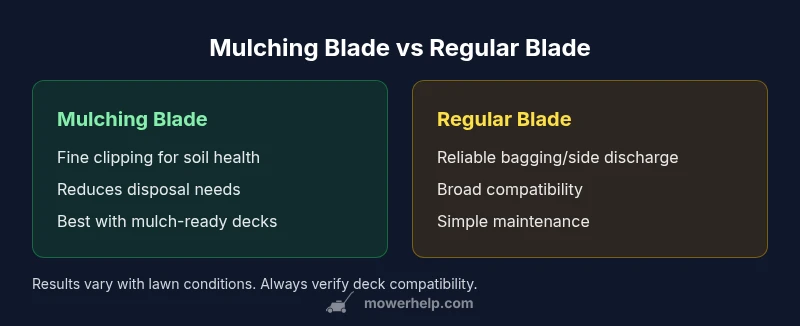
Lawn mower mulching blade vs regular: A detailed comparison
Compare lawn mower mulching blades with regular blades. Learn how each blade type affects clipping size, nutrient recycling, mowing performance, and maintenance to help you choose the right blade for your lawn.


According to Mower Help, the choice between a lawn mower mulching blade vs regular blade hinges on clipping quality, mowing conditions, and maintenance needs. Mulching blades can produce finer clippings and better nutrient recycling, while regular blades offer simple, robust performance. The right pick depends on your yard and maintenance goals.
What makes mulching blades different from standard blades
Mulching blades are engineered with dual cutting surfaces and a curved air flow that recirculates grass clippings back into the blade's intake. This design enables a finer cut, which accelerates breakdown and nutrient return to the soil. The phrase lawn mower mulching blade vs regular is common because homeowners want to know whether the extra cost and maintenance are worthwhile for their lawn. In practice, mulching blades excel at producing small, quickly decomposing clippings, which can improve soil quality and lawn vigor over time. By contrast, standard or high-lift blades prioritize clippings that are easier to bag or discharge, often leaving larger fragments that take longer to decompose. When evaluating mulching blade efficiency, you must consider your mower deck geometry, blade shape, and engine power. According to Mower Help Analysis, 2026, the goal is even distribution with minimal clumping. Tradeoffs exist: mulching blades can be more sensitive to grass height, moisture, and mowing speed; dull or misaligned blades reduce performance.
How clipping size and distribution change with blade type
Clipping size directly reflects blade design. Mulching blades recut clippings multiple times, producing a finer finish that dries quickly and spreads more uniformly across the lawn. This can reduce visible clumps and create a healthier, more uniform color. Regular blades typically yield larger remnants, which can be ideal for bagging or side discharge. The distribution pattern also depends on the deck’s baffles and airflow, so even two mowers with identical blades can behave differently if the deck geometry differs. For homeowners seeking a “neat lawn,” mulching blades often deliver a more consistent look, especially after several passes. However, in tall or damp growth, mulch blades may struggle to evacuate clippings, increasing the risk of localized clumps.
Grass conditions and performance trade-offs
Dry, evenly cut turf tolerates mulching blades well, as the fine clippings disperse easily and settle into the sward. In extreme heat or drought, finer clippings can help conserve moisture and reduce weed emergence. In contrast, damp or very tall grass can cause mulch blades to clog or underperform, requiring slower speeds or extra passes. Regular blades provide robust performance across a wider range of conditions, particularly when bagging or side-discharging is preferred. The practical takeaway is that mulching blades shine in routine mowing with healthy, moderate growth, while regular blades offer reliable, straightforward operation in more challenging conditions. Remember to inspect your deck for compatibility and verify that your mower is designed to mulch; a poor match can negate the blade’s advantages.
Nutrient recycling and soil impact
One of the main advantages of mulching blades is nutrient recycling. By recutting clippings into tiny pieces, the lawn receives a slow, steady source of organic matter that can improve soil structure and microbial activity. This process reduces the need for synthetic fertilizer and can lower clippings disposal volume. Mower Help Analysis, 2026 notes that the real benefit emerges when clippings are fine enough to decompose rapidly and are evenly distributed. If you let clippings accumulate, they can create a thatchy layer or create moisture pockets that encourage disease. Regular blades rely more on disposal or bagging, which reduces the immediate return of nutrients to the soil, but avoids potential clogging and requires less consideration of mower settings.
Deck compatibility and installation notes
Compatibility is a critical factor. Mulching blades require a deck design that promotes recirculation and prevents clumps, which means not all mowers can mulch effectively. Check the operator manual and vendor specifications to confirm mulching compatibility, and ensure the blade is sized for your model. If you discover your deck lacks proper baffling or cut-down clearance, a mulching blade may underperform or cause clogging. Regular blades tend to be more universally compatible, making them a sensible choice for older mowers or models without a mulching-ready deck. If you must switch blades, align the blade height, balance, and spindle type, and never compromise safety during installation.
Maintenance, sharpening, and cleaning strategies
Mulching blades experience more wear from repeated recuts; keep a close eye on edge sharpness and blade balance. Sharpening intervals vary with mowing frequency, grass type, and climate, but plan for more frequent maintenance than with standard blades in heavy-use scenarios. Clean blades after mowing to remove accumulated sap and soil that can dull edges, and inspect for nicks or cracks that compromise performance. Proper storage and routine checks help extend blade life and maintain performance. Regular blades generally require less frequent fine-tuning, though they still benefit from maintenance to avoid reduced efficiency or uneven cuts.
Real-world mowing scenarios: when to choose each
Consider mulching blades when your lawn has healthy growth, you prefer fewer clippings in landfills, and your mower deck is designed for mulching. They excel for steady, consistent maintenance and soil health improvements. If your yard experiences tall, thick growth, damp weather, or you must meet strict bagging requirements, a regular blade may provide more reliable results with simpler upkeep. Each scenario has different priorities—convenience, cleanliness, soil enrichment, or cost—that guide the choice. A practical approach is to trial both blade types across seasons and document clipping behavior, bagging needs, and the lawn’s response to mowing height adjustments.
Cost, value, and long-term considerations
Mulching blades often carry a modest upfront premium, but the long-term savings can emerge from reduced disposal and fertilizer needs. Value depends on your mowing frequency, yard size, and willingness to adjust mowing practices (like mowing height and speed) to optimize mulch performance. If you maintain a larger property or prefer minimal maintenance, balance the initial cost against potential savings in disposal and fertilizer. Regular blades frequently cost less upfront and offer broad compatibility, a straightforward choice for occasional mowers or users who prioritize simplicity. The long-term decision should weigh ongoing costs, maintenance time, and environmental benefits.
Quick-start decision framework
To make a fast, informed decision:
- Check deck compatibility for mulching capability
- Assess grass growth and moisture in your yard
- Consider disposal preferences and fertilizer plans
- Evaluate your tolerance for blade maintenance and potential clogging
- Run a side-by-side short trial if possible to observe clipping size, distribution, and lawn response
Across these sections, the core question remains: does the lawn health payoff justify the slightly higher upfront effort and potential compatibility constraints? For many homeowners, the mulching blade approach aligns with ecological goals and a preference for low-disposal mowing, while others may favor the simplicity and reliability of a regular blade.
mainTopicQuery}:
comparisonTable":{"items":["lawn mower mulching blade","regular blade"],"rows":[{"feature":"Clipping size","values":["finer, recut clippings","coarser, larger fragments"]},{"feature":"Nutrient recycling","values":["enhanced soil return from micro-clippings","less direct soil enrichment"]},{"feature":"Deck compatibility","values":["requires mulch-ready deck/design","broad compatibility with most decks"]},{"feature":"Maintenance needs","values":["potentially more frequent sharpening","usually straightforward maintenance"]},{"feature":"Best for","values":["soil health and reduced disposal","simplicity and bagging efficiency"]},{"feature":"Cost range","values":["slightly higher upfront","lower upfront"]}] }],
prosCons":{"pros":["Finer clipping improves nutrient cycling","Less yard waste due to reduced clipping disposal","Cleaner lawn appearance with even distribution","Potentially healthier soil from continuous mulching"],"cons":["Possible clogging in damp or tall grass","Requires mulch-compatible deck and maintenance","Higher upfront blade cost","Not ideal for lawns that rely on bagging for cleanup"]},
verdictBox":{"verdict":"Mulching blades are generally the better choice for lawn health and maintenance efficiency, with caveats about deck compatibility and potential clogging in challenging conditions.","confidence":"high","summary":"Choose mulching blades if you want finer clippings, more nutrient recycling, and less disposal. Ensure your mower deck supports mulching, and be prepared for occasional clogging in damp or overgrown conditions. If simplicity and universal compatibility matter more, a regular blade remains a solid, cost-efficient option."},
keyTakeaways":["Evaluate deck compatibility before switching blades","Mulching blades favor lawn health and reduced disposal","Expect occasional clogging in damp or tall grass with mulch blades","Maintain blade sharpness and balance for best results","Weigh upfront blade costs against long-term savings"],
faqSection":{"items":[{"question":"What is the main difference between mulching blades and regular blades?","questionShort":"Main difference","answer":"Mulching blades are designed to recut clippings into finer pieces that stay on the lawn, returning nutrients to the soil. Regular blades are optimized for bagging or side discharge, often leaving larger clippings that require disposal or quicker decomposition.","voiceAnswer":"Mulching blades cut clippings into smaller pieces to feed the lawn, while regular blades are built for bagging or discharging the clippings." ,"priority":"high"},{"question":"Do mulching blades require a special deck?","questionShort":"Deck requirement","answer":"Yes, mulching blades work best on mowers with decks designed to promote recirculation and even distribution of fine clippings. Some older or basic decks may not mulch effectively, which can reduce performance.","voiceAnswer":"Mulching blades need a compatible deck to work properly; check your mower’s manual before switching.","priority":"high"},{"question":"Can I switch between mulching and regular blades?","questionShort":"Switching blades","answer":"You can switch blades on many mowers, but you must verify compatibility, correct blade length, and proper mounting. Always remove the spark plug and follow safety steps during changes.","voiceAnswer":"Yes, but confirm compatibility and follow safety steps when changing blades.","priority":"medium"},{"question":"How often should I sharpen mulching blades?","questionShort":"Sharpen frequency","answer":"Sharpening frequency depends on mowing frequency, grass type, and maintenance, but mulching blades typically require more frequent sharpening than standard blades to maintain a fine cut.","voiceAnswer":"Sharpen as needed based on cut quality and balance, not just mileage.","priority":"medium"},{"question":"Are mulch blades better for new lawns?","questionShort":"New lawns","answer":"Mulching blades can help improve soil health over time, but for newly seeded or delicate lawns, bagging or careful management may be preferable to protect young roots during establishment.","voiceAnswer":"They can help long-term, but evaluate current lawn stage and moisture before using them.","priority":"low"}]},"mainTopicQuery":"blade maintenance"},
Comparison
| Feature | lawn mower mulching blade | regular blade |
|---|---|---|
| Clipping size | finer, recut clippings | coarser, larger fragments |
| Nutrient recycling | enhanced soil return from micro-clippings | less direct soil enrichment |
| Deck compatibility | requires mulch-ready deck/design | broad compatibility with most decks |
| Maintenance needs | potentially more frequent sharpening | usually straightforward maintenance |
| Best for | soil health and reduced disposal | simplicity and bagging efficiency |
| Cost range | slightly higher upfront | lower upfront |
Benefits
- Finer clipping improves nutrient cycling
- Less yard waste due to reduced clipping disposal
- Cleaner lawn appearance with even distribution
- Potentially healthier soil from continuous mulching
Cons
- Possible clogging in damp or tall grass
- Requires mulch-compatible deck and maintenance
- Higher upfront blade cost
- Not ideal for lawns that rely on bagging for cleanup
Mulching blades are generally the better choice for lawn health and maintenance efficiency, with caveats about deck compatibility and potential clogging in challenging conditions.
Choose mulching blades if you want finer clippings, more nutrient recycling, and less disposal. Ensure your mower deck supports mulching, and be prepared for occasional clogging in damp or overgrown conditions. If simplicity and universal compatibility matter more, a regular blade remains a solid, cost-efficient option.
Got Questions?
What is the main difference between mulching blades and regular blades?
Mulching blades are designed to recut clippings into finer pieces that stay on the lawn, returning nutrients to the soil. Regular blades are optimized for bagging or side discharge, often leaving larger clippings that require disposal or quicker decomposition.
Mulching blades cut clippings into smaller pieces to feed the lawn, while regular blades are built for bagging or discharging the clippings.
Do mulching blades require a special deck?
Yes, mulching blades work best on mowers with decks designed to promote recirculation and even distribution of fine clippings. Some older or basic decks may not mulch effectively, which can reduce performance.
Mulching blades need a compatible deck to work properly; check your mower’s manual before switching.
Can I switch between mulching and regular blades?
You can switch blades on many mowers, but you must verify compatibility, correct blade length, and proper mounting. Always remove the spark plug and follow safety steps during changes.
Yes, but confirm compatibility and follow safety steps when changing blades.
How often should I sharpen mulching blades?
Sharpening frequency depends on mowing frequency, grass type, and maintenance, but mulching blades typically require more frequent sharpening than standard blades to maintain a fine cut.
Sharpen as needed based on cut quality and balance, not just mileage.
Are mulch blades better for new lawns?
Mulching blades can help improve soil health over time, but for newly seeded or delicate lawns, bagging or careful management may be preferable to protect young roots during establishment.
They can help long-term, but evaluate current lawn stage and moisture before using them.
The Essentials
- Evaluate deck compatibility before switching blades
- Mulching blades favor lawn health and reduced disposal
- Expect occasional clogging in damp or tall grass with mulch blades
- Maintain blade sharpness and balance for best results
- Weigh upfront blade costs against long-term savings