Should Lawn Mower Blades Be Parallel or Perpendicular?
Learn whether your mower blades should be parallel or perpendicular, why this question matters for cut quality, and proven steps to install, sharpen, and balance blades safely for optimal performance.


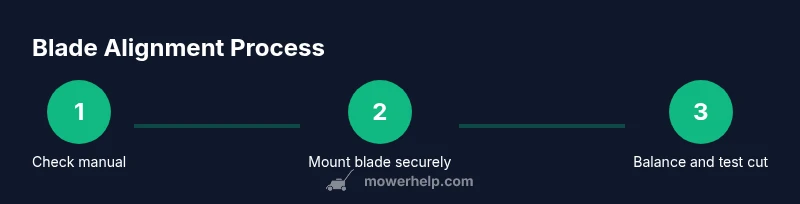
Should lawn mower blades be parallel or perpendicular? In practice, there is no universal parallel/perpendicular setting for most mower blades. Blades are installed in a model-specific orientation, and the focus should be on correct mounting, balanced blades, and proper bevels when sharpening. Follow the manual, check for even balance, and maintain consistent mowing results.
Should lawn mower blades be parallel or perpendicular? A practical overview
Many homeowners wonder whether blades should be mounted parallel or perpendicular to the mower deck. According to Mower Help, there is no universal parallel/perpendicular setting that applies to every model. Blade orientation is typically dictated by the blade's mounting pattern and the design of the spindle. The real determinants of a good cut are proper mounting, balanced blades, and maintaining the correct bevel when sharpening. The Mower Help team found that following the manufacturer's instructions and verifying a true, level blade plane consistently yields the best results. If you’re unsure, start with the orientation shown in your manual and verify by balancing the blade after installation. A correctly mounted and balanced blade reduces vibration, improves cut quality, and extends deck life.
How blade mounting typically works on most decks
Blade mounting relies on a central spindle with a lug pattern that matches the blade holes. The orientation is often fixed by the blade’s hole alignment, so rotating the blade 180 degrees may be possible on some models to balance weight, but it is not a universal option. Always align the blade so that the sharp cutting edge points outward from the blade nut region and away from the deck surface. If your blade has a bevel on one side, ensure the bevel faces the air for an effective cut. In short, there isn’t a general instruction to mount parallel or perpendicular; follow the model’s specific mounting instructions and keep the blade plane true to the spindle hub.
The importance of balance, bevel, and orientation
Balance is crucial for a smooth cut and reduced vibration. A blade that’s out of balance or installed with an inconsistent bevel can wobble, wear the adapter, and cause uneven lawn patterns. Orientation matters for the bevel angle and airflow through the deck. For most blades, the critical tasks are to maintain the original bevel angle, ensure both blades (if your deck uses two) are balanced against each other, and recheck balance after every installation. The goal is a clean, even cut with minimal vibration.
Signs you may have the wrong blade orientation
If you notice excessive vibration, uneven cutting patterns, or clumps of uncut grass, the blade orientation or balance may be off. A blade that isn’t seated flat against the deck can also cause noise and heat buildup. Inspect both sides of the blade for burrs, nicks, or a bent mounting surface. If the blade looks uneven or doesn’t sit flush, remove it, recheck the seating, and test again after rebalancing. Remember: some models require torque checks on the mounting bolts to ensure a secure fit.
Safe installation practices and necessary tools
Before removing or reinstalling blades, disconnect the spark plug (gas mowers) or unplug (electric mowers) and engage the parking brake if applicable. Wear cut-resistant gloves and use a sturdy wrench to prevent drops. Check for a balanced blade by spinning it on a blade balancer or using a simple weight-check approach. Make sure the blade is seated flat and that the bolts are tightened to the manufacturer’s torque specification. Keep hands clear of the blade path during installation and testing.
Sharpening, balancing, and reinstallation: preserving the angle
Sharpen with the blade flat on a stable surface, maintaining the original bevel angle. Avoid grinding away too much metal, which can alter balance. After sharpening, perform a balance test; if one side is heavier, remove the blade and adjust by grinding evenly on both sides or by rebalancing with a balancing tool. Reinstall the blade with correct orientation as per the manual, and torque bolts to spec. This preserves performance and extends blade life.
Verifying correct orientation after reinstallation
To verify, visually inspect that the bevel is even and that the blade and hub are aligned. Spin the blade by hand to feel for wobble; if you detect it, recheck the mounting and balance. Listen for any unusual grinding or buzzing noises when starting; these can indicate a loose bolt or misalignment. Finally, perform a test cut on a small patch of grass to ensure a clean, even finish.
Special cases: mulching blades, high-lift blades, and offset mounting
Mulching blades often have different bevels or flight patterns than standard blades and may require specific orientation for effective clippings. High-lift blades are designed to improve grass pickup and may influence the cutting angle. Some decks offer offset mounting options to adjust airflow or balance; only use these features if your manual permits. When in doubt, revert to the standard orientation recommended by the manufacturer and test on a small lawn area.
Tools & Materials
- Gloves (cut-resistant)(Protect hands when handling sharp blades)
- Wrench set or socket wrench(Torque spec per manual)
- Blade balancer (or coin method)(Helps verify balance without lab equipment)
- New or spare blade(s)(Keep a spare in case of nicks)
- Torque wrench (optional)(Used to meet exact torque specs on mounting bolts)
- Safety glasses(Eye protection during maintenance)
Steps
Estimated time: 45-60 minutes
- 1
Power off and secure the mower
Disconnect the spark plug wire or unplug the mower. Engage the parking brake if present and place the mower on a flat, stable surface. This prevents accidental starts while you work.
Tip: Keep tools organized to prevent slips. A clean workspace reduces the risk of dropping blades. - 2
Remove the blade safely
Loosen the blade bolt with the appropriate wrench while holding the blade in place. Carefully remove the blade from the spindle. Do not touch the sharpened edge to avoid cuts.
Tip: Use a blade removal tool if available to prevent slippage and protect your hands. - 3
Inspect and balance the blade
Check for nicks, chips, or warping. If the blade is damaged, replace it. Balance the blade by placing it on a balancer or balancing method.
Tip: If you replace blades, match the weight and balance on both sides of a two-blade deck. - 4
Sharpen and restore bevel
Apply even strokes on the blade edge with a file or grinder, maintaining the original bevel angle. Do not remove excessive material. Wipe clean after sharpening.
Tip: Avoid overheating the blade; dip in water to cool if needed and prevent losing temper resistance. - 5
Reinstall with correct orientation
Place the blade on the spindle in the same orientation as factory or per manual, ensuring the bevel faces the correct direction. Tighten bolts to the specified torque, working oppositely to the direction of rotation.
Tip: Double-check the blade isn’t inverted; the cutting edge should be in the correct outward position. - 6
Test spin and final checks
Manually spin the blade to confirm it's balanced and flush with the deck. Reconnect power and perform a short test cut in a controlled area, listening for unusual vibrations.
Tip: If vibration persists, re-check balance and torques; a loosely mounted blade is a common culprit.
Got Questions?
Should mower blades be mounted parallel or perpendicular to the deck?
There isn’t a universal setting for all mowers. Blade orientation is model-specific, and the key is to install, balance, and bevel the blade correctly according to the manual. A true cutting plane and balanced blade yield the best results.
There isn’t a universal parallel or perpendicular setting. Follow your model’s manual and balance the blade for best results.
Can I rotate the blade 180 degrees for balance on every mower?
Not every mower allows blade rotation. If your model supports it, balanced replacement may require rotating the blade by 180 degrees. Always consult the manual before rotating.
Rotation depends on the model; check the manual before rotating the blade.
What happens if the blade is installed upside down?
Installing upside down can cause poor cutting, increased vibration, and potential damage to the deck. If you’re unsure, re-check the mounting and ensure the bevel faces the correct direction.
Upside-down blades lead to poor cuts and more vibration; verify orientation.
How often should I check blade orientation and balance?
Check blade orientation and balance after installation and at the start of each mowing season, and any time you notice vibration or uneven cuts. Regular checks help prevent damage.
Check after installation and at season start; watch for vibration.
Are mulching blades different regarding orientation?
Mulching blades can have different balance and bevel requirements. Always follow the mulching blade manufacturer’s guidelines and the mower’s manual to ensure proper airflow and clipping.
Mulching blades may require special orientation; follow the manual.
If I don’t have a blade balancer, what’s a simple check?
A simple check can be done by balancing on a nail or using a cheap balance tool. If one side is heavier, you may need to file the edge evenly or replace the blade.
Use a basic balance method; even out the blade to reduce wobble.
Watch Video
The Essentials
- Understand there is no universal parallel/perpendicular rule.
- Balance and bevel maintenance are essential for a clean cut.
- Follow the manufacturer’s mounting instructions for each model.
- Regularly inspect and balance blades after installation.