Victa Lawn Mower Blades: Maintenance and Replacement
Master Victa blade care with steps for inspection, sharpening, and safe replacement. This guide covers safety, tools, and routine maintenance to keep your Victa lawn mower cutting cleanly, season after season.


You're going to learn how to inspect Victa lawn mower blades, decide whether sharpening or replacement is needed, and perform safe maintenance. This quick guide covers essential tools, safety steps, and a practical workflow to extend blade life and improve cut quality. Whether you DIY in a weekend or need quick checks, this answer helps you start confidently.
Why Victa blade care matters
Victa lawn mower blades play a central role in how cleanly your lawn is cut and how safely your mower operates. Damaged blades dull quickly, grab grass instead of slicing it, and can cause vibrations that wear out the engine. According to Mower Help, regular blade care starts with a quick visual check and ends with a precise sharpening or safe replacement when needed. The goal is a balanced, sharp edge that slices through grass rather than tearing it. Good blade health also reduces clumping, prevents metal fatigue at the mount, and helps maintain battery or fuel efficiency because the mower doesn’t have to work as hard. By integrating blade maintenance into your routine, you’ll enjoy a healthier lawn and fewer surprise breakdowns. This section lays the groundwork for practical checks you can perform before each mowing session.
How to inspect Victa blades
Before touching the blade, ensure the mower is off, on a flat surface, and cool. Remove the blade according to your Victa model’s manual, then lay it flat on a clean surface. Look for cracks along the root, chips along the edge, or a blade that’s noticeably bent. A knife-edge blade with a few minor nicks can sometimes be restored by sharpening; otherwise, replacement is safer to avoid unbalancing the crankshaft. Also check the mounting hole for elongation or corrosion and assess whether the blade’s balance remains true. If the blade shows any structural weakness or heavy damage on one side, replace it rather than attempting to salvage it. Finally, rotate the blade visually; any wobble indicates a need for replacement or truing with a professional. Keeping notes of each blade’s condition helps schedule future maintenance.
Sharpening vs. replacement: when to choose
Edge condition is the deciding factor for sharpening versus replacement. A blade with a uniform edge and only minor nicks can often be safely sharpened, preserving material and cost. If you notice deep chips, curved edges, cracks near the mounting area, or a worn bevel, replacement is the safer option. Always maintain the original bevel angle as closely as possible and avoid removing excessive width, which weakens the blade. After sharpening, recheck the balance; an unbalanced blade can vibrate and shorten mower life. For Victa blades, use a sharpening file or stone that removes material evenly and avoids creating beveled corners that hit the mower deck. If you’re unsure, err on the side of replacement to protect both your safety and the engine.
Step-by-step blade maintenance workflow
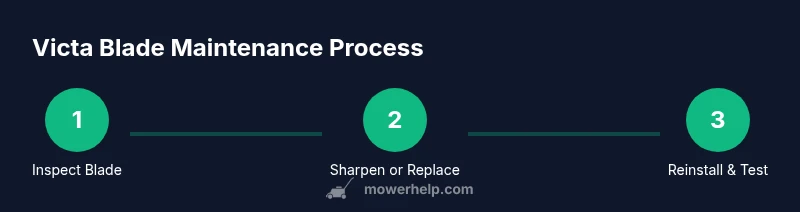
This workflow provides a high-level view of the process. Start by power down; Then remove blade; Inspect; Decide sharpen or replace; Reinstall; Test. Use the tools listed in the next section and follow safety guidance. Keeping to a consistent sequence minimizes risk and ensures clean cuts. Remember to work in a well-ventilated area and secure the mower so it cannot move.
Tools & Materials
- Safety glasses(ANSI-approved protective eyewear)
- Work gloves(Leather durability preferred)
- Socket wrench set or adjustable wrench(Common sizes for blade bolts (check mower manual))
- Torx/Phillips screwdriver(For blade retention screws)
- Replacement Victa blade(s) compatible with your model(Check model number before purchase)
- Metal file or sharpening stone(For sharpening the edge (if sharpening))
- Penetrating oil or lubricant(Helpful if bolts are stiff)
- Towel or rags(Clean up after handling blades)
Steps
Estimated time: 30-60 minutes
- 1
Power down and secure
Ensure the mower is turned off, cooled, and on a stable surface. Remove the spark plug wire if applicable to prevent accidental starts. This step is crucial for your safety before you touch any moving parts.
Tip: Never skip disconnecting the ignition to avoid unexpected starts. - 2
Remove the blade
Loosen the blade bolt with the appropriate tool while keeping the blade flat and supported to avoid dropping it. Do not use brute force; if a bolt is stubborn, apply a little penetrating oil and wait about 5 minutes.
Tip: Hold the blade firmly and avoid contact with the spinning mower deck. - 3
Inspect the blade
Check for cracks, chips, bends, and excessive wear. If you see any structural damage, plan for replacement rather than attempting to salvage it. Note any wear pattern to inform sharpening needs.
Tip: A slightly nicked edge can be sharpened, but cracks mean replacement. - 4
Decide sharpen or replace
If the edge is even and the blade is structurally sound, sharpening is acceptable. If the edge is deeply gouged or the blade is cracked, replace it. Preserve the original bevel angle and avoid removing excessive material.
Tip: When in doubt, replace to maintain safety and cutting quality. - 5
Reinstall the blade
Position the blade with the correct orientation (face the sharp edge toward the mower head). Tighten the mounting bolt firmly, but do not over-tighten. Re-check alignment to ensure it sits flat against the mounting surface.
Tip: Use a torque-friendly approach: snug and then a light additional turn by feel. - 6
Test run and cleanup
Reconnect power or spark plug, and perform a short test run in a clear area. Listen for unusual vibrations and check that the blade isn’t wobbling. Clean up any debris and return tools to their place.
Tip: If you hear a wobble, stop immediately and re-check blade installation.
Got Questions?
How do I know if my Victa blade needs replacement?
If you see cracks, bending, excessive wear, or deep chips that compromise the edge, replacement is the safer option. A balanced blade also helps prevent vibration and engine strain.
Look for cracks or severe wear; if in doubt, replace rather than repair. A balanced blade reduces vibration during mowing.
Can Victa mower blades be sharpened, or should they be replaced?
Sharpening is possible for blades with minor nicks and a solid edge. If the blade is chipped, cracked, or heavily worn, replacement is safer to protect the engine and cut quality.
Sharpen minor nicks if the blade remains solid; replace when damage is significant.
How do I safely remove the blade?
Turn off the mower, disconnect power, and clamp or support the blade. Use the proper tool to loosen the bolt while holding the blade securely to prevent it from slipping or striking you.
Make sure the mower is off and the blade is supported before loosening the bolt.
What blade size does my Victa mower use?
Blade size varies by model. Check your mower's manual or look up the exact OEM blade length and mounting hole pattern for your Victa model before purchasing replacements.
Check the manual or model specs to confirm blade size before buying replacements.
How often should I sharpen blades?
Frequency depends on mowing conditions and blade wear. Inspect blades regularly and sharpen only when the edge is even and free of deep nicks, replacing when in doubt.
Inspect regularly; sharpen when the edge is even and replace if damaged.
Is it safe to test run after replacement?
Yes, perform a brief test in a clear area after reinstalling and torquing the blade. Listen for vibrations and stop if anything sounds off.
Do a quick test run in an open area and stop if you hear unusual noise.
Watch Video
The Essentials
- Assess blade condition before every mow
- Sharpen only if edge is even and blade is intact
- Replace blades with cracks or heavy wear
- Reinstall with correct orientation and torque, then test