Toro lawn mower vs Craftsman: Brand comparison
An objective, in-depth comparison of Toro lawn mowers vs Craftsman, covering build quality, features, price ranges, warranty, maintenance, and value for homeowners.


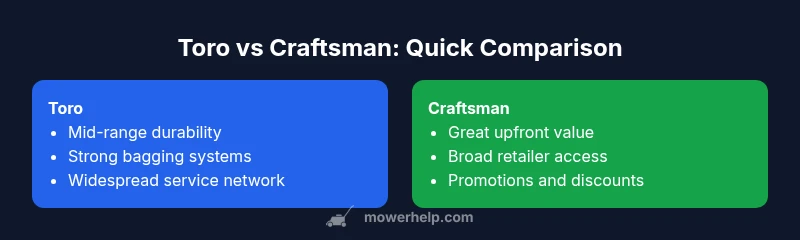
Toro lawn mowers generally excel in build quality, bagging efficiency, and after-sales support in mid-range lines, while Craftsman models often deliver strong upfront value with broader retailer access. Neither brand is universally superior; the best fit depends on yard size, feature needs, budget, and local service options. For many homeowners, a mid-range Craftsman offers value, while Toro shines in durability and refinement.
Key decision factors in the Toro lawn mower vs Craftsman choice
Choosing between Toro lawn mowers and Craftsman mowers is less about brand prestige and more about how well a model matches your yard, maintenance willingness, and budget. For homeowners, the most impactful factors are yard size and terrain, ease of use, and the strength of the local service network. According to Mower Help, when you review the question "toro lawn mower vs craftsman" you should map your needs to model-level options rather than rely on brand stories alone. If your yard is small and flat, you’ll benefit from a lighter, highly maneuverable mower with dependable bagging and mulching options. For larger or uneven terrain, look for models with wider cutting decks, stable drive mechanisms, and straightforward maintenance routines. In practice, start by listing your top priorities: cut quality, maintenance effort, noise and vibration, and the availability of parts and service. Then compare two or three specific models from each brand that fit those criteria. Remember that price isn’t the sole predictor of value; ongoing costs like oil, blades, and filters will drive the total cost of ownership over time.
Brand positioning and product lines
Both Toro and Craftsman offer a spectrum of consumer-grade mowers, but they emphasize slightly different strengths. Toro tends to push for refined cutting performance, quieter operation, and user-friendly handling in its mid-range lines, alongside robust bagging systems and straightforward maintenance routines. Craftsman, by contrast, often emphasizes value, broad in-store availability, and promotional pricing that makes budget-conscious shoppers feel confident about a purchase. This dynamic means a buyer with a tight budget may find Craftsman models that meet essential needs at a lower upfront cost, while a buyer seeking smoother operation and possibly longer service life may prefer Toro. Consider your local store ecosystem; if you rely on frequent sales and easy in-person support, Craftsman’s retail presence can be a decisive factor. If you want a model that feels premium in hand and maintainable over several seasons, Toro models in the mid-range are worthy contenders.
Build quality and reliability expectations
Reliability in both brands hinges on the specific model and its components. In general, Toro’s mid-range mowers emphasize sturdy deck construction, well-tuned cutting geometry, and reliable bagging performance, which contribute to consistent cut quality and less clogging in damp grass. Craftsman’s models, particularly those positioned to offer savings, typically balance deck robustness with cost-effective components. You may encounter more variability model-to-model when shopping Craftsman if you focus primarily on the lowest price tier. Regardless of brand, inspect the mower’s deck structure, handle ergonomics, and wheel quality during pre-purchase testing. Look for solid fasteners, minimal flex in the handle, and a smooth engage-and-disengage experience for the blade. Regular maintenance—blade sharpening, air filter replacement, and oil changes—will influence long-term reliability more than any single feature claim.
Engine, power, and cut quality
Most consumer-grade Toro and Craftsman mowers rely on gas engines sourced from established manufacturers. The key differences you’re likely to notice are throttle response, vibration management, and how the engine tunes translate into consistent cutting performance. In practical terms, the Toro line often prioritizes responsive power delivery for tougher patches and hills, with a focus on a clean cut and even grass elevation. Craftsman models typically deliver reliable performance across a broad range of yard conditions while keeping the running costs approachable. If you frequently cut tall or thick grass, prioritize a mower with solid deck-to-engine synchronization and dependable blade engagement. If you mow in cooler, damp weather, verify that the machine has reliable starting behavior and straightforward maintenance intervals to keep performance steady across seasons.
Features, design differences, and user experience
Feature differences between Toro and Craftsman surfaces in several areas: bagging capacity and mulch compatibility, ease of adjustment, and operator comfort. Toro’s mid-range models often feature well-regarded bagging systems with strong suction and efficient mulching compatibility, plus intuitive levers and height adjustments. Craftsman models tend to prioritize value-added features at a lower price point, including accessible maintenance ports, straightforward bag removal, and a broad selection of handle grip configurations. Consider whether you need mulching capability, side discharge, or specialized mulch kits, and whether the model supports simple wash ports to clean under the deck. The best choice will align with your preferred mowing style, your tolerance for upkeep, and how often you’ll use the mower in varied terrain.
Pricing, warranty, and total cost of ownership
Pricing in consumer mower lines typically varies by deck size, features, and warranty terms. In broad terms, Craftsman models commonly offer strong upfront value in the budget-to-mid-range spectrum, especially during promotions at big-box retailers. Toro counterparts in the same range tend to price slightly higher but often come with perceived benefits in materials, bagging efficiency, and a smoother user experience. Warranty length for most consumer Toro and Craftsman mowers commonly sits in the 2-3 year range, with some higher-tier lines offering longer coverage. When evaluating total cost of ownership, estimate annual maintenance costs (oil, blades, fluids), expected lifespan (years of use before major overhauls), and the frequency of service visits in your area. A model that costs a bit more upfront but yields lower maintenance time and fewer repairs can be the better long-term value.
Maintenance, parts availability, and service networks
Maintenance ease and parts availability are crucial for real-world ownership. Toro’s network often emphasizes dedicated service centers and authorized dealers, which can simplify parts ordering and repairs in many regions. Craftsman benefits from a broad retail footprint, with many parts and service options available at major home-improvement stores and independent shops. Regardless of brand, confirm that replacement blades, spark plugs (where applicable), air filters, and replacement decks are readily available in your region. If you live in a rural area, you may encounter longer wait times for parts from your local retailer. Factor in the potential for longer downtimes if you rely on seasonal mowing windows. Planning ahead—checking part availability before purchase—helps you avoid prolonged downtime during peak mowing season.
How to choose based on yard size and use case
A practical decision framework starts with yard size and terrain. For small, flat lawns with light mowing requirements, a lighter Toro or Craftsman model that prioritizes maneuverability and bagging capacity will suffice. If you have a medium-to-large yard with uneven terrain or tall grass, look for models with larger deck widths, stronger drive coordination, and robust height adjustments. Consider storage space: a compact model that folds down or has a small footprint can ease seasonal storage challenges. Noise sensitivity and neighbors’ proximity also influence choice—Toro models with refined engine tuning can offer quieter operation in some lines. Finally, assess after-sales support in your area. A mower with easy-to-find parts and accessible service will reduce downtime and preserve model value over time.
Quick decision framework and next steps
To close the loop, create a simple decision sheet. List your yard size, typical mowing frequency, and preferred features (bagging, mulching, or side discharge). Rank what matters most (cut quality, maintenance ease, price, service). Shortlist two Toro mid-range models and two Craftsman mid-range models that meet your criteria. Visit local dealers to test handle ergonomics, bagging capacity, and height adjustment feel. Check current promotions and confirm warranty coverage for the exact model you select. By focusing on real-use needs and local service availability, you can choose confidently between a Toro lawn mower vs Craftsman and maximize your mowing efficiency for years to come.
Comparison
| Feature | Toro lawn mower | Craftsman lawn mower |
|---|---|---|
| Engine/Power strategy | Gas-powered engines commonly used; emphasis on smooth operation and reliable starts | Gas-powered with emphasis on value and regionally available parts |
| Deck size range | Wide variety across models (smaller to mid-size decks) | Varied deck sizes, with many budget models in the 42-54 inch range |
| Bagging performance | Strong bagging performance on mid-range Toro models | Competitive bagging; solid performance in mid-range Craftsman models |
| Mower type and drive | Push mowers with select drive options in higher tiers | Push mowers with occasional front-wheel assist or basic drive options |
| Price range (typical) | Mid-range to premium within Toro lines | Budget-friendly to mid-range within Craftsman |
| Warranty length (typical) | 2-3 years on many Toro consumer models; longer on select lines | 2-3 years common; extended options on higher tiers |
Benefits
- Broad model availability across price points
- Strong dealer and parts network for both brands
- Toro mid-range models often emphasize cut quality and bagging efficiency
- Craftsman offers strong upfront value and wide retailer access
Cons
- Model-to-model variation can create buying confusion
- Parts availability can vary by region and retailer
- Maintenance costs vary by model and usage
- Brand-specific features may require a learning curve
Balanced choice depends on yard needs and budget
If you prioritize durability and refined cut quality, Toro mid-range models are compelling. If upfront value and easy access to parts/warranty matter more, Craftsman delivers strong value. Use a yard-size and feature-based checklist plus local service availability to finalize your pick.
Got Questions?
Is Toro generally more reliable than Craftsman?
Reliability depends on the model, but both brands offer solid consumer-grade mowers. Check warranties, review service networks in your area, and inspect the specific model’s build quality before buying.
Reliability varies by model; review warranty and local service options before you decide.
Which brand is cheaper upfront, Toro or Craftsman?
Craftsman models often present a lower upfront price, especially in discount retail channels, though promotions and model specifics can narrow or widen that gap.
Craftsman usually saves you at checkout, but compare exact models to be sure.
Are parts available easily for Toro and Craftsman mowers?
Both brands have broad parts ecosystems, but availability can vary by retailer and region. Check local suppliers for blades, filters, and decks before purchase.
Parts are generally easy to find, but confirm local stock before buying.
What warranty should I expect on these mowers?
Most consumer models carry a 2- to 3-year warranty, with extended options on higher tiers. Read the fine print for exclusions and coverage limits.
Most mowers are covered for two to three years; check what’s included.
What should I consider when choosing for a small yard?
For small yards, prioritize light weight, easy maneuverability, and solid bagging/mulching options. Craftsman often offers excellent value on compact models, while Toro can deliver smoother handling in some mid-range lines.
For small lawns, pick a light, easy-to-maneuver model with good bagging.
Do these brands offer electric or battery-powered options?
Yes, both brands offer electric/battery options in some regions. Availability and runtime vary by market, so confirm local models and charging times.
Yes—electric options exist in some markets; check local availability and run time before buying.
The Essentials
- Map your yard size and terrain before shopping
- Prioritize bagging or mulching features based on grass type
- Check local service networks and parts availability
- Compare price ranges and total ownership costs
- Test ergonomics and comfort in-store before buying