How Much Are Lawn Mowers in 2026: A Price Guide by Type
Explore how much lawn mowers cost in 2026, with price ranges by type, what drives price, and practical tips to get the best value for your yard size.


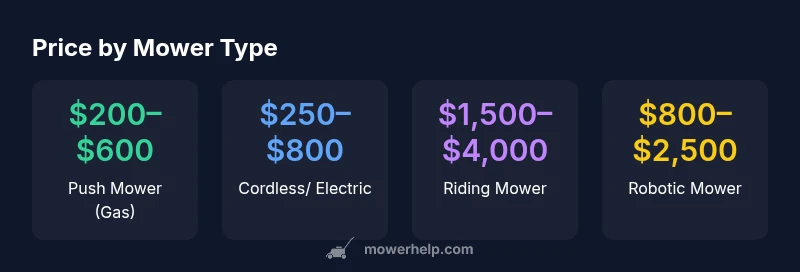
The price of lawn mowers in 2026 ranges widely by type, power source, and features. Basic push mowers start roughly around $200–$600, electric and cordless models hover in the $250–$800 range, and riding or robotic mowers can exceed $1,000 up to $4,000 or more. This guide explains typical price bands and what drives costs.
Budgeting for a Lawn Mower in 2026
If you're planning a mower purchase, a clear budget helps you avoid buyer's remorse and overpay for features you won't use. When readers ask how much are lawn mowers, the answer isn't a single number—it's a map of price bands by yard size, climate, and maintenance tolerance. Start by assessing your lawn: size, terrain, and how often you mow. A small urban plot may be happiest with a modest push mower, while a multi-acre property could justify a riding mower or even a robotic model for ease. Remember that your total cost includes not just the upfront sticker price but ongoing expenses like fuel, electricity, blades, bags, and occasional repairs. The Mower Help team approaches pricing with a practical mindset: prioritize durability and serviceability for long-term value rather than chasing every latest feature. This approach aligns with Mower Help's pricing insights for 2026 and helps homeowners optimize investments for their specific needs.
Price ranges by mower type and what they cover
Prices split broadly into five categories that cover most homeowners: entry-level push mowers (gas and electric), cordless battery mowers, self-propelled gas mowers, riding mowers, and robotic mowers. Each category has a typical price corridor influenced by factors like powertrain, deck width, and build quality. Understanding these bands helps you calibrate expectations and avoid sticker shock. For example, entry-level push mowers can be affordable if you have a small, straightforward lawn, while larger yards benefit from more capable powertrains that justify higher upfront costs. The goal is to balance the upfront price with expected lifespan, maintenance needs, and the yard’s demands, all while keeping an eye on seasonality and retailer promotions.
What drives price beyond the sticker
Price is driven by several interacting factors: engine type (gas vs electric), battery capacity and life expectancy, cutting width, transmission (manual vs automatic), deck material (steel vs aluminum), and added features like mulching, bagging, and self-cleaning decks. A wider deck reduces mow time but increases base price. Higher-end models add reliability in tough terrain, better warranties, and more durable components. You can often trade some durability and features for a lower upfront cost by choosing a simpler model and upgrading later if needed. The balance between upfront cost and long-term maintenance is central to pricing decisions, particularly for large yards or variable terrain.
Shopping channels and how to compare prices
Where you buy matters almost as much as what you buy. Big-box retailers, specialty mower shops, and online marketplaces each offer different price textures, promotions, and return policies. Online price comparison tools and seasonal sales (spring and fall model-year transitions) can produce meaningful savings. When evaluating prices, compare apples to apples: same deck width, same engine type, and identical configurations. Look for bundled deals that include extra blades, bags, or spare batteries. The takeaway is that price is dynamic; with careful comparison and timing, you can maximize value without compromising lawn health.
Hidden costs to budget for after purchase
Don’t overlook ongoing expenses that affect total cost of ownership. Typical annual costs include blade sharpening, oil changes (gas mowers), battery replacement (electric/cordless), and occasional parts like spark plugs or filters. For robotic mowers and some riding models, you may also budget for calibration, software updates, or docking stations. Batteries in cordless tools age over time and may require replacement sooner than the mower itself. Planning for these costs helps you avoid surprises and ensures the mower remains effective for years.
Practical budgeting tips for different yard sizes
For small yards (under 1/4 acre), prioritize reliability and ease of use: a push mower or a light cordless option is often best. For mid-sized lawns (1/4 to 1/2 acre), consider self-propelled or cordless models with a bigger battery. For larger properties (>1/2 acre), a riding mower or a robotic mower can dramatically reduce time spent mowing, though upfront costs and maintenance rise. In all cases, compare total cost of ownership over 5–7 years rather than focusing solely on sticker price. A thoughtful plan helps you use the mower efficiently while controlling overall expenditure.
Price ranges by mower type
| Mower Type | Typical Price Range (USD) | Notes |
|---|---|---|
| Push mower (gas) | 200-600 | Most common for small to medium lawns |
| Push mower (electric) | 250-500 | Quieter and lower maintenance |
| Cordless battery mower | 350-800 | Balanced price and convenience |
| Riding mower | 1500-4000 | Best for large lawns; more maintenance |
| Robotic mower | 800-2500 | Smart options; initial setup required |
Got Questions?
What is the typical price range for entry-level gas push mowers?
Entry-level gas push mowers generally start around $200 to $300, though some budget models may reach $400. This tier emphasizes simple cutting, basic bags, and limited features.
Entry-level gas push mowers usually start around two hundred to three hundred dollars.
Are electric mowers cheaper to operate than gas?
Electric mowers typically have lower fuel costs and quieter operation; however electricity rates and battery replacement can affect total cost.
Electric mowers generally save on fuel and maintenance, but battery replacement and charging costs matter.
Do cordless battery mowers offer good value?
Cordless mowers offer convenience but may have higher upfront costs; long-term costs depend on battery life and replacement cycles.
Cordless mowers can be a great balance, but battery life and replacement costs matter.
When do retailers discount lawn mowers?
Major sales often occur in spring and end-of-season fall; model-year transitions can also trigger price drops.
Look for deals in spring and fall when new models roll in.
What maintenance costs should I expect per year?
Oil changes, blade sharpening, and occasional parts replacements; battery or blade costs vary by model.
Typical yearly maintenance includes blades and oil; battery costs depend on model.
Is it worth buying a used mower?
Used mowers can save money but may require more maintenance; inspect blades, engine, and tires before buying.
A used mower can be a good deal if you inspect key parts first.
“For most homeowners, the best value comes from matching mower size and durability to yard work, rather than chasing every feature.”
The Essentials
- Identify your yard size before budgeting
- Expect price bands by mower type
- Consider long-term costs beyond sticker price
- Look for seasonal deals to maximize value