Weed Eater vs Lawn Mower: The Clear Buying Guide
A data-driven comparison of weed eaters and lawn mowers for homeowners and DIY enthusiasts. Explore performance, maintenance, cost, and ideal yard scenarios to decide which tool fits your property and workload.


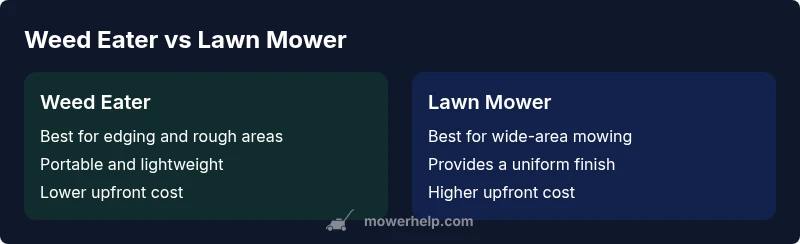
For most homeowners, a weed eater handles edging, rough patches, and tough weeds, while a lawn mower covers wide, flat areas with a clean, uniform cut. The right choice depends on yard size, terrain, and maintenance willingness. If your property combines edging tasks with mowing, a dual setup or a versatile tool is ideal.
Overview: Weed Eater vs Lawn Mower
According to Mower Help, weed eaters and lawn mowers are complementary tools designed for different tasks in lawn care. A weed eater (string trimmer) excels at edging, trimming around obstacles, and tackling tall weeds in irregular spaces. A lawn mower, by contrast, provides faster coverage for open areas and produces a uniform cut across larger swaths of turf. Understanding these roles helps homeowners optimize a pruning-and-mowing workflow and decide whether to buy one device, two separate tools, or a versatile multi-function model. The term weed eater lawn mower sometimes appears in marketing, but dedicated devices generally perform better for specific tasks. For most properties, a thoughtful combination—rather than a single tool—delivers the best overall results.
As you read, consider how your yard size, shape, and maintenance tolerance influence whether a weed eater, a lawn mower, or a hybrid approach is right for you.
Key Differences that Matter
- Power source and cutting action: A weed eater uses a rotating line to trim along edges and through tall weeds, offering flexibility in tight spaces. A lawn mower uses a blade to produce an even, uniform cut across open turf. The difference in cutting method affects finish quality and speed for different sections of your lawn.
- Terrain and layout: Weed eaters excel around obstacles, along fences, and on slopes or irregular terrain. Lawns with long, flat stretches benefit from a mower’s broad swath and consistency. For properties with a mix of features—slopes, beds, and wide-open areas—a hybrid approach is often optimal.
- Noise, emissions, and maintenance: Gas models tend to be louder and require more routine maintenance; electric variants reduce emissions and generally lower ongoing upkeep. Environmental considerations and neighbor noise preferences may push you toward electric options if feasible.
- Storage and handling: Weed eaters are lighter and more portable, making them easy to pull out for quick edging tasks. Lawnmowers are bulkier and require more storage space, but they simplify weekly mowing routines.
- Cost and lifecycle: Basic weed eaters usually have a lower upfront cost, while lawn mowers—especially larger or riding models—command higher initial investment and longer-term maintenance costs. Over time, the total cost of ownership reflects usage patterns, maintenance needs, and fuel or battery strategies.
If you are weighing the combined value of both tools, remember that a dedicated weed eater and a traditional lawn mower typically outperform any single-mission tool in mixed yards.
Performance and Use-Case Scenarios
Consider three representative yard profiles to understand when each tool excels. A small urban lot with ornamental edging, a few landscaped beds, and narrow walkways is the classic scenario where a weed eater shines, trimming along edges and tackling stray weeds in hard-to-reach areas. A larger suburban yard with expansive, flat turf benefits from a mower’s speed and uniform finish. For properties that blend these conditions—say, a mid-sized lawn with flower beds and steep slopes—a practical strategy is a dedicated weed eater for edging and detail work, paired with a mower for the main mowing sessions. Some homeowners also explore multi-function tools or stand-on models that attempt to blend capabilities, but the trade-off in compromise can be noticeable in performance for either task.
From a maintenance perspective, match your choice to your preferred workflow. If you want quick edge work with minimal setup, a weed eater may reduce the number of trips to the shed. If your goal is a rapid, even lawn, a mower will deliver the cleanest finish most consistently. The decision is rarely binary; planning around your yard layout, seasonal needs, and storage constraints yields the best overall result.
When you encounter tall, persistent weeds or uneven turf, remember that a weed eater and a mower handle different tasks best. The weed eater tackles the tough, overgrown patches along borders; the mower handles broad, even cuts across open spaces. The combination is often the most efficient setup for a typical residential property.
For homeowners exploring a hybrid option, consider starting with a mid-range electric weed eater for edging and a compact gas or electric mower for mowing. This pairing balances upfront cost, maintenance, and usability across a range of yard conditions.
Cost of Ownership and Maintenance
Ownership costs extend beyond the initial purchase price. A basic weed eater typically has a lower upfront cost and simpler parts inventory, but ongoing maintenance involves replacing line, occasionally servicing the trimmer head, and refueling or recharging. Gas models require fuel, air filters, and spark plug checks, while electric versions reduce fuel costs and some maintenance items but demand battery care and occasional charging cycles. A lawn mower, especially a larger model, generally carries a higher upfront price and more parts that may require service over time: blades, belts, spark plugs (gas engines), oil changes, and air filters. Battery-powered riding mowers add battery replacement costs to consider. Across both tool types, the total cost of ownership depends on usage frequency, terrain, and how often you need to sharpen blades or replace parts.
To minimize expenses, implement a simple maintenance routine: inspect and replace lines or blades as needed, clean air intakes, and store equipment properly to extend life. For electric versions, follow battery care guidelines to maximize cycle life, and for gas engines, schedule regular professional tune-ups to prevent minor problems from becoming major failures. Budgeting for occasional blade sharpening and line replacement keeps performance consistent without surprises.
In community settings, many homeowners find that budgeting for a new string trimmer every 3–5 years and a mower every 7–12 years aligns with typical wear patterns, but your local climate and yard conditions will shift that range. Mower Help Analysis, 2026, emphasizes planning around maintenance cycles to avoid sudden downtime and keep your equipment ready when seasons peak.
Safety and Best Practices
Operator safety is essential for both weed eaters and lawn mowers. Always wear eye protection, hearing protection if using gas models, sturdy gloves, and appropriate footwear. Secure long hair and loose clothing to prevent entanglement, and inspect the work area for rocks, debris, and hidden obstacles before starting. For weed eaters, keep a steady pace to prevent line wear and adjust the trimmer head height to avoid scattering debris into beds or spray zones. For mowers, check blade sharpness and secure blades properly; inspect the mowing deck for damage and ensure belts, pulleys, and safety switches function correctly. When working on slopes, move slowly, maintain balance, and never attempt to trim from unstable positions. Following maintenance schedules and manufacturer guidelines reduces the risk of injury and equipment failure over time.
Environmental considerations matter too. Gas motors emit exhaust and contribute to noise levels, so plan mowing times and consider quieter electric options when possible. Dispose of old batteries and fuel responsibly, following local regulations and manufacturer recommendations. Your safety decision should always align with yard conditions and your comfort level with manual tasks.
For families with shared spaces, communicate maintenance plans and safety expectations, so neighbors understand when equipment might be in use and what areas may be affected by noise. Consistent safety practices build confidence and reduce the likelihood of accidents over the long term.
How to Choose: Quick Criteria and a Decision Framework
Start with a simple decision framework to determine whether you need one tool, two tools, or a hybrid approach. Step 1: Map your yard into zones—edges and beds, slopes or irregular terrain, and large flat areas. Step 2: Prioritize tasks—edging, weed control, or mowing speed and finish. Step 3: Evaluate storage and handling constraints—can you accommodate a larger mower, or do you need something compact? Step 4: Consider maintenance tolerance—are you willing to perform regular head and line maintenance or prefer fewer parts to service? Step 5: Decide on a power preference—gas models offer raw power and runtime, while electric options reduce noise and maintenance. Step 6: If you want a single all-purpose device, research multi-function models with interchangeable heads; however, assess whether performance for each task meets your standards. Finally, create a practical plan that suits your yard. The goal is to minimize trips to the shed, maximize mowing speed, and ensure a clean finish on open areas and neat edges around beds and fences.
In markets where a single device is marketed as a weed eater lawn mower, approach claims with caution. Often, dedicated devices outperform marketed hybrids in specific tasks, but a well-chosen two-tool setup or a modern, versatile model can deliver strong overall results for most residential properties. The key is to align your purchase with your yard’s unique layout and your willingness to perform routine maintenance.
A practical checklist: 1) yard size and terrain, 2) proportion of edging vs mowing tasks, 3) storage space, 4) tolerance for maintenance, 5) budget and long-term cost expectations. This framework helps you compare options more clearly and avoid overpaying for features you won’t use. By focusing on real needs rather than marketing claims, you can select the best weed eater lawn mower configuration for your home.
Authority sources
This section aggregates credible sources to support the buying guidance below.
- EPA. https://www.epa.gov
- Cooperative Extension, Oregon State University. https://extension.oregonstate.edu
- Consumer Product Safety Commission. https://www.cpsc.gov
Comparison
| Feature | Weed Eater | Lawn Mower |
|---|---|---|
| Power source | Gasoline or battery-powered options | Gasoline, corded electric, or battery-powered options |
| Cutting action | Rotating line for edging and tall weeds | Rotating blade for uniform turf cuts |
| Best terrain | Edges, slopes, obstacles | Open, flat lawns with even surfaces |
| Maintenance needs | Line replacement and head maintenance | Blade sharpening and routine engine maintenance |
| Cost range | Lower upfront for basic models | Higher upfront with larger cutting width and power |
| Best for | Edging tasks and detail work | Large-area mowing and quick results |
Benefits
- Better for edging, corners, and irregular terrain
- Lower upfront cost for basic weed eaters
- Compact and lightweight for storage
- Electric options reduce emissions and maintenance
Cons
- Limited mowing capability on large lawns
- Frequent line replacements or blade sharpening required
- Gas models require fuel, maintenance, and can be louder
Hybrid approach often wins for mixed yards; use a dedicated weed eater for edges and a mower for open areas
For most homes with a mix of edging and mowing needs, pairing a weed eater with a lawn mower provides the best balance of performance, cost, and convenience. If you must choose one tool, prioritize your primary task: edge work points to a weed eater, while large, flat lawns point to a mower.
Got Questions?
What is the main difference between a weed eater and a lawn mower?
A weed eater uses a rotating line to trim edges and tall weeds, ideal for irregular spaces. A lawn mower uses a blade to cut a broad, even swath, delivering speed and a uniform finish on flat lawns.
Weed eaters trim edges and rough spots, while mowers handle the big, even cuts.
Can I replace a lawn mower with a weed eater?
Not fully. A weed eater excels at edges and irregular areas, but it can’t consistently replace a mower for large, flat lawns that require a uniform cut. For most yards, a combination works best.
A weed eater can’t perfectly replace a lawn mower for big, open spaces.
Are electric weed eaters as powerful as gas models?
Power varies by model. Gas models generally provide more torque and runtime, while electric models offer lower maintenance, quieter operation, and adequate performance for many tasks.
Gas usually has more power; electric is quieter and easier to maintain.
What maintenance does a weed eater require?
Regularly replace the trimming line, inspect the head, and service the engine if needed (fuel, air filter, spark plug for gas models). Proper storage and periodic checks extend tool life.
Keep the line fresh and the head clean for best performance.
Which tool is cheaper upfront, weed eater or lawn mower?
Typically, basic weed eaters cost less upfront than most lawn mowers. However, total ownership costs depend on usage, maintenance needs, and model choice over time.
Weed eaters usually cost less to start, but long-term costs vary.
The Essentials
- Assess yard size and terrain first
- Edge work benefits most from a weed eater
- Open, flat lawns benefit from mowing speed and finish
- Consider a two-tool setup for mixed yards or a versatile model for simpler maintenance