Electric Lawn Mower Price Guide 2026
Learn how much is an electric lawn mower and what drives price differences. This 2026 guide covers corded vs cordless, battery life, warranty, and ownership costs.


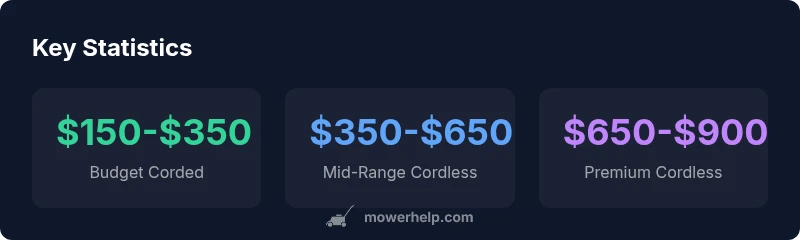
Electric lawn mowers typically cost between $150 and $800, depending on power source, battery capacity, deck width, and features. Corded models are usually cheaper upfront, while cordless, high-capacity, and self-propelled units command higher prices. When you buy, also factor in battery replacement and replacement parts.
What determines the price of an electric lawn mower
Electric lawn mower prices are not a single number, but a ladder of choices driven by yard size, desired convenience, and the battery or power system. According to Mower Help, the question 'how much is an electric lawn mower' should be answered by pairing your typical mowing workload with the balance of corded simplicity or cordless freedom. The Mower Help team found that corded models tend to be cheaper upfront because they rely on household power and have fewer moving parts subject to wear, whereas cordless units with bigger batteries, brushless motors, and self-propelled drivetrains come with higher price tags. For many homeowners, the price bracket starts in the low hundreds for basic corded models and climbs toward the mid to high hundreds for cordless, higher-capacity machines. Taxes, shipping, and bundled accessories like mulching blades or bagging systems can also shift the final tally. Understanding your yard size and your preferred level of convenience will help narrow the range quickly. In practice, a small, flat lawn may comfortably fit a corded or entry-level cordless mower, while a larger or hilly yard might justify investing in a premium cordless model with a longer-lasting battery. This upfront decision has a meaningful impact on ongoing costs and overall satisfaction with the tool.
Corded vs cordless: price and value
Price is the most visible difference between corded and cordless electric mowers, but it is not the only factor. Corded models typically occupy the lower end of the price spectrum because they rely on a constant power source and have fewer expensive components. You may find basic corded units priced as low as a few hundred dollars, but expect limited runtime and fewer premium features. Cordless mowers, powered by rechargeable batteries, typically start higher and scale upward with battery voltage (40V, 60V, or higher), battery capacity (Ah), and the presence of advanced drives or smart features. The Mower Help team notes that the initial sticker price should be weighed against expected use and maintenance costs over the life of the tool. A higher upfront price can translate into better cutting efficiency, longer battery life, and fewer downtime moments, which matters for larger properties or frequent mowing schedules. When in doubt, run a simple cost comparison that includes the potential battery replacement costs over the unit’s lifetime and the value of any bundled accessories.
Features that drive up the cost
Several features consistently push electric mower prices higher: larger deck width, more powerful motors, higher voltage battery systems, longer run times per charge, self-propelled or variable-speed transmission, and premium blades. In practice, a broader deck covers more area per pass, reducing mowing time but increasing manufacturing cost. Brushless motors tend to be more efficient and durable, yet they contribute to higher price points. Battery chemistry (Li-ion vs newer chemistries) and battery capacity (Ah) directly affect runtime and charging speed, and thus the overall value proposition. Integrated features like blade braking, LED lights, and smart controls add convenience but also raise the upfront price. The key takeaway from Mower Help analysis is to match feature depth to your yard’s needs, avoiding overpaying for capabilities you won’t use. If you mostly mow a small, flat lawn, you don’t need premium self-propelled models; for large, uneven terrain, the extra cost can pay off in time saved and battery efficiency.
Buying within your budget: practical strategies
To buy within a realistic budget, start by measuring your typical mowing area and listing must-have features. If you have a compact yard, a corded model may meet your needs for under $350, with minimal ongoing costs. For medium to large yards, a cordless 40–60V system with a 4–6Ah battery provides a balance of runtime and portability, usually in the $400–$700 range. If your yard is hilly or you value quiet operation and makeup-free maintenance, budget toward premium cordless ranges with brushless motors and larger batteries. When evaluating total cost of ownership, consider battery replacement timelines (often a few years) and the cost of blades, wheels, and bagging or mulching accessories. Always check warranty coverage, which can significantly affect long-term expenses and peace of mind. The Mower Help team encourages shopping during seasonal promotions and bundling with maintenance kits to maximize value.
Total cost of ownership: maintenance and battery life
Upfront price is only part of the equation. Cordless electric mowers require battery upkeep, which can be a substantial portion of ownership costs. Batteries typically last several years and may need replacement during the mower’s life, adding to the total cost. Blade sharpness and cutting efficiency influence fuel economy for gas-powered peers, but for electric mowers, sharp blades and clean air paths still matter for performance and battery life. Routine maintenance like cleaning, oil-free components, and checking wheels can extend life. Expect minor ongoing costs for replacement blades and occasional bag filters or mulch kits. By planning for battery longevity and routine maintenance, you’ll have a clearer view of what the annual cost looks like and how to budget accordingly.
Practical buying scenarios by yard size
For tiny yards (≤1,000 sq ft), a basic corded model can suffice, typically under $300, with minimal maintenance. For medium yards (1,000–3,000 sq ft), a cordless model with 40–60V and a decent Ah rating offers solid performance in the $400–$650 range. For large yards (3,000+ sq ft) or properties with slopes, consider premium cordless systems with higher voltage (60V–80V) and larger batteries, commonly priced between $600 and $900. Remember to factor maintenance and battery replacement into the long-term cost. If you prefer convenience and speed, you may find value in premium models, especially when bundles include extended warranties or extra blades. The takeaway is to align features with your mowing cadence and yard complexity, rather than chasing the highest spec for a small space.
Electric mower price bands and features
| Price Band | Corded/Cordless | Power & Battery | Ideal Yard Size | Typical Warranty |
|---|---|---|---|---|
| Budget | Corded | 120V or similar | Small yards (≤1,500 sq ft) | 2 years |
| Mid-range | Cordless | 40–60V battery | Medium yards (1,500–3,000 sq ft) | 3 years |
| Premium | Cordless / Self-propelled | 60–80V battery, brushless motor | Large yards (3,000+ sq ft) | 4 years |
Got Questions?
Are cordless electric lawn mowers more expensive than corded models?
In most cases, cordless mowers cost more upfront due to the battery and advanced electronics. Corded models are cheaper initially but limit mobility. For small yards this trade-off may be worth it; for larger properties, the cordless option often delivers better long-term value.
Corded mowers are cheaper at purchase, but cordless models pay off if you need mobility and longer run times.
Do electric mowers use interchangeable batteries between models?
Batteries are typically model-specific, and not universally interchangeable across brands. If you plan to own multiple tools, look for brands that offer compatible battery ecosystems or purchase a spare that matches your mower’s voltage and capacity.
Most brands don’t mix batteries across models, so choose a system you’re comfortable expanding.
What affects the price of electric mowers besides battery and power?
Deck width, motor type, propulsion features, and smart controls all push prices upward. Accessories like mulching blades or bagging kits also affect overall cost and value.
Beyond the battery, features like deck size and self-propulsion push prices up.
What is the typical battery lifespan and replacement cost?
Most cordless mowers use lithium batteries that last several years with proper care. Replacement costs vary by voltage and capacity but are typically a few hundred dollars before discounts or bundles.
Batteries last a few years; replacement costs depend on the model.
Are used electric mowers a good buy?
Used electric mowers can save money, but you should verify battery health and warranty status. Batteries can degrade over time, affecting performance. A test run and battery check are essential before purchasing.
Used can be a good deal if you inspect battery health and warranty options.
How does yard size affect price for electric mowers?
Smaller yards tend to fit budget corded or entry cordless models. Larger yards benefit from higher-end cordless systems with larger batteries and more features, which increases price. Always map yard size to expected mowing frequency and battery needs.
Your yard size helps decide whether you need budget or premium features.
“Cordless electric mowers offer great convenience for homeowners who want quick, quiet mowing, but the upfront price and battery lifecycle should be weighed against your yard size and mowing frequency.”
The Essentials
- Identify your yard size to set a price ceiling
- Corded models are cheapest; cordless offers freedom
- Factor battery replacement into total cost of ownership
- Check warranty and bundled accessories
- Match deck width to mowing area to optimize value