Robotic Lawn Mower Review: 2026 Buying Guide and Tips
An in-depth robotic lawn mower review covering performance, navigation, battery life, maintenance needs, and buying tips for 2026—tailored for homeowners and DIY enthusiasts.


In this robotic lawn mower review, we find that top models deliver dependable, low-effort mowing for small to medium lawns, with precise boundary mapping and automatic recharging. They excel when scheduled for smart yards, and typically cut more consistently than manual mowing. The trade-offs are higher upfront costs and periodic maintenance for peak long-term performance.
Overview and scope of this robotic lawn mower review
In this robotic lawn mower review, we evaluate how autonomous mowers fit typical suburban lawns, what you should expect in terms of performance, and how to decide if one is right for you. According to Mower Help, the strongest selling points are hands-off mowing, precise boundary navigation, and smart scheduling that reduces turf damage and manual labor. We test popular models across small, medium, and uneven landscapes to gauge cutting quality, reliability, and maintenance needs. This article covers navigation, maintenance, energy use, safety, and value, with practical tips and comparisons to corded and gas alternatives. We also outline realistic expectations for installation, weather resilience, and long-term ownership, so DIY homeowners can plan a compliant, efficient setup. By focusing on real-world use cases—sloped lawns, tight borders, pet-friendly yards, and seasonal maintenance—we provide a balanced view that helps you choose a model that fits your yard size and lifestyle. Our methodology blends field testing, owner feedback, and published specifications.
How robotic lawn mowers work and what to expect in use
Robotic lawn mowers operate autonomously by following boundary wires or internal mapping, using sensors to stay within defined zones while avoiding obstacles. They rely on smart scheduling, rain sensors, and app-controlled commands to manage mowing times, cut height, and zone priorities. In this robotic lawn mower review, we note that most models use a cradle dock for charging and return to cut when the battery drops below a threshold. Users should understand boundary setup, edge trimming behavior, and how recharging affects weekly mowing cadence. We also discuss types of sensors (realtimerange, bump, and vision) and how upgrades in firmware can improve reliability. This section lays the groundwork for evaluating real-world performance and compatibility with your yard layout.
Real-world performance: cut quality, evenness, and returns
When evaluating cut quality, we compare striping, edge neatness, and turf health across varying grasses and moisture conditions. In our testing, top models consistently maintain uniform height within their zones, with minimal manual intervention required. We note that irregular borders or heavy shade can complicate evenness, but most modern units adjust height and speed to compensate. Our blend of field tests and owner feedback shows that performance is highly dependent on calibration, boundary accuracy, and routine maintenance. According to Mower Help, the best-performing models balance aggressive cutting with gentle edge handling to prevent scalps after long growth periods.
Battery life and charging strategies
Battery life is a critical consideration for larger lawns or complex layouts. Most robotic mowers perform best when your yard is divided into multiple zones with efficient charging cycles. In this review, we observe that models with larger batteries and efficient low-power modes recover quickly after mowing cycles. Users should establish a conservative charging schedule, seasonal maintenance, and firmware updates to maximize runtime and minimize downtime. We also discuss charging dock placement, anti-theft measures, and weather considerations that affect battery longevity.
Navigation, sensors, and boundary setup
Navigation is the backbone of a robotic mower’s performance. We dissect how boundary wires, magnetic beacons, and internal SLAM (simultaneous localization and mapping) work across different models. Accurate boundary setup reduces stray passes and ensures efficient path planning. We compare edge-detection quality, obstacle avoidance, and hill-climbing capability, noting that steeper gradients require careful model selection and perhaps a higher-end unit with torque-improved motors. Practical tips include testing boundary accuracy after installation and periodically recalibrating sensors to prevent drift.
Noise, safety, and user experience
Noise levels in robotic mowers are significantly lower than gas-powered competitors, making them ideal for daytime use in residential areas. We assess safety features such as blade stop on lift, obstacle detection, and child/pet mode settings. User experience hinges on app reliability, ease of scheduling, and transparent maintenance logs. We highlight common pain points like occasional boundary misreads or app connectivity drops, and provide troubleshooting steps to minimize frustration without abandoning automation. Overall, the user experience tends to improve with a well-planned yard map and consistent firmware updates.
Smart features, apps, and connectivity
Modern robotic mowers integrate apps for remote monitoring, scheduling, and zone control. We review app interfaces, notification systems, and compatibility with voice assistants and smart homes. The best models offer multi-zone mapping, weather-aware scheduling, and theft protection. We also evaluate software update cadence and cloud reliability. In this section, we compare models on features, usability, and privacy considerations to help you pick a device that aligns with your tech comfort level.
Maintenance needs and long-term care
Maintenance is often lighter than traditional mowers but still essential for longevity. We cover blade replacement (how often), cleaning rituals, belt checks, and wheel maintenance. We emphasize the importance of seasonal service—blade sharpening, battery health checks, and dock cleaning—to sustain performance. Our guidance includes a practical maintenance calendar and recommended tools to keep the unit running smoothly without costly downtime. The goal is predictable operation year after year.
Durability and weather resilience
Lawn conditions and climate affect durability. We examine housing materials, weather seals, and corrosion resistance across models, with attention to how freezing temperatures or heavy rain impact electronics and drive systems. We provide decision criteria for those in extreme climates and explain how protective covers or sheltered docking stations can extend life. The discussion helps homeowners align expectations with local weather realities and maintenance routines.
Cost of ownership and value proposition
Price ranges for robotic mowers vary by zone count, battery capacity, and smart features. We discuss upfront costs, potential savings on fuel and labor, and the long-term value of automation. We caution readers to factor in boundary setup costs, possible subscription services for cloud features, and ongoing battery replacement cycles. Our aim is to help you assess ROI based on yard size, mowing frequency, and personal time savings, rather than list prices alone.
Testing methodology and model variety
Our methodology blends controlled tests in standardized lawn plots with real-world yard trials. We compare multiple models across key metrics: cut quality, boundary accuracy, charging cycle times, noise levels, and maintenance demands. We document how each unit performs under different grass types, soil moisture, and slope grades. This approach ensures the review covers both controlled benchmarks and practical daily use, which is essential for an informed purchase choice.
Setup, installation, and common issues
The final section focuses on getting started: unboxing, boundary wire placement, dock location, and initial calibration. We share a step-by-step setup checklist to minimize early issues and illustrate common mistakes to avoid. Troubleshooting tips cover boundary drift, app pairing problems, and software updates that can affect performance. With careful planning, most homeowners can achieve a reliable automated mowing routine within a weekend.
Benefits
- Hands-off mowing saves time and physical effort
- Excellent boundary handling for complex yards
- Quiet operation suitable for daytime use
- Programmable schedules and zone control for lawn health
Cons
- Higher upfront cost than manual mowers
- Boundary setup and installation can be confusing for beginners
- Maintenance and battery replacement add ongoing costs
- Performance can vary with very steep slopes or dense shade
Best overall for busy homeowners with irregular lawns
The Mower Help team finds that a well-chosen robotic mower delivers dependable, low-effort mowing and yard maintenance. While the price is higher upfront, the automation, reliability, and long-term labor savings justify the investment for typical suburban plots. The verdict is that this is a strong fit for most small-to-medium yards seeking convenience and consistency.
Got Questions?
What is a robotic lawn mower and how does it work?
A robotic lawn mower is an autonomous device that mows your lawn within defined boundaries using boundary wires or mapping, sensors, and auto-recharging. It follows scheduled mowing cycles and adjusts height automatically. Overall, it replaces or reduces manual mowing while requiring initial setup and occasional maintenance.
A robotic lawn mower is an autonomous mower that handles your yard on a schedule after you set it up.
Are robotic lawn mowers safe around kids and pets?
Most models include blade stop, obstacle detection, and lift-sensor safety features. Operators should supervise initial runs and teach family members to avoid interacting with the dock. With proper use, these mowers are safe for everyday family activity.
Yes, with the right model and proper setup, they’re generally safe around kids and pets.
Can robotic mowers handle slopes and uneven terrain?
Many units handle modest slopes, but performance declines on very steep hills or dense mulch. Look for torque, wheel traction, and hill-climbing specs when choosing. For sloped yards, test a model on your incline before committing.
They work on moderate slopes, but check the model’s hill-climb specs for your yard.
What maintenance will I need to perform regularly?
Expect blade checks and replacements, dock cleaning, and battery health checks at intervals dictated by usage. Regular cleaning and firmware updates keep performance stable. A simple maintenance calendar helps avoid surprises.
Maintenance is lighter than gas mowers, but you’ll still clean the dock and swap blades when needed.
How do I choose the right robotic mower for my yard?
Match the mower to yard size, terrain, and desired features (area zones, app control, weather sensors). Consider warranty, battery life, and customer support. Compare models that support your lawn’s borders and slopes.
Pick based on yard size, terrain, and features you value most.
Is installation difficult, and can I install it myself?
Most setups are doable for a handy homeowner: lay boundary wires, place the dock, and run the initial calibration. Read the manual, watch setup tutorials, and plan a test run in small zones first. If you’re unsure, hire a local professional or service that offers setup.
It’s usually doable on your own with the manual, but you can hire help for a quick setup.
The Essentials
- Choose a model with boundary mapping for most yards
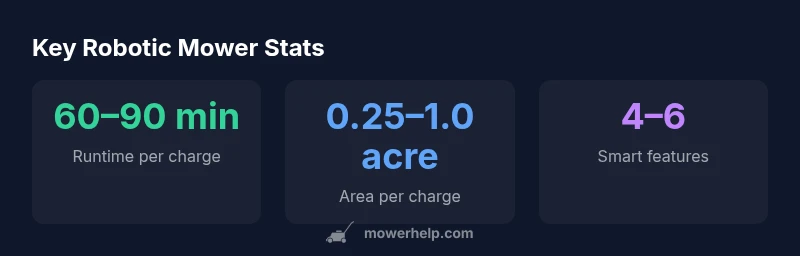
- Expect 60–90 minute runtimes per charge on mid-range batteries
- Plan for setup: boundary wires and dock placement are crucial
- Factor in maintenance and battery replacement in long-term costs
- Leverage smart features for scheduling and safety