Price Robotic Lawn Mower: Costs, Tiers, and Buying Tips
A comprehensive guide on price robotic lawn mower costs in 2026, exploring price ranges, total ownership costs, and practical buying tips from Mower Help for homeowners.


Price robotic lawn mower prices vary widely but generally fall between five hundred and twenty-five hundred dollars, depending on yard size, cutting width, battery life, and smart features. Entry models tackle small lawns with basic guidance, while premium units offer GPS-assisted mowing, app controls, and obstacle sensing. For larger yards, expect higher price brackets and longer warranties, per Mower Help analysis, 2026.
Understanding the price landscape for price robotic lawn mower
This section explains how price robotic lawn mowers are shaped by yard size, feature sets, and reliability. According to Mower Help, the sticker price often reflects the complexity of navigation (random vs GPS mapping), the breadth of sensors, and how robust the unit is against weather and terrain. Homeowners should also consider long-term savings: more capable models may reduce maintenance time, fuel or electricity use, and blade replacements. In 2026, the market continues to expand with models designed for small city lots and larger suburban yards alike. By weighing immediate sticker price against long-term value, you can avoid overpaying for features you won’t use while still ensuring reliable mowing performance.
Price ranges by feature tier
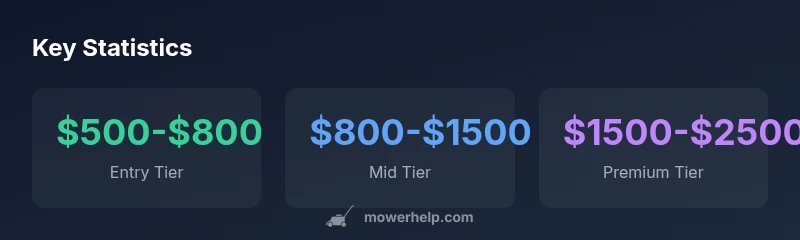
- Entry-level models: Basic obstacle sensing, manual app compatibility, suitable for yards under 0.25 acres. Typical price: $500-$800.
- Mid-range models: Improved navigation, smart scheduling, better battery life, multi-zone mowing. Typical price: $800-$1500.
- Premium models: GPS mapping, advanced sensing, hybrid charging, multi-zone planning, premium warranties. Typical price: $1500-$2500.
- Large, complex landscapes: Some high-end options incorporate lidar, cloud-based mapping, and extensive warranty coverage; price can exceed $2500.
When evaluating price, compare the feature slate directly. A higher upfront cost can be justified if the model saves you time and reduces maintenance across multiple mowing seasons.
How features affect sticker price
Navigation technology is one of the strongest price levers. GPS-based models tend to cost more but offer precise coverage for irregular lawns and multi-zone layouts. Battery chemistry and capacity influence run time and recharge speed, which can push prices higher by 5-20% for models with longer life. Cutting width determines how quickly a mower can cover space; wider decks mean more powerful motors and greater cost. App integration, smart home compatibility, and warranty length also add up. If you’re balancing price against risk, prioritize reliable sensors, dependable boundary control, and consistent mowing performance over flashy, rarely used features.
Total cost of ownership beyond the sticker price
Don’t focus solely on the upfront price. Warranty length, service availability, and blade replacement costs add up. Battery replacement can be a significant future expense, depending on usage and charging cycles. Consider the model’s electricity usage—robo-mowers use electricity, not fuel, but idle time or charging inefficiencies can affect annual costs. Seasonal sales can trim the upfront price, while extended warranties provide peace of mind for pricey units. A simple rule of thumb is to estimate five-year ownership costs by adding expected maintenance, battery replacements, and energy usage to the sticker price. This helps you compare long-term value more accurately.
Yard size, terrain, and installation considerations
Smaller lawns (under 0.25 acres) often fit entry to mid-range models. Larger yards (0.25-0.5+ acres) typically require mid-range to premium models with longer battery life and better mapping. Sloped or irregular terrain benefits from models with stronger motors and more advanced sensors. Boundary wire installation is usually straightforward for DIYers, while more complex landscapes may need professional setup. If you have trees, rocks, or frequent shade, prioritize models with obstacle‑avoidance and robust edge trimming. The right choice minimizes maintenance and reduces the need for manual touch-ups.
Brand landscape and value comparisons
The market presents a spectrum from economy-focused brands to premium manufacturers offering advanced mapping and cloud connectivity. While price alone doesn’t determine value, models with GPS mapping, multi-zone coverage, and strong customer support tend to offer better long-term savings through reduced maintenance and more consistent results. Compare at least three models in your price tier, focusing on battery life, reliability, and warranty. In our assessment, you’ll often find the sweet spot where mid-range models deliver near-premium performance without the highest sticker shock. The Mower Help team notes that value is realized when the model’s features align with your yard’s specifics.
Financing, warranties, and seasonal deals
Look for seasonal promotions around spring and end-of-season sales during late fall. Financing options can make higher-priced units more accessible, but watch for interest rates and terms. A longer warranty (3-5 years) can offset higher upfront costs by reducing maintenance risk. Some manufacturers offer bundled service plans that cover blade replacements and routine calibration. Before buying, review the warranty terms for coverage of battery life, motor components, and boundary wire. A well-chosen warranty can prevent unexpected repair costs and improve total ownership value.
Buying checklist and quick decisions
- Define yard size, terrain, and mowing frequency.
- List must-have features: GPS, multi-zone mapping, edge handling, app control.
- Set a realistic budget that includes installation and maintenance.
- Compare at least three models across entry, mid-range, and premium tiers.
- Verify warranty terms and service availability in your region.
- Check for seasonal promotions and bundled services.
- Read independent reviews focused on reliability and customer support.
Authority sources
- Authority sources: Where to find price details and buying guidance from major publications (for reference and comparison):
- Consumer Reports: Robotic lawn mower buying guide (URL placeholder for credibility)
- Popular Mechanics: Best robotic lawn mowers (URL placeholder for credibility)
- CNET: Best robotic lawn mower (URL placeholder for credibility)
Price bands by feature tier and yard need
| Price Range | Typical Features | Suitable Yard Size |
|---|---|---|
| $500-$800 | Entry-level navigation, basic sensors | Small yards up to 0.25 acres |
| $800-$1500 | Mid-range navigation, app control | Medium yards 0.25-0.5 acres |
| $1500-$2500 | GPS mapping, advanced sensors, premium app | Large yards >0.5 acres |
| $2500+ | High-end lidar, cloud mapping, multi-zone | Complex landscapes or estates |
| Maintenance/yr | Blade replacement, battery care | Varies by usage |
Got Questions?
What is the typical price range for a robotic lawn mower?
Most models range from about $500 to $2,500, depending on yard size, cutting width, battery life, and smart features. Entry models suit small lawns, while premium units feature GPS mapping and advanced sensors. Always compare features to price to ensure long-term value.
Most robotic lawn mowers cost between five hundred and twenty-five hundred dollars, with higher prices tied to bigger yards and smarter features.
Are there ongoing costs beyond the purchase price?
Yes. Expect maintenance like blade replacements, occasional calibration, possible battery replacements, and electricity usage. Battery life and usage patterns influence the frequency of replacements, which should be budgeted into ownership costs.
Beyond the upfront price, you’ll pay for maintenance, batteries, and electricity over time.
Do I need professional installation for most models?
Most models are DIY-friendly with boundary wires and basic setup. Some complex landscapes may benefit from professional help, especially to ensure boundary accuracy and optimal sensor placement.
Most setups are DIY, but complex yards can benefit from a pro.
Which features drive the price most?
Navigation type (GPS vs basic), battery capacity, cutting width, sensor sophistication, and app connectivity are the main price drivers. More advanced mapping and longer-lasting batteries raise the upfront cost.
GPS mapping and bigger batteries usually push the price up.
What is a reasonable warranty range for these devices?
Warranty length typically ranges from 2 to 5 years depending on the model and brand. Check what’s covered (battery, motor, sensors) and if extended plans are available.
Most come with 2-5 year warranties; read what’s covered.
Is a mid-range model worth it over a premium model?
For many yards, a mid-range model offers most features needed for reliable mowing at a lower upfront cost. Premium models suit large, complex landscapes where GPS mapping or lidar provides clear benefits. Calculate five-year ownership costs to decide.
Mid-range models hit a sweet spot for many yards; premium is best for complex landscapes.
“Pricing robotic lawn mowers isn't just about upfront cost—it's about long-term savings in time, yard quality, and maintenance, which is why smart shoppers compare feature-for-feature.”
The Essentials
- Understand your yard first to target the right price tier
- GPS mapping adds value but costs more upfront
- Plan for total ownership costs, not just sticker price
- Shop during seasonal sales and compare warranties
- Choose models aligned with maintenance expectations