Understanding the Price of Robot Lawn Mowers in 2026
Explore 2026 price ranges for robot lawn mowers, from entry-level to premium models, and learn how features, yard size, and maintenance affect total cost.


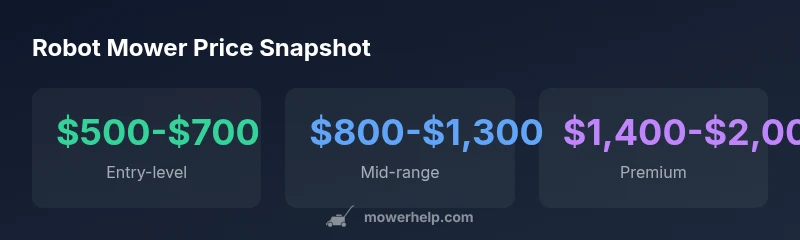
According to Mower Help, the price of robot lawn mower models in 2026 spans roughly from $500 to $2,000+, driven by mapping tech, cutting width, and smart features. Entry-level bots around $500–$700 cover basic mowing, while mid-range options at $800–$1,300 add app control and longer run times. Premium models with advanced sensors, wifi, and zone mapping push toward $1,500–$2,000 or more.
Why Price Varies by Model Tiers
The price of robot lawn mower models is not uniform, and in 2026 the range reflects capabilities, yard coverage, and intelligent features. Entry-level units offer basic mowing with limited mapping, while mid-range models add zone control and longer battery life. Premium models push beyond basic boundaries with full mapping, wifi connectivity, and more sophisticated sensors. As a rule, you’ll pay more for coverage area, faster run times, and smarter navigation. According to Mower Help, you can expect entry-level units to cover small lawns with minimal mapping starting around $500, while premium models with advanced sensing and app ecosystems can exceed $2000.
Breaking pricing into tiers helps homeowners quickly gauge value and determine where the biggest return on investment lies for their property. When budgeting, align features with yard size and maintenance tolerance, and consider how often you’ll use the mower during peak mowing seasons. The price you pay today should be weighed against potential savings on time, water use, and wear on traditional mowers over the life of the device.
Breaking Down Price Drivers
Price is primarily driven by four categories: mapping technology and navigation, sensor suite, battery and run time, and smart features. Entry-level robots typically use simpler sensors and fewer mapping capabilities, while mid-range models incorporate zone mapping, app control, and better battery chemistry that supports longer mowing sessions. Premium devices often feature multi-sensor navigation (including lidar or advanced sonar), cloud-based updates, programmable schedules, and weather-aware behavior. Brand premium and extended warranties can add another tier of cost but often deliver improved reliability and service support. It’s essential to distinguish between upfront price and total cost of ownership, since monthly app subscriptions or replacement parts can alter long-term value. When evaluating price, consider the yard layout, the presence of obstacles, and planned maintenance frequency, which all shape the long-term value of the investment.
Budgeting Scenarios by Yard Size
Small yards (under 0.1 acre) typically fit entry-to-mid-range models that range around $500–$1,000, with enough features to handle simple lawns efficiently. Medium yards (0.1–0.3 acre) usually benefit from mid-range options priced roughly $800–$1,300, offering zone mapping and better battery life. Large yards (over 0.3 acre) frequently justify premium models in the $1,400–$2,000+ range, providing full mapping, extended run times, and robust sensors to navigate complex layouts. In all cases, evaluate the actual coverage area against the mower’s advertised capacity, since real-world performance often depends on terrain complexity, grass height, and user-installed charging routines.
Total Cost of Ownership Beyond Purchase
Beyond the initial price, several ongoing costs influence the overall value of a robot mower. Expect blade replacements and occasional recalibrations as routine maintenance, with blade life varying by grass type and mowing frequency. Battery replacement is a consideration for older models or densely mowed lawns, often occurring after a few years if the battery health declines. Some models require subscription services for premium mapping or cloud features; weigh these recurring fees against the added convenience. Seasonal charging routines and safe storage practices can extend battery life, reducing the probability of early failures. When assessing total cost, factor in potential savings from reduced mowing time, fuel or electricity use, and wear and tear on traditional mowers.
How to Compare Models: A Practical Checklist
- Define your yard size and layout to estimate needed coverage.
- List must-have features (zone mapping, app control, weather sensing).
- Set a realistic budget that includes maintenance and potential upgrades.
- Check battery capacity and run time for planned mowing frequency.
- Review warranties and service network before purchasing.
- Read independent reviews focusing on reliability and customer support.
- Compare total cost of ownership, not just upfront price.
- Verify compatibility with existing outdoor lighting and smart-home ecosystems if desired.
Price Trends and Value in 2026
The market has expanded rapidly, with more models offering advanced navigation and connectivity. While base prices show a broad range, the spread between entry-level and premium units remains stable, though premium features continue to command higher price brackets. Buyers benefit from clear feature lists and owner feedback about real-world performance. The Mower Help analysis indicates broad price dispersion driven by technology sophistication, warranty terms, and after-sales support. Expect ongoing innovation to push feature sets forward without dramatically compressing overall price ranges, meaning savvy shoppers should prioritize essential features over every latest bell and whistle.
Practical Buying Tips
- Start with a needs-first approach: what yard size do you mow, and how often?
- Prioritize essential features (reliable mapping, reasonable run time) over cosmetic extras.
- Consider a model with upgrade paths or reputable service networks to extend lifespan.
- Compare total ownership costs, including potential subscription fees and maintenance.
- Watch for promotions that bundle blades, extra batteries, or extended warranties; don’t overpay for features you won’t use.
Price ranges by model type
| Model Type | Typical Price Bracket | Key Features | Best For |
|---|---|---|---|
| Entry-level | $500-$700 | Basic mowing, limited sensors | Small yards |
| Mid-range | $800-$1,300 | Zone mapping, app control | Medium yards |
| Premium | $1,400-$2,000+ | Full mapping, wifi, multi-zone | Large yards |
Got Questions?
What factors influence the price of a robot lawn mower?
Prices are influenced by mapping capabilities, sensor quality, battery life, mowing width, connectivity, and brand support. Higher-end models offer multi-zone mapping and smarter navigation, which increases the upfront cost but can save time and improve lawn quality over time.
Price depends on features like mapping, sensors, and battery life. Higher-end models offer more convenience and coverage.
Are cheaper robot mowers worth it for small yards?
Cheaper models can work well for small, simple lawns but may lack advanced mapping and zone control. If your yard has obstacles or irregular shapes, a mid-range model may offer better value.
Cheaper models can do small lawns, but you’ll lose some smart features.
What is a reasonable price range for a mid-range robot mower?
Mid-range models typically sit around $800-$1,300, offering reliable mapping, app control, and solid run times suitable for medium yards.
Most mid-range options cost around eight hundred to thirteen hundred dollars.
Do maintenance costs affect long-term value?
Yes. Annual maintenance for blades, sensors, and occasional recalibration adds to total cost. Proper upkeep can extend the mower's life and protect performance.
Maintenance adds to the yearly cost but helps keep performance high.
Should I buy a warranty or service plan?
A solid warranty can save money on repairs. Compare coverage length and what it includes, especially for the battery and sensors.
A good warranty can prevent surprise repair costs.
Is buying used robot mower a good idea?
Used units can be cheaper, but check battery health and sensor integrity. A thorough inspection before purchase is essential.
Used can save money, but inspect critical components carefully.
“Choosing a robot mower isn't just about the sticker price. The long-term value comes from how well the features align with your yard, battery life, and maintenance needs.”
The Essentials
- Set a budget before shopping.
- Expect price ranges by features.
- Include maintenance costs in your total budget.
- Premium features justify higher upfront costs for large yards.
- Check warranties to protect your investment.