Are Lawn Mower Batteries AGM? A Practical Guide for DIYers
Explore AGM batteries for lawn mowers: how they work, pros/cons, charging tips, installation, and when to choose AGM vs flooded designs. A data-driven guide for homeowners and DIY enthusiasts.


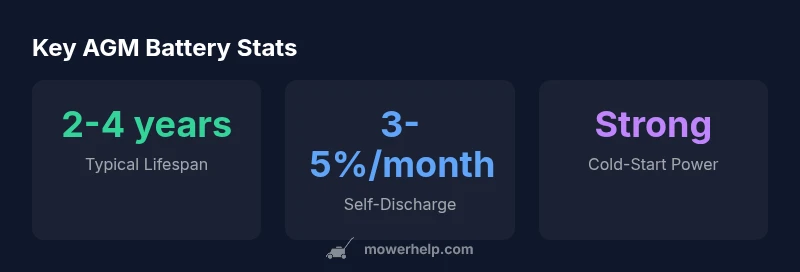
Are lawn mower batteries AGM? AGM stands for Absorbent Glass Mat, and these are maintenance-free, sealed lead-acid batteries. The electrolyte is soaked into a fiberglass mat, which makes the battery spill-resistant and less prone to gassing. AGM batteries typically provide better vibration resistance, slower self-discharge, and stronger cold-cranking performance, making them a popular choice for riding mowers and tools. They often require a smart charger and correct wiring. In guides, readers often ask: are lawn mower batteries agm?
Why AGM technology matters for lawn mower batteries
According to Mower Help, AGM stands for Absorbent Glass Mat, a design that replaces free liquid electrolyte with a mat-packed electrolyte system. This makes AGM batteries sealed, spill-resistant, and less prone to leakage during transport or rough handling—an important consideration for tools stored in sheds or unlevel storage spaces. The Mower Help team found that the sealing also reduces gassing risk, which translates into safer operation in garages and cabins during cold weather. For homeowners evaluating a replacement, AGM often provides a dependable balance of performance and reliability across a wide temperature range and under frequent vibration. While upfront costs can be higher than flooded designs, the longer service life and minimal maintenance can lower total ownership costs over several mowing seasons. In practice, AGM is a practical choice for most modern mowers and a strong upgrade from older flooded lead-acid batteries.
- How AGM works in practice: A glass mat absorbs electrolyte, keeps the system sealed, and reduces electrolyte slosh during movement.
- Real-world impact: Fewer spills, less maintenance, and better vibration tolerance on rough terrain.
- What this means for you: If you own a mower with a higher vibration profile or you store it in a shed, AGM is worth considering.
Top features to evaluate in AGM mower batteries
Modern AGM batteries for lawn care share several characteristics that make them attractive for DIYers and pros alike. Look for robust cold-cranking amps (CCA), a low self-discharge rate, and a robust venting system that remains sealed under normal operation. Compatibility with smart chargers is another practical feature; many AGM batteries are designed to accept trickle or short smart charges without risk of thermal runaway. When comparing models, also check vibration resistance ratings, as riding mowers encounter more road and yard irregularities than mainline hand tools. For those upgrading from older flooded designs, verify the battery’s physical dimensions to ensure a snug fit in the existing compartment and confirm terminal layout aligns with your mower’s wiring harness. Finally, consider warranties and service support as indicators of long-term reliability.
- Key features: sealed case, low maintenance, high vibration tolerance, compatible with smart chargers.
- Fit matters: measure dimensions, check terminal layout, and confirm mounting points.
- Warranties matter: longer warranties often correlate with higher quality build.
AGM vs flooded lead-acid: performance, reliability, and cost
The contrast between AGM and flooded lead-acid batteries is largely a question of maintenance, reliability, and lifespan. AGM batteries are sealed, spill-resistant, and require no water top-ups, which reduces maintenance time and risk for novice installers. They typically offer better vibration resistance—a crucial factor for mowers that vibrate on uneven terrain—and improved resistance to self-discharge, especially in cooler environments. Flooded designs may have a lower upfront price per unit, but they demand regular water top-ups and careful orientation to avoid leaks. In terms of reliability, AGM packs generally retain charge longer when not in use and resume strong starting power after periods of rest. Total cost of ownership tends to favor AGM over multiple mowing seasons when you consider maintenance labor and the risk of battery failure mid-season.
- Upfront vs long-term costs: AGM costs more initially but can save on maintenance and replacement.
- Reliability: AGM handles vibration and deep cycling more consistently than flooded designs.
- Your climate matters: In cold climates, AGM’s starting performance often outperforms flooded batteries.
Sizing, compatibility, and installation tips
Choosing the right AGM battery starts with compatibility: verify your mower’s voltage (most common is 12V), terminal layout, and physical dimensions. Check the CCA rating to ensure you meet or exceed your mower’s starting requirements, especially for larger riders or engines with higher compression. Some older models may still use standard flooded batteries; in such cases, ensure your chosen AGM model matches the same post spacing and overall footprint. Installation steps are straightforward but must be performed with care:
- disconnect the negative terminal first, then the positive; 2) align the battery with the mounting tray; 3) tighten hardware to the manufacturer’s torque specification; 4) reconnect the cables in the correct order; 5) test start and charging once installed. Always use protective gear and work in a well-ventilated area.
- Verify voltage and fit: 12V is common, but always confirm with your mower’s manual.
- Check mounting and wiring: ensure no loose connections and secure mounting.
- Use a smart charger: an AGM-friendly charger helps optimize life and performance.
Charging and storage best practices for AGM batteries
Proper charging is essential to maximize AGM lifespan. Use a smart charger designed for AGM chemistries and avoid high-voltage desulfation routines that can stress the electrolyte mat. While some chargers can float-charge for extended periods, always follow the charger’s instructions and avoid leaving the battery constantly connected to a high-charge source in extreme heat. For storage during off-season months, keep AGM batteries at a moderate, above-freezing temperature and maintain a shallow charge to prevent sulfation. Regular short charging sessions during storage can help maintain performance. If you notice slow cranking or a persistent dim glow on startup, it may be time to test the battery and charging system for possible faults.
- Use AGM-rated chargers and avoid DIY overcharging rituals.
- Storage temperature matters: cool, dry locations are ideal.
- Maintain a light charge during downtime to prevent sulfation.
Troubleshooting common AGM battery issues
Even the best AGM batteries can encounter issues. Common symptoms include slow cranking, a clicking starter, or a battery that seems to hold a charge poorly after a few weeks. Start troubleshooting with the simplest steps: inspect terminals for corrosion, clean and tighten connections, and verify the charger is functioning correctly. If voltage drops quickly under load, the battery may be nearing end-of-life or exhibit internal cell failure. Sulfation is less common in AGM than in flooded designs, but it can occur if the battery remains deeply discharged for extended periods. If the battery remains problematic after basic checks, consider load testing or professional testing to determine whether the unit should be replaced under warranty.
- Check for corrosion and tight connections.
- Test with a load tester or professional tester.
- Replace under warranty if applicable.
Cost considerations, warranties, and replacement guidance
AGM batteries typically carry a higher upfront price than flooded options, reflecting their sealed design and enhanced durability. When budgeting for a mower upgrade, factor in the longer expected lifespan and reduced maintenance. Warranties vary by brand and model, but many AGM mower batteries come with 1- to 3-year warranties. For homeowners managing multiple tools, the cost-per-year of use often favors AGM due to reduced maintenance needs and a lower likelihood of mid-season failure. If you are replacing an aging flooded battery, evaluate both the expected lifespan and the compatibility of your mower’s charging system with AGM chemistry. Always ensure the replacement is properly rated for your engine size and that the mounting space and terminal arrangement align with the new battery.
- Expect higher upfront cost but longer life.
- Look for warranties that cover both capacity and defects.
- Confirm compatibility with your charger and mower model.
Quick-reference replacement guide for your mower
If you are replacing an old battery, use this practical guide to ensure a smooth swap. Step 1: consult your mower’s manual for voltage and terminal layout. Step 2: remove the negative terminal, then the positive, and record the correct orientation. Step 3: secure the new AGM battery onto the tray using the manufacturer’s mounting hardware. Step 4: reconnect the terminals in the reverse order, ensuring clean, corrosion-free connections. Step 5: perform a test start and verify the charging indicator or charger reading. Step 6: store the mower in a dry, moderate environment if not in immediate use. This approach minimizes troubleshooting later and ensures reliable performance from the first startup.
Choosing between AGM and other options for different mower types
For compact push mowers with lower starting requirements, a basic flooded lead-acid battery might suffice if you’re price-sensitive. For larger ride-on mowers or frequent users in variable climates, AGM tends to offer better reliability and lower maintenance over time. Electric mowers with battery packs can benefit from AGM’s sealed design, especially in environments with limited airflow or higher vibration. Always consider climate, storage conditions, and your willingness to perform routine checks when making the final decision.
- Push mowers: consider budget options but balance with reliability.
- Riding mowers: AGM often pays off over time.
- Electric mowers: AGM can help with safety and performance in varied environments.
AGM vs Flooded vs Gel battery comparison
| Battery Type | Common Voltage | Typical Lifespan | Maintenance Needs | Typical Cost Range |
|---|---|---|---|---|
| AGM | 12V | 2-4 years | Low maintenance | $60-$140 |
| Flooded Lead-Acid | 12V | 2-4 years | Regular water top-ups | $40-$100 |
| Gel | 12V | 2-5 years | Low maintenance | $70-$120 |
Got Questions?
What does AGM stand for and how does it work in a lawn mower battery?
AGM stands for Absorbent Glass Mat. In an AGM battery, electrolyte is absorbed into a fiberglass mat, creating a sealed, spill-resistant design. This improves vibration resistance, reduces maintenance, and enhances charging efficiency in lawn mowers.
AGM stands for Absorbent Glass Mat, a sealed design that helps with vibration and maintenance.
Are AGM batteries maintenance-free compared with flooded ones?
Yes, AGM batteries are generally maintenance-free because their electrolyte is absorbed in a mat and sealed. Flooded batteries require periodic water top-ups and more careful handling to prevent leaks, especially in portable tools.
Yes, AGM batteries are usually maintenance-free compared with flooded batteries.
Can I use an AGM battery in any mower model?
Most modern 12V mowers are compatible with AGM batteries, but you must match voltage, terminal type, and fit. Always check the mower’s manual for specifications before replacing.
Check your mower’s manual; most 12V mowers support AGM, but fit and terminals matter.
How should I charge an AGM mower battery?
Use a smart charger designed for AGM chemistry. Avoid high-voltage desulfation routines and avoid leaving the battery on a constant high charge. Charge at a safe rate and follow the charger’s instructions.
Use an AGM-friendly smart charger and follow safe charging guidelines.
What are common signs that an AGM battery needs replacement?
Common signs include slow starting, dim lights, frequent recharging, or voltage dropping under load. If the battery fails a load test or won’t hold a charge, replacement is usually the best option.
If it struggles to start or won’t hold charge, consider replacement.
How long should I store an AGM battery during off-season?
Store AGM batteries in a cool, dry place with a partial charge. If possible, recheck and recharge periodically to prevent sulfation during long storage.
Keep it in a cool, dry place and recharge periodically during storage.
“AGM batteries provide maintenance-free operation with strong starting power in a compact, vibration-resistant package. With the right charger and storage, they offer reliable service across seasons.”
The Essentials
- Choose AGM for maintenance-free operation and strong vibration resistance.
- Match battery size, shape, and terminal layout to your mower for a safe install.
- Use an AGM-compatible charger and store properly to maximize life.
- Consider total cost of ownership, not just upfront price.