How Big Is a Lawn Mower Engine? A Practical Size Guide
Explore engine size (cc) and horsepower for lawn mowers, how it affects cutting power, performance, and choosing the right size for your yard.


Engine size for most residential mowers is measured by displacement (cc). Typical walk-behind engines run 120–190 cc, delivering about 1.5–3.5 hp. Riding mowers commonly use 350–700 cc engines with higher horsepower. In practice, displacement correlates with torque, but real performance also depends on deck width, blade design, and weight. Choose engine size that matches your yard, terrain, and maintenance preferences.
What engine size means for mower power
Engine size, commonly listed as displacement in cubic centimeters (cc), is the primary way homeowners gauge a mower's raw power. Displacement reflects the volume the engine can move per revolution, which translates to torque at a given rpm. Horsepower (hp) is related but not identical; torque curves and operating speed also shape performance. In practical terms, a larger cc typically helps with thick grass, hills, and heavy loads, but blade design, weight, transmission, and deck width affect how that power translates into actual cutting results. For homeowners, this means picking an engine size that suits yard size, terrain, and how often you mow, while keeping maintenance in mind.
Typical displacement ranges for popular mower types
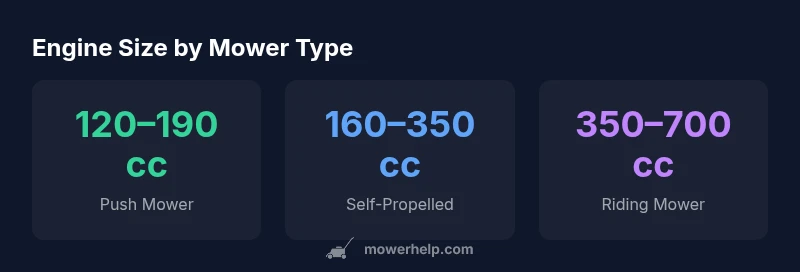
Most walk-behind mowers used by homeowners fall in the 120–190 cc range, with common engines around 140–190 cc. Self-propelled mowers often sit higher, roughly 160–300 cc, to provide adequate torque for movement and cutting on moderate slopes. Riding lawn tractors and zero-turns typically use larger displacement engines, commonly in the 350–700 cc range, designed for longer duty cycles and tougher vegetation. Remember that some brands push high-torque designs with lower displacement, so compare both cc and hp and consider torque specs when available.
How size affects mowing performance in real-world scenarios
Displacement contributes to engine torque, which you feel when grass resists the blade or when mowing on a slope. A 170 cc engine may handle a medium-dense lawn at a comfortable pace, while a 350 cc engine provides more capability on tall weeds or damp grass. However, bigger cc does not automatically equal faster mowing. RPM, torque curves, and blade speed at load matter. For most homeowners, the sweet spot balances engine size with deck width and mower weight. If you routinely encounter thick growth or uneven terrain, a bit more displacement and torque can reduce fatigue and improve blade responsiveness.
Reading the size on your mower: labeling and specs
Engine size is typically listed as cc on the engine housing or specification plate. Some manufacturers publish horsepower instead of displacement, or both. For example, you might see 190 cc or 6.5 hp, depending on the design and marketing. Hp values can be approximate and depend on testing conditions, while cc numbers indicate displacement directly. When comparing models, review both cc and hp, and if available, check torque and rpm ranges. Look for oil capacity and maintenance labels to inform upkeep.
Choosing the right engine size for your yard
Use yard size, terrain, and mowing frequency as primary filters. For small, flat yards under a quarter acre, a push mower in the 120–180 cc / 1.5–3.5 hp zone is usually sufficient, with a deck ~18–21 inches. For medium yards with gentle slopes, a self-propelled mower in the 160–290 cc range offers a balance between noise, weight, and torque. For large lots, hills, or dense growth, riders in the 350–700 cc band provide the necessary mass and torque to maintain pace. Consider fuel type and maintenance expectations alongside engine size.
Maintenance and efficiency: size interacts with upkeep
Engine size interacts with maintenance demands, fuel type, and oil change frequency. Larger displacement typically requires higher-grade lubricants and more frequent air filter checks. While larger engines deliver more torque, they can burn more fuel, increasing operating costs. Smaller engines may struggle with thick grass or heavy loads, increasing wear if overworked. Following manufacturer service intervals, using the recommended oil, and inspecting air filters and spark plugs regularly helps any engine size perform reliably.
Upgrade options and safety considerations
Upgrading engine size is not always straightforward and may require compatible chassis, mounting, and safety interlocks. If you consider an upgrade, consult a professional to verify deck width, transmission compatibility, and safety features. For homeowners seeking more sustained power without a full engine swap, choosing a model with a larger displacement from the start or a design with a better torque curve is often more practical. Always prioritize compatibility and maintenance needs over displacement alone.
Quick-start decision checklist
Use this basic checklist to guide your engine-size choice: yard size, typical grass density, hills, and mowing frequency. For under 0.25 acres on flat terrain, aim for 120–180 cc. For 0.25–0.5 acres with gentle slopes, target 160–300 cc. For larger properties or hilly terrain, 350–700 cc is a reasonable range. Always verify deck width, weight, and maintenance access to ensure a comfortable, efficient mowing experience.
Engine sizes by mower type
| Mower Type | Typical Engine Size (cc) | Typical Horsepower (hp) | Notes |
|---|---|---|---|
| Push Mower | 120–190 cc | 1.5–3.5 hp | Best for small, flat yards |
| Self-Propelled Mower | 160–350 cc | 3–6 hp | Balanced for medium yards |
| Riding Mower | 350–700 cc | 10–25 hp | Large yards, tougher tasks |
Got Questions?
What does engine displacement measure on a lawn mower?
Engine displacement measures how much air-fuel mixture the engine moves per revolution, expressed in cc. It correlates with torque and overall capability, especially under load. Horsepower also matters, but displacement is a primary, comparable metric across models.
Engine displacement tells you how much air and fuel the engine can move per revolution. More displacement usually means more torque, but look at torque curves and the whole engine system too.
How does engine size affect mowing performance?
Larger displacement generally increases torque, helping with thick grass and slopes. However, performance also depends on blade design, deck width, and weight. For flat lawns, a moderate size often suffices; for hills or dense growth, a larger displacement with good torque is beneficial.
More displacement usually means more torque, which helps with tough conditions. But the blade, deck, and weight matter just as much.
Is bigger engine always better?
Not necessarily. A larger engine may waste fuel and add weight if your yard is small or flat. The best choice depends on yard size, terrain, and how often you mow. For many homeowners, a moderate displacement with good torque provides the best balance.
No—bigger isn’t always better. For many people, a balanced engine size with good torque fits best.
What engine size is typical for a small yard?
For small, flat yards, many homeowners choose engines in the 120–180 cc range, often around 1.5–3.0 hp. This size keeps weight manageable while delivering adequate cutting power for regular maintenance.
For small yards, a 120–180 cc engine is usually enough.
Can I upgrade my mower engine to a larger size?
Engine swaps on consumer mowers are uncommon and can be impractical due to mounting, transmission, and safety interlocks. If you need more power, it’s typically better to purchase a model designed for higher displacement and torque that matches your deck and drivetrain.
Upgrading a mower’s engine isn’t usually practical; consider a higher-displacement model instead.
“Engine displacement is a solid guideline for torque and capability, but true mowing performance depends on the whole system—from blade to transmission.”
The Essentials
- Engine size (cc) is a key torque indicator.
- Push mowers typically use 120–190 cc engines.
- Read both cc and hp when comparing models.
- Choose size based on yard size and terrain.
- Maintenance affects performance across all engine sizes.