How Big Is a Lawn Mower? A Practical Size Guide
Learn how big a lawn mower is across types, deck widths, and models. A practical guide to sizing, storage, and yard considerations from Mower Help.


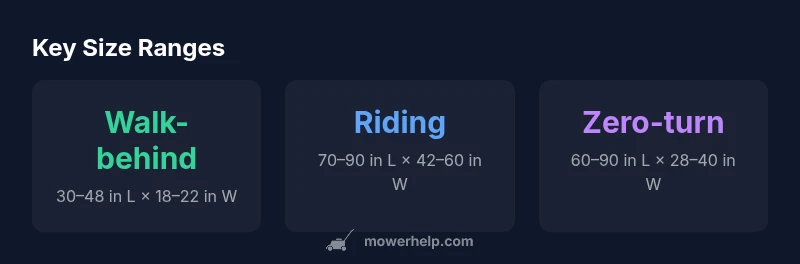
How big is a lawn mower? It depends on type. A typical walk-behind mower measures about 30–48 inches long and 18–22 inches wide, with a 20–22 inch cutting deck. Riding mowers are larger: overall length around 70–90 inches with deck widths of 42–60 inches. Exact sizes vary by model and brand.
What determines mower size
If you're asking how big is a lawn mower, size is driven by type, deck width, and overall chassis geometry. Footprint is primarily a function of the cutting deck width and the mower's length, with storage height also affecting how much space it occupies in a shed or garage. Additional factors include wheelbase, handle configuration, and any folding mechanisms for storage. For homeowners, the most tangible metrics are deck width, overall length, and the space needed for storage; always confirm exact dimensions from the manufacturer. According to Mower Help, gathering precise measurements before buying saves space and avoids mismatches with sheds and gates.
Typical dimensions by mower type
Lawn mowers come in several configurations, each with a distinct footprint. The most common categories and their rough footprints are:
- Walk-behind (push) mowers: length typically 30–48 inches; width 18–22 inches; height around 34–40 inches; cutting deck 20–22 inches.
- Self-propelled mowers: length around 40–50 inches; width 18–22 inches; deck width generally 21–28 inches; height about 38–42 inches.
- Riding mowers: length about 70–90 inches; width 42–60 inches; deck widths commonly 42–60 inches; overall height varies by model.
- Zero-turn mowers: length typically 60–90 inches; width 28–40 inches; deck widths 42–54 inches.
These ranges reflect typical market offerings; deck width is the primary determinant of footprint. Based on Mower Help research, expect larger differences between classes than within a class.
Storage, transport, and maneuverability implications
Size directly impacts where you can store a mower and how easily you can transport it through doors, gates, and tight corners. A wider deck requires wider gate clearance; longer machines may need longer storage shelves or lifts. When planning transport, consider whether you can tilt or fold components (handles, wheels) to reduce length. For homeowners with limited garage space, understanding these dimensions helps prevent buying a mower that won’t fit through the shed door or into a corner.
Measuring a mower you already own
To determine current footprint, measure in three directions: (1) length (front to back), (2) width (side to side), and (3) height (ground to top when seat or handle is raised). Record the deck width separately, as that often drives fit through gates and into storage. If you can, measure the mower with any attachments installed, since trimmings, mulchers, or baggers add to the footprint. Use a tape measure and double-check your readings for accuracy; this helps you compare against new models or storage constraints.
How to choose the right size for your yard
Match mower size to yard area, layout, and gate dimensions. For tight spaces or irregular lots, a narrower, shorter machine may reduce fatigue and improve turning. For larger lawns with long straight runs, a longer machine with a wider deck can improve efficiency. Always verify gate clearance and shed dimensions before purchase. The goal is to balance mowing efficiency with storage feasibility and ease of transport.
Practical tips and common mistakes
Helpful tips: measure gate openings in several spots, check whether your shed has a ceiling height constraint when using vertical storage, and compare both folded and unfolded dimensions. Common mistakes include assuming a bigger mower is always better, failing to account for storage constraints, and overlooking weight and maneuverability on slopes. By planning around the yard’s geometry, you minimize returns, awkward turns, and space issues. The Mower Help Team emphasizes tailoring size to your yard to avoid over- or under-sizing.
Data sources and further reading
For readers who want to compare models, consult official spec sheets and manufacturer diagrams. Always cross-check with multiple model lines to identify outliers and ensure measurements reflect your intended configuration (standard vs. oversized decks, folding handles, or storage aids). Mower Help provides guidance based on typical market ranges and field experience to help you size up your options.
Typical size ranges by mower type
| Mower Type | Typical Length | Typical Width | Deck Width Range |
|---|---|---|---|
| Walk-behind (push) | 30–48 in | 18–22 in | 20–22 in |
| Self-propelled | 40–50 in | 18–22 in | 21–28 in |
| Riding mower | 70–90 in | 42–54 in | 42–60 in |
| Zero-turn | 60–90 in | 28–40 in | 42–54 in |
Got Questions?
What is the smallest mower size available?
Smallest push mowers commonly feature 16–18 inch decks with overall footprints around 28–40 inches long. These compact models excel in tight spaces and narrow gate entries, though they may require more passes for large lawns.
The smallest mowers have around an 16 to 18 inch deck and fit tight spaces, but you’ll need more passes for large lawns.
How does deck width affect cutting reach?
Deck width determines how much area you cut per pass. A wider deck increases coverage but also footprint; always balance deck width with gate clearance and storage space.
A wider deck cuts more per pass, but it can make storage and gate clearance harder.
Will a bigger mower fit through my gate?
Measure your gate opening and compare it to the mower’s width. If needed, look for models with folding handles or smaller-diameter wheels that help squeeze through.
Measure the gate first, and consider models with folding handles if you’re close on clearance.
Can I buy a mower with a foldable handle for storage?
Yes, many mowers offer foldable handles to reduce storage footprint. Check the product specs for folded dimensions and weight.
Yes, folding handles reduce storage space; check the specs for folded size.
What size should I choose for a medium yard?
For a medium yard (roughly a quarter to half an acre), a 28–36 inch deck often provides a good balance of reach and maneuverability, with storage considerations in mind.
For a medium yard, a 28–36 inch deck is usually a good balance, with gate and storage checks.
“Sizing your mower correctly reduces effort, fatigue, and maintenance, while improving overall mowing efficiency.”
The Essentials
- Start with deck width to gauge footprint
- Riding mowers are significantly larger than walk-behind models
- Check gate clearance before buying
- Measure storage space and door openings
- Tailor mower size to yard layout and tasks