How many hours is a lot for a mower: a practical wear-life guide
Understand how mower hours signal wear, compare gas vs electric wear, and extend mower life with smart maintenance. This guide uses Mower Help Analysis, 2026, to help homeowners judge when hours indicate end-of-life.


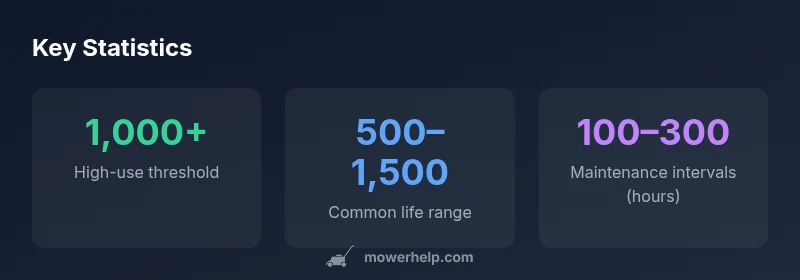
Question: how many hours is a lot for a mower? Typically, more than 1,000 hours of operation is considered high-use for a mower, though the exact threshold varies by model and maintenance. In practice, many homeowners reach 500–800 hours before major service is needed, while well-maintained engines can exceed 1,000 hours. Track hours and maintenance to decide when attention is due.
How many hours is a lot for a mower? Interpreting hours in context
According to Mower Help, the question how many hours is a lot for a mower depends on usage patterns, maintenance, and mower type. Hours are a useful proxy for wear, but they must be read alongside service records and performance signals. In practice, thresholds vary, but many owners find that 500–800 hours marks high-use, with engines accumulating meaningful wear beyond 1,000 hours. When you ask how many hours is a lot for a mower, think in terms of ranges rather than a single number, and consider the model, maintenance quality, and environmental conditions that influence wear.
Keep a running log of hours and note any decline in cut quality, starting struggles, or unusual noises. These signals often appear before you reach the upper end of a given hour range, so proactive maintenance is your best defense against unexpected failures.
Gas-powered vs electric: does hour count differ?
Hour counts matter for both gas and electric mowers, but the wear patterns and failure modes differ. Gas engines accumulate wear in pistons, rings, and valves, so hours are a rough proxy for internal wear. Electric mowers rely on motor windings and battery health; while hours still matter, cycles and charge-discharge patterns often drive performance more than raw runtime. Consequently, a high-hour threshold for gas might not align with an electric model. In practice, plan maintenance around hours and cycles, and treat them as complementary signals rather than a single metric.
For homeowners, a practical approach is to tie service reminders to both hour totals and cycle counts, especially for battery-powered units where battery life can be a dominant factor in performance.
How to track mower hours and estimate remaining life
Begin with the hour meter if your mower has one. If not, estimate from start date and typical usage per week, then adjust as you log actual run time. Maintain a simple service log noting dates, oil changes, air-filter cleanings, spark-plug replacements, blade sharpenings, and fuel quality. Look for patterns: repeated compression losses, degraded cutting quality, or reduced engine response typically indicate that wear has moved into a higher range. Use hours alongside service history to guess remaining life, but anticipate that certain components (spark plugs, filters, blades) will require replacement long before a major engine overhaul.
How to extend mower life beyond counting hours
Good habits beat clock-watching every time. Prioritize regular maintenance: change oil and filter at manufacturer-recommended intervals, replace air filters, inspect and sharpen or replace blades, and keep spark plugs clean or new. Use high-quality fuel or fuel stabilizers, and implement proper storage during off-seasons. Clean the deck after use to prevent grass buildup, and run the mower under load occasionally to prevent stale fuel damage in batteries or carburetors. Finally, use a reputable repair source for wear patterns and respect recommended service windows to avoid cascading failures.
Used mowers and the hours factor: what to expect
When evaluating a used mower, hours are a key data point but not a sole determinant of value. A well-maintained unit with 700–900 hours can outperform a poorly maintained machine with 400 hours. Always verify service history, inspect for oil leaks, check blade condition, and test start-up behavior. For buyers, focus on maintenance evidence, not just the meter reading. Sellers should provide complete records, enabling buyers to assess remaining life more accurately than hours alone.
Lifespan estimates by mower type
| Mower Type | Common Lifespan (hours) | Maintenance Window (hours) |
|---|---|---|
| Gas mower | 600-1500 | 100-300 |
| Electric mower | 1000-2000 | 200-400 |
Got Questions?
What counts as a 'lot of hours' for a gas mower?
For gas mowers, 'a lot of hours' usually begins around the 1,000-hour mark, though thresholds vary by model and maintenance. Consistent service and good fuel quality can push that boundary higher.
Gas mowers reach high-hour wear around a thousand hours, depending on upkeep and model.
Do electric mowers have hours?
Yes. Electric mowers are evaluated by runtime and charge cycles, but overall life often hinges on battery health and motor wear. Hours remain a useful indicator, especially with frequent usage.
Electric mowers wear with use and battery cycles; hours still matter.
How can I check the hours on a used mower?
Look for an hour meter or review the service logs. If unavailable, ask the seller about usage patterns and maintenance history, and verify with the serial number where possible.
Inspect the hour meter and service history, ask about usage.
Should I replace the engine at 1,000 hours?
Engine life varies; many engines reach 1,000+ hours with proper maintenance, but individual parts wear differently. Plan based on maintenance history and observable performance.
Engine life depends on care; 1,000 hours is not a universal cutoff.
What maintenance intervals matter most for extending life?
Regular oil changes, air filter replacement, spark plug checks, blade sharpening, and fuel-quality management have the biggest impact on longevity.
Stick to the maintenance schedule and use good fuel.
“"Regular maintenance and timely part replacement extend a mower's life far more reliably than simply watching the hour meter."”
The Essentials
- Track hours with maintenance logs.
- High-use thresholds commonly begin around 1,000 hours for many mowers.
- Gas and electric wear follow different patterns; expect model-dependent lifespans.
- Regular maintenance drives longevity more than chasing hours alone.