Lawn Mower Ramp Calculator: Safe Ramp Lengths Guide
Learn how to determine the correct ramp length for a lawn mower using a simple ramp calculator. This guide covers rise, slope, safety, and practical DIY tips for safer loading and maintenance tasks.


Why this topic matters for homeowners
A reliable ramp length calculator is a practical tool for DIY mower maintenance. For homeowners, choosing the wrong ramp length can lead to wheel slips, tipping, or damage to the mower and the surface you’re loading onto. A well-designed ramp—guided by a ramp calculator—helps you plan ahead, confirm that your ramp can safely clear the mower deck height, and minimize the risk of accidents. According to Mower Help, using a ramp calculator supports safer load handling and reduces guesswork during routine maintenance tasks. The calculator also helps you compare different ramp designs before you start building, ensuring you select a configuration that matches your mower model and workspace.
How the math behind ramp length works
Ramp length is determined by basic geometry: if you know how high the ramp must rise (rise) and how steep you want it (slope as a percent), you can compute the horizontal run and the actual ramp length. The relationship typically uses rise h (in feet) and slope p (in percent). The run is h * 100 / p, and the ramp length L is the hypotenuse of the right triangle: L = sqrt(h^2 + run^2). In calculator-friendly form, L = pow( hh + (h100/p)(h100/p), 0.5 ). This approach avoids trigonometry while giving accurate length for safe loading. When you adjust rise or slope, the length changes in predictable ways: a higher rise or steeper slope increases required length.
How to use inputs and outputs in real life
The calculator typically needs three inputs: rise (the vertical height you must clear), slope (the incline you’re comfortable with, expressed as a percent), and output precision. Start with your mower’s deck height to ensure the rise covers what you need. Pick a slope that minimizes tilt while staying safe for your wheelbase and surface. The output ramp length is given in feet, typically rounded to two decimals for construction planning. If you’re unsure about the slope, use conservative values (shallower ramps) to prioritize stability over compact space.
Practical examples (step-by-step)
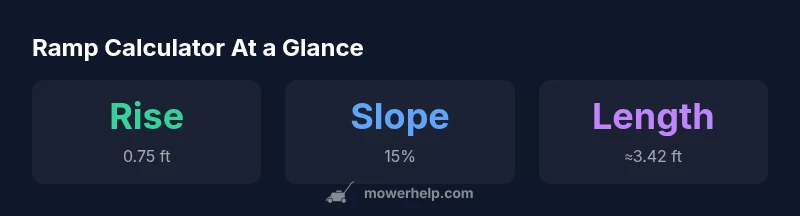
Example A: rise 0.75 ft, slope 15%. Run = 0.75 * 100 / 15 = 5.0 ft. Length L = sqrt(0.75^2 + 5.0^2) ≈ 5.06 ft. This gives a safe, gradual incline for most small to mid-size mowers.
Example B: rise 1.0 ft, slope 20%. Run = 1.0 * 100 / 20 = 5.0 ft. Length L = sqrt(1.0^2 + 5.0^2) ≈ 5.10 ft. A slightly longer ramp reduces tilt and helps with traction.
Safety first: best practices for any ramp design
- Keep the surface dry and free of debris to prevent wheel slip. - Use non-slip traction on both ramp and landing surfaces. - Ensure the ramp has side rails or lips to prevent wheels from riding off. - Check that the ramp length, slope, and weight-bearing surface meet your mower’s weight class. - Avoid wet grass or unstable soil areas; test with a small weight before loading the mower fully.
Maintenance, testing, and verification within your routine
Regular checks are essential: inspect the ramp for cracks, warping, or hardware loosening before each season. Recalculate length if you upgrade a mower or deck height. To keep your workflow smooth, store the ramp plan and the calculator output in a dedicated home maintenance folder, so you can quickly reference the exact ramp length for future servicing. This habit reduces improvisation when you’re in a time crunch and keeps safety at the forefront.
How this tool fits into your mower maintenance workflow
Incorporate the ramp calculator into your routine alongside blade sharpening, oil changes, and tire maintenance. Use it during planning for seasonal tune-ups or when you move your mower between storage and the shed. Shared projects with family members become safer when everyone understands the ramp length and slope, and can verify the numbers quickly using the calculator. Mower Help’s guidance emphasizes consistency and safety when performing DIY maintenance tasks.