Mulching Leaves with a Lawn Mower: A Practical Guide
A comprehensive, DIY-friendly guide to mulching leaves with a lawn mower. Learn blade choices, mower settings, timing, safety, and practical steps to turn leaves into nutrient-rich mulch that rejuvenates your lawn.


Mulching leaves with a mower turns yard debris into nutrient-rich mulch, reduces waste, and saves you time. You’ll learn how to choose the right blades and settings, prepare the mower, and follow a safe, step-by-step process to shred leaves into fine particles that feed the lawn. This guide covers tools, timing, and common mistakes to avoid.
What mulching leaves with a mower involves
According to Mower Help, mulching lawn mower leaves turns yard debris into nutrient-rich mulch. This approach recycles organic matter back into the lawn, reducing waste and the need for external mulch. The goal is to shred leaves into fine, particle-sized bits that decompose quickly and enrich the soil. Mulching works best when leaves are dry, the mower blades are sharp, and the mower is operated in mulching mode or with a compatible mulching kit. For homeowners dealing with a heavy autumn leaf load, mulching leaves is a practical, eco-friendly option that can support turf health without frequent bagging. Mulching lawn mower leaves also reduces yard cleanup time and helps prevent leaf piles from accumulating on driveways or in storm drains. The Mower Help team emphasizes that proper technique and equipment choice are essential for consistent results.
Key takeaway: Start with small leaf volumes and gradually increase to avoid overwhelming the mower. If your leaves are damp or thick, consider breaking them into thinner layers with a rake or blower before mowing. This approach reduces clogs and improves shredding quality.
Benefits and potential trade-offs of mulching leaves
Mulching leaves can improve soil structure by returning organic material to the turf, promoting microbial activity, and conserving soil moisture. Finely shredded leaves act like a natural slow-release fertilizer, adding micronutrients as they break down. When executed correctly, the mulch layer adds insulation for shallow roots and can help suppress weed growth by keeping the soil cooler and more shaded. However, there are trade-offs. Heavily infested leaf beds or damp, mat-forming leaves can mat down and smother grass if not broken up. In very thick leaf layers, a single pass may not be enough, and several light passes are preferred. Dimensional shredding also reduces the chance of creating clumps that smother grass blades. In some cases, homeowners may choose to rake up large quantities of leaves or use a blower to pre-break piles before mulching. This ensures a more uniform mulch layer and reduces clogging.
Mower Help analysis shows that dry, fine leaves mulch best and that maintaining blade sharpness is critical for consistent results. A well-tuned mower with a proper mulch blade can produce mulch that looks like dust or snow—easy to distribute and quick to break down, which supports ongoing lawn health. For best outcomes, aim for a continuous, even shredding action rather than large, inconsistent clumps.
Mower readiness: blade types, deck height, and leaf moisture
Your mower’s ability to mulch leaves effectively depends on blade design, deck height, and leaf moisture. A dedicated mulching blade or mulching kit is often essential for fine shredding. Ensure the mower deck is clean and free of debris that could impede airflow. Leaf moisture dramatically affects performance: ultra-dry leaves shred easily, while leaves that are damp tend to mat and resist cut, forming clumps. In wet conditions, you may need to postpone mulching or work the leaves in thinner passes. Always remove any rocks, sticks, or hard obstructions before you begin. If your mower lacks a mulch option, you may still mulch by using sharp blades and a higher cut, but the results will be less uniform. The goal is to keep the clipping size small enough to decompose quickly and to maintain good airflow under the deck.
Guidance: If you’re unsure about compatibility, consult your mower’s manual or the manufacturer’s support resources to confirm mulching suitability and required blade types.
Tools & Materials
- Mulching blade or mulching kit(Compatible with your mower; ensure mulch-mode is usable.)
- Safety gear (eye protection, gloves, sturdy shoes)(Protect eyes from debris and sharp blades.)
- Leaf rake or leaf blower (optional)(Helpful for breaking up thick piles before mulching.)
- Tarps or compost bin (optional)(For collecting mulch or storing leaves.)
- Sharp replacement blades or sharpening tool(Dull blades mulch poorly and can tear leaves.)
Steps
Estimated time: 60-90 minutes
- 1
Prepare the mower for mulching
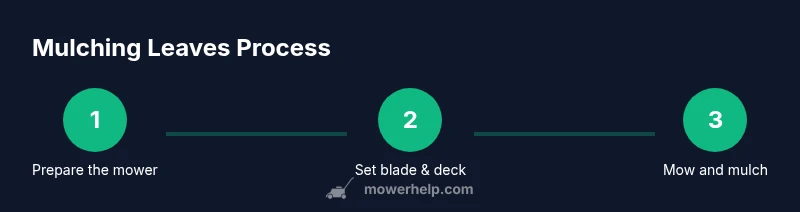
Inspect the deck and blades, remove the grass catcher if used, and install a mulching blade or kit as needed. Confirm the mower is set to mulch mode and that the blade gap is appropriate for leaf shredding.
Tip: Test run on a small patch to verify clippings are fine. - 2
Clear the mowing area
Remove obstacles such as sticks, toys, and garden hoses. Dry, loose leaves shred more consistently than damp, wet leaves and reduce the risk of clogging.
Tip: If piles are thick, break them into thinner layers with a rake or blower. - 3
Sharpen blades and clean the deck
Ensure blades are sharp and balanced; clean the underside of the deck to remove built-up leaf matter. A clean deck improves airflow and shredding efficiency.
Tip: Dull blades tear leaves; sharp blades cut cleanly for finer mulch. - 4
Set deck height and mowing speed
Lower the deck for finer shredding if leaves are dense; reduce mowing speed to maintain consistent cut. In dry weather, moderate speeds typically yield better results.
Tip: Use multiple light passes rather than one hard pass. - 5
Monitor and adjust during mowing
Watch for clogs, uneven shredding, or large clumps. If you see buildup, stop, clear the deck, and continue with light passes.
Tip: Pause after every few meters to clear debris if needed. - 6
Finish and evaluate mulch output
Inspect clippings; they should be small enough to blend into the lawn. Return mulch to the turf or compost excess if desired.
Tip: Avoid leaving a thick mulch layer that can smother grass.
Got Questions?
Can I mulch heavy piles of leaves in a single pass?
Large piles can overwhelm the mower and cause blade or deck clogs. Mulch in smaller portions with multiple light passes.
Don’t try to mulch a big pile in one go; do it in smaller passes.
Will leaf mulch harm my grass?
When finely shredded, leaf mulch returns nutrients to the soil and supports soil life. Avoid a thick, compact layer that blocks light.
Finely shredded leaves feed the soil; avoid thick mats.
What blade should I use for mulching leaves?
Use a mulching blade or a mulching kit compatible with your mower for the finest shredding.
A mulching blade makes leaf shredding easier.
Should I bag leaves or mulch?
Mulching is usually preferable to return nutrients to the lawn. Bagging can be useful for compost or disposal.
Mulch to feed the lawn; bag for disposal or compost.
What moisture level works best for mulching leaves?
Dry leaves mulch best; damp leaves clump and are harder to shred.
Dry leaves mulch best; damp leaves clump.
How many passes are needed for dense leaf layers?
Expect several light passes, gradually reducing leaf volume with each pass.
Several light passes work better than one heavy pass.
Watch Video
The Essentials
- Mulching leaves recycles yard waste into lawn nutrients
- Keep blades sharp and use a dedicated mulching setup
- Dry leaves mulch best; damp leaves can clog and smear
- Mow in multiple light passes for finer mulch
- Wear safety gear and stay aware of mower heat and movement