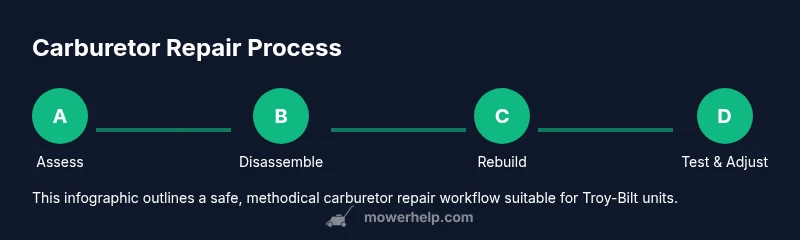
Troy-Bilt Carburetor Repair Guide for Lawn Mowers
A homeowner-friendly guide to inspecting, cleaning, and rebuilding a Troy-Bilt carburetor. Learn safe steps, common issues, tools, and preventive maintenance.


By following this guide, you will diagnose, clean, rebuild, and tune a Troy-Bilt carburetor to restore reliable starts and smooth operation. You’ll learn safety steps, required tools, and a practical step-by-step workflow, plus maintenance tips to prevent future clogs and seasonal performance issues. This overview helps homeowners complete the task with confidence.
Understanding the Troy-Bilt carburetor and why it fails
The carburetor on a Troy-Bilt lawn mower is a small but critical engine component that meters air and fuel to achieve a stable flame in the combustion chamber. Over time, varnish, gum, and sediment from old fuel can clog passages and jets, causing poor idle, hard starts, or stalling. According to Mower Help, a clogged Troy-Bilt carburetor is a common culprit of hard starting and uneven performance, often tracing back to stale fuel and varnish buildup. You’ll often see boosted symptoms when the weather is hot or when the mower sits with fuel in the bowl for extended periods. Troubleshooting starts with a methodical check of fuel supply, air intake, and linkage before probing into the tiny internal passages.
A well-maintained carburetor is not magic; it’s a balance of clean fuel, correct air mixing, and reliable seals. The Troy-Bilt carburetor relies on precise diaphragm movement and calibrated jets. If any piece is sticky, cracked, or out of alignment, you’ll notice hesitation, surging, or lack of power. Knowing this helps you decide between cleaning, rebuilding, or replacing components. While some issues mimic fuel delivery problems, always verify the simplest fixes first—fuel valve, choke operation, and air filter condition—before diving into the carburetor itself.
Diagnosing common symptoms and what they mean
Common symptoms of carburetor trouble include hard starting, rough idle, stalling at idle or under load, and sudden power loss during cutting. If the mower runs briefly and dies, the float bowl may be empty or the fuel jets clogged. If you smell gas or see fuel dripping, the needle seat or gasket could be failing. In many cases, symptoms point to varnish buildup or a swollen diaphragm rather than a completely failed carburetor. Start with a visual inspection: look for cracks, loose linkage, and leaks around fittings. Check the air filter; a clogged filter can mimic carb issues by starving the engine of air.
Troy-Bilt carburetors respond well to a clean surfaces check. If you notice fuel in the bowl, that’s a sign to inspect the float and needle valve. If the engine overheats or stalls under load, the mixture could be too rich or too lean—this will require adjusting the screws or jets within the rebuild kit. For homeowners, a systematic approach—fuel source, air intake, then carb—helps you identify whether the problem is fuel delivery, air intake, or the carburetor internals.
Safety first: Tools, precautions, and prep
Safety always comes first when working on small engines. Begin by disconnecting the spark plug to prevent accidental starting, and drain the fuel from the tank to minimize spills. Work in a well-ventilated space away from open flames. Wear gloves and safety glasses, and keep rags away from moving parts. Lay out a labeled tray for small screws, springs, and jets to avoid misplacing components. A clean, dry bench with good lighting makes inspection easier and reduces the risk of losing tiny parts. Remember: ethanol-gas blends can varnish more quickly, so plan for thorough cleaning and degreasing when removing parts.
The goal of this prep is to create a safe, organized workspace where you can inspect, clean, and reassemble without forcing parts or losing critical alignment. Start by removing the air filter and opening the carburetor access to confirm there are no obvious obstructions or fuel leaks. If you are unsure about the model, consult the mower’s service manual or a trusted guide like Mower Help for model-appropriate techniques.
Cleaning and rebuilding: overview and best practices
A rebuild kit typically includes gaskets, diaphragms, needle valves, and jets. Cleaning the carburetor involves removing it from the intake, separating the float bowl, and inspecting internal channels for varnish and gum. Soak metal parts in carburetor cleaner, then use a soft brush to scrub deposits. Blow out all passages with compressed air, ensuring jets and orifices are clear. When reassembling, place gaskets in the correct orientation and verify the diaphragm sits flat with no wrinkles. Avoid forcing parts, which can cause micro-damage that leads to leaks.
During reassembly, confirm that the float moves freely and that the needle seats smoothly. A trembling or sticking float can cause inconsistent fuel levels, leading to an unreliable mixture. Double-check all connections—linkages, springs, and screws—to ensure the throttle operates smoothly and return springs pull correctly. Take photos during disassembly to guide reassembly and reduce guesswork.
Tuning for performance: idle and mixture adjustments
Once rebuilt, the carburetor requires careful tuning to match the engine’s needs. Start with the idle speed screw set to a gentle, stable idle. If the engine surges, the air-fuel mixture may be off; turning the mixture screw in small increments can lean or richen the mixture, depending on the design. After warm-up, test under load (mowing) and adjust for smooth acceleration and consistent RPM. Keep a notebook of settings so you can reproduce successful results after future maintenance.
Tuning should be performed slowly and in short intervals. If you detect backfiring or black smoke, stop and recheck the seals and diaphragms—these components affect mixture more than the jets themselves. Remember to recheck the air filter, as a clogged filter will skew fuel/air balance regardless of carburetor adjustments.
Gaskets, seals, and replacement parts
Carburetor maintenance often hinges on the quality of gaskets and seals. Over time, gasket material can crack, and diaphragms can harden, creating vacuum leaks that undermine performance. Use a proper rebuild kit and avoid reusing old gaskets if you’re unsure of their integrity. When a diaphragm shows any sign of wear, replace it. The float needle and seat should seal cleanly; if you see fuel seepage around the needle, replace the seat and gasket set.
Keep a spare set of essential seals on hand, and store them in a labeled container. If you’re unsure whether a gasket is reusable, replace it—this reduces the risk of a leak that can cause fuel-rich conditions, poor starting, and potential fire hazards.
Maintenance routine to prevent future clogs
Prevention is easier than restoration. Use fresh, ethanol-free fuel when possible and add a fuel stabilizer if you store the mower for more than a few weeks. Run the engine briefly after adding stabilizer to circulate fuel through the system. Change fuel filters if your model has one, and replace the air filter regularly; a clean intake makes carburetor life easier. Schedule carburetor checks at the start of mowing season and mid-season to catch varnish buildup before it causes performance issues.
A light, periodic cleaning of the exterior and quick inspection of hoses and fuel lines can prevent surprises. Compatible cleaning with compressed air and a soft brush keeps the carburetor internals clear from varnish, reducing the likelihood of hard starts and stumble events during peak mowing times.
When to replace vs rebuild:判断 jurisdiction considerations
Not every carburetor can be saved with cleaning and gaskets. If the unit shows persistent fuel leaks, warped body surfaces, or cracked diaphragms that resist rebuilding, replacement may be the safer option. Replacing with an OEM-compatible carburetor or a high-quality aftermarket unit is often more reliable than attempting to salvage a severely worn component. Always compare the total cost and time of rebuilding versus replacing, especially if you anticipate long-term use of the mower.
For homeowners, evaluate not just the immediate fix but the expected life of the repair. If you are unsure about compatibility with your Troy-Bilt model, consult the manual or a professional. Mower Help’s guideline is to weigh the effort against durability and follow safer, documented repair paths whenever possible.
Tools & Materials
- Carburetor rebuild kit (gaskets, diaphragms, needle valve, jets)(Choose a kit that matches your Troy-Bilt carburetor type and model family.)
- Screwdrivers (flathead and Phillips)(Precision bits; include small sizes for tight screws.)
- Pliers (needle-nose)(For removing springs and clamps without damage.)
- Carburetor cleaner spray(Lubricates and dissolves varnish; use in well-ventilated area.)
- Compressed air can or blower(Blows out jets and passages; avoid high pressure on delicate diaphragms.)
- Small brushes or old toothbrush(Scrubs deposits from external and accessible passages.)
- Catch tray or small bowls(Collect fuel and small parts to prevent spills.)
- Rags, lint-free cloths(Keep surfaces clean and dry during reassembly.)
- Gloves and safety glasses(Personal protective equipment for handling cleaners and fuel.)
- Gasket sealant (if recommended by rebuild kit)(Only use if kit specifies and manufacturer allows.)
- Model-specific reference photos(Helpful during reassembly to ensure correct orientation.)
Steps
Estimated time: 60-90 minutes
- 1
Prepare and safety-check
Disconnect the spark plug, drain fuel, and set the mower on a flat surface. Remove the air cleaner to access the carburetor. This step reduces fire risk and ensures you can inspect everything clearly.
Tip: Always unplug the spark plug first to prevent accidental starting. - 2
Remove the carburetor from the engine
Loosen mounting bolts and disconnect fuel lines carefully. Support the carb and avoid bending the throttle linkage. Label hoses if necessary to simplify reinstallation.
Tip: Take a photo of the mounting and linkage arrangement for reference. - 3
Disassemble the carburetor
Carefully separate the bowl, diaphragm, and gasket stack. Keep track of small parts and note your orientation. Inspect the float and needle valve for wear.
Tip: Do not force parts; if something resists, reassess alignment or damage. - 4
Clean and inspect internal passages
Soak metal parts in carb cleaner, then scrub varnish from passages with a soft brush. Use compressed air to blow jets clean from both directions to ensure clear flow.
Tip: Blow out from both sides to avoid leaving varnish in restricted passages. - 5
Replace gaskets, diaphragms, and jets
Install new diaphragms and gaskets from the rebuild kit. Replace all worn jets and the needle valve. Ensure seals are seated flat with no deformation.
Tip: Always verify the diaphragm seating to prevent vacuum leaks. - 6
Reassemble the carburetor
Align components in the correct order and torque screws as specified by the kit. Ensure the float moves freely and the needle seats without sticking.
Tip: Use photos or notes to confirm the correct orientation during reassembly. - 7
Reinstall and test
Reconnect fuel lines and mount the carburetor back on the engine. Reconnect the air cleaner and add fresh fuel. Start the mower and check for smooth idling and response.
Tip: If it dies after start, recheck for vacuum leaks and misaligned linkage. - 8
Fine-tune and verify performance
Adjust idle and, if present, mixture screws in small increments during warm-up. Run under load to confirm stable RPM and power across typical mowing conditions.
Tip: Document the final settings for future maintenance.
Got Questions?
Should I attempt a Troy-Bilt carburetor rebuild myself or hire a professional?
If you have basic mechanical skills and follow safety steps, a homeowner rebuild is feasible. For uncertain repairs or older units, consider a professional to avoid costly mistakes.
If you’re comfortable with basic engine work and safety steps, you can rebuild it yourself; otherwise, a professional can ensure proper seals and timing.
Can I reuse the original carburetor if it’s clogged or damaged?
Reusing is possible if every gasket, diaphragm, and jet is replaced and the unit seals properly. If the body is warped or the diaphragm shows cracks, replacement is safer.
You can reuse parts if you replace worn gaskets and diaphragms; otherwise, replacement is safer for long-term reliability.
What signs indicate a carburetor needs cleaning or rebuilding?
Hard starting, erratic idle, stalling under load, uneven power, and fuel smell are common indicators. If performance returns after a cleaning, a rebuild may still be beneficial.
Hard starts or a rough idle usually mean it’s time to clean, and more stubborn symptoms may require a rebuild.
Is ethanol in fuel harmful to carburetors, and what should I use?
Ethanol can cause varnish and gum buildup over time. Use stabilized, ethanol-free fuel when possible and avoid long-term storage with ethanol fuels.
Ethanol can gum up carburetors; use ethanol-free fuel when you can, especially for storage.
Do I need to remove the fuel tank to service the carburetor?
In most Troy-Bilt designs you can access the carburetor with the tank still attached, but some models require partial removal for full access. Refer to your manual for model-specific steps.
Usually you can access the carburetor without removing the fuel tank, but check your model’s instructions.
How long does a typical Troy-Bilt carburetor rebuild take?
A careful, well-prepared rebuild typically takes about an hour or two, depending on model and how clean the internals are. Allow extra time if you’re learning as you go.
Most homeowners complete it in 60 to 120 minutes with proper tools and preparation.
Watch Video
The Essentials
- Inspect the fuel system first, then the carburetor.
- Use a model-matched rebuild kit for a reliable seal.
- Clean all paths and test under load for proper tuning.
- Replace worn diaphragms and gaskets to prevent leaks.
- Document settings to simplify future maintenance.