Oil Type Honda Lawn Mower: An Essential Maintenance Guide
Discover the right oil for your Honda lawn mower, how viscosity varies by climate, and a clear oil-change process from Mower Help to keep your engine performing at its best.


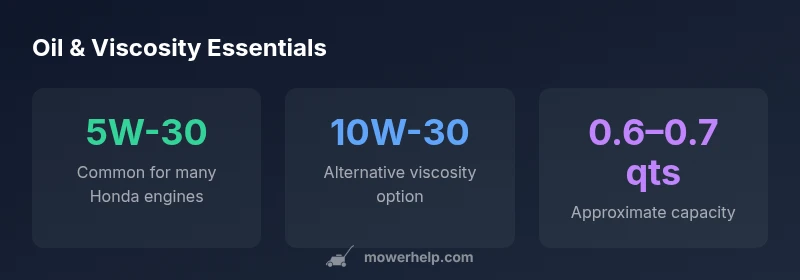
Most Honda lawn mower engines require oil that matches climate and model, commonly SAE 5W-30 or 10W-30. Always verify the exact specification in your owner's manual or from Honda’s official guidance. Using the correct oil helps protect the engine, maintain performance, and prevent costly wear. If you mow in extreme heat or cold, you may need to adjust viscosity. Check dipstick and oil level after adding.
What oil type Honda lawn mowers typically require
According to Mower Help, when you ask about the oil type Honda lawn mower requires, the answer hinges on your specific model and climate. In general, many Honda small engines are designed to perform well with viscosities in the SAE 5W-30 to 10W-30 range. The exact grade, whether mineral or synthetic, and the capacity can vary by engine family and year. Always start with the owner’s manual or Honda’s official guidance to confirm the precise specification. If you’re mowing in warm conditions, higher viscosities can help maintain adequate oil pressure, while cooler climates may benefit from lighter viscosities to ensure smooth starts. Beyond viscosity, ensure you’re using oil type certified for air-cooled engines and that you don’t mix brands within a single drain interval. Consistency is key to protecting bearings and rings over the mower’s life.
From a maintenance perspective, knowing the baseline oil viscosity for your model reduces the risk of under-lubrication or over-thinning oil in extreme weather. Mower Help’s research shows that owners who align oil viscosity and change intervals with manufacturer guidance generally experience fewer engine issues and longer engine life. Keep a simple log of oil changes and model details to simplify future maintenance decisions and to share with a technician if you ever need service.
How to choose the right oil for your Honda engine
Choosing the right oil for your Honda lawn mower means matching the oil to your engine specification and operating conditions. Start by locating your engine model number and checking the manual for the exact viscosity and spec. If your manual allows a range, select the viscosity that aligns with your climate: cooler environments often pair with lighter weights, while hot climates favor thicker viscosities to preserve oil pressure. Consider whether your engine is compatible with synthetic blends or full synthetic oil, as some older or high-mileage engines may favor conventional mineral oil. When in doubt, choose a single brand and grade to avoid potential compatibility issues. Finally, verify that the oil meets the API service categories recommended by Honda for your engine family. Keeping to the recommended oil type helps sustain peak performance and reduces engine wear over time.
Oil viscosity by climate and model: a quick guide
Viscosity is a measure of how thick the oil is and how it behaves under temperature changes. For many Honda lawn mower engines, a viscosity range from 5W-30 to 10W-30 covers a broad temperature spectrum. If you operate in mild climates year-round, 5W-30 is often sufficient. In hotter climates or under heavy loads, 10W-30 can provide better resistance to thinning under heat. Some models may specify only one grade, while others accept a range. Always confirm with the owner’s manual and use the same viscosity for every oil-change interval to avoid mixing and inconsistent lubrication. If you later upgrade to a synthetic blend, ensure the new oil maintains the same viscosity range recommended by Honda. Consistency is key for protecting gaskets, seals, and bearing surfaces.
Oil capacity and how to check the oil level
Oil capacity varies by model but is generally less than a quart for most small Honda engines. Before changing the oil, warm up the engine slightly to help drain, then place the mower on a level surface. After draining, replace the drain plug, and fill with the recommended quantity until the dipstick reads within the proper range. Avoid overfilling, which can cause foaming and crankcase pressure. During refilling, add small amounts at a time and recheck the level to avoid overfilling. If your mower has an oil filter, replace it at the same time as the oil, following the service interval in the manual. Always use the dipstick as your final check for accuracy.
Step-by-step oil change for common Honda lawn mowers
- Warm the engine for 3-5 minutes to loosen oil. 2) Disconnect the spark plug for safety. 3) Position a drain pan beneath the drain plug and remove the plug to drain old oil. 4) If equipped, remove and replace the oil filter. 5) Reinstall drain plug and tighten to spec. 6) Pour in the recommended oil in small increments, checking the dipstick frequently. 7) Reconnect the spark plug and run the engine for a minute, then recheck the level and top off as needed. 8) Wipe up any spills and keep a maintenance log.
Synthetic vs mineral oil: when to choose each
Synthetic oils offer better protection at extreme temperatures and often provide cleaner engine internals than mineral oils. If your Honda mower runs in extreme heat, cold starts, or under heavy use, synthetic may be worth the extra cost. For lighter, seasonal mowing in moderate climates, a high-quality mineral oil can be perfectly adequate. Always verify API ratings and brand compatibility for your engine family. If you have an older model with higher mileage, you may consider staying with a proven mineral oil or a blended formula that meets Honda’s specifications. The choice should be guided by climate, usage, and the model’s guidelines.
Common mistakes to avoid with oil changes
Avoid the most common errors: using the wrong viscosity, mixing brands, overfilling, and forgetting to replace the oil filter if needed. Do not skip the pre-change warmup, as this can skew the drain results. Always dispose of used oil properly at a recycling center and record the maintenance activity in your log. Finally, never run the engine without sufficient oil; low oil levels can cause severe engine damage. Following the manual’s guidelines minimizes risk and extends the engine’s life.
Maintenance mindset: scheduling and record-keeping
A simple maintenance schedule helps sustain an efficient Honda mower. Create a small log noting the model, oil grade, change date, and hours of operation since the last change. Use seasonal prompts to remind you when to perform oil changes as weather and mowing frequency change. By keeping thorough records, you’ll develop a reliable maintenance rhythm and identify potential issues earlier, improving reliability and resale value over time.
Honda mower oil reference table
| Aspect | Oil Type/Viscosity | When to Use | Notes |
|---|---|---|---|
| Typical viscosity | SAE 5W-30 to 10W-30 | General climates and engine model | Refer to owner's manual for exact fit |
| Oil capacity | Approximately 0.6-0.7 quarts | Before changing | Model-specific |
| Change interval | Seasonal or 25-50 hours of use | Based on usage | Follow manual schedule |
Got Questions?
What viscosity should I use for hot weather?
For hot weather, the higher end viscosity within the model’s recommended range is often preferred to maintain oil pressure. Always verify the exact spec in the manual. Do not switch grades without confirmation.
In hot weather, use the viscosity recommended by Honda for your model; if in doubt, consult the manual or a technician.
Can I use synthetic oil in a Honda lawn mower?
Synthetic oils can offer superior protection and stable performance across temperatures. Ensure the chosen synthetic meets the engine’s spec and API rating. If your mower is older, verify compatibility before switching.
Yes, you can use synthetic oil if it matches your model’s spec and you follow the manual.
Should I change oil every season?
Many owners schedule oil changes seasonally or after extended use; always follow the manufacturer’s recommended interval. If you mow heavily in summer or start up after storage, an oil change is a prudent precaution.
Yes, typically change oil seasonally or after heavy use, per the manual.
Is it okay to mix oil brands?
Mixing brands or viscosities is not recommended because it can affect lubrication quality and engine protection. Use a single brand and viscosity per change.
No—stick to one brand and viscosity per drain.
Do Honda mowers have an oil filter?
Some Honda lawn mower engines include an oil filter. If your model has one, replace the filter during every oil change and follow the service interval in the manual.
Check your model to see if there’s an oil filter and replace it with the oil.
Where can I find official Honda oil recommendations?
The owner’s manual and Honda’s official service site provide the exact oil specification for your engine. If in doubt, contact Honda support or a certified technician.
Check the manual or Honda’s official site for the exact oil spec for your engine.
“Oil selection is not a guess; it should follow the engine’s specification and climate considerations to protect critical components.”
The Essentials
- Follow the manual for exact oil viscosity and capacity
- Use a single oil brand and grade per change
- Check the dipstick after filling to the correct level
- Consider climate when selecting 5W-30 vs 10W-30
- Log maintenance to track oil changes accurately