How Big Is a Riding Lawn Mower? Dimensions by Deck Size
Learn how big a riding lawn mower is across common deck sizes. This practical guide covers typical widths, lengths, and storage considerations for homeowners and DIY enthusiasts.


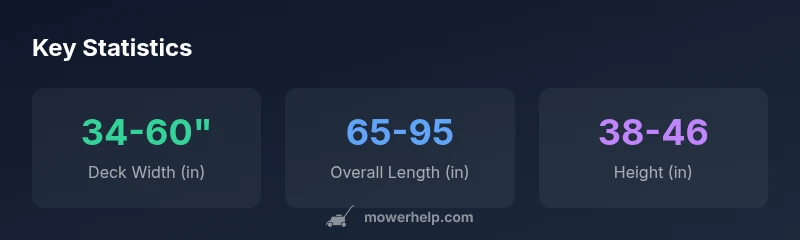
If you're asking 'how big is a riding lawn mower', typical footprints are about 34–60 inches wide (deck size dictates width), 75–90 inches long, and 38–44 inches tall, depending on model and engine. Always check the official spec sheet for exact numbers to ensure it fits through gates, into storage, and around your yard.
What determines a riding lawn mower's size?
According to Mower Help, the size of a riding lawn mower is driven by the deck width and the overall chassis footprint. A larger cutting deck increases the mower's width, while the base length and wheelbase influence how far the front and rear extend. Height is affected by the engine orientation, seating position, and any attached accessories. Understanding these three dimensions helps homeowners assess fit for storage, gate clearance, and maneuverability across variable terrain. The key takeaway is that the deck size is the dominant factor in footprint, but overall length and height matter for real-world access and usability. This nuance is especially important for DIY enthusiasts who juggle a tight shed or garage space, gate openings, and seasonal storage. When you map out your space, you can translate rough yard size into a practical deck width, and then verify the mower’s length and height against doors, ramps, and curbs.
How deck size translates to your footprint
Deck widths of 30, 42, 48, 54, and up to 60 inches are common in riding mowers. Each increment in deck width adds roughly a few inches to the mower’s overall width, and often to the machine's length due to the mower’s frame and turning geometry. Smaller decks yield a tighter turning radius and easier storage, while larger decks reduce mowing passes per session but require more gate width and storage space. In practice, choosing a deck size is a trade-off between mowing speed and space constraints, not just lawn size. For homeowners with irregular lawns or sloped terrain, the wider footprint can influence traction and balance, especially when crossing thresholds or entering uneven ground.
Practical steps to measure for your space
Start by measuring the widest point the mower will need to pass through—gate openings, doorways, and shed entrances. Next, measure the proposed storage area’s width and length, leaving a few inches of clearance on each side. When you shop, compare the deck width (for width) and the overall length and height to your measurements. Finally, verify that your mowing area can accommodate the length of the machine when turning and parking. These steps help ensure you won’t buy a mower that won’t fit through obstacles or into storage. A simple tape-measure exercise and a drawn plan can save costly returns.
Storage, gates, and maneuverability considerations
Most riding mowers exceed a typical doorway width when measured at the widest point. Plan for a little extra clearance over the bare minimum, especially if you’ll navigate through tight gates or porch areas. Consider your driveway and shed layout—will you need to pivot in confined spaces? Larger deck sizes also demand wider gate openings and longer storage spaces. If you have irregular terrain, a lighter or narrower model might be easier to maneuver than a heavier, high-deck option. For DIYers, test-fitting a scaled mock-up of the mower footprint against your gate and storage entry helps prevent surprises on moving day.
Size categories and real-world examples
- Compact deck (30-34 inches): Best for small yards and tight spaces, footprint roughly 65-75 inches long and 38-42 inches wide.
- Mid-size deck (42-48 inches): Standard choice for most suburban lawns, footprint around 75-85 inches long and 46-52 inches wide.
- Large deck (54-60 inches): Suited for larger properties, footprint about 85-95 inches long and 54-60 inches wide.
Choosing the right size for your mowing needs
Start with your yard size and gate dimensions. If you mow on tight corners or have narrow gates, a compact deck model may be best. If you aim to reduce the number of passes on a large, open lawn, a larger deck can boost efficiency but requires more storage and passage space. Always verify the full dimensions in the spec sheet and allow extra clearance for turning and attaching accessories.
Approximate footprint by common deck sizes
| Deck Size (inches) | Estimated Overall Length (inches) | Estimated Overall Width (inches) | Estimated Height (inches) | Notes |
|---|---|---|---|---|
| 30-34 | 65-75 | 38-42 | 38-40 | Compact and narrow access |
| 42-48 | 75-85 | 46-52 | 40-44 | Balanced for most yards |
| 54-60 | 85-95 | 54-60 | 42-46 | Larger yards and longer storage |
Got Questions?
What is the typical width of a riding mower?
Most riding mowers range from about 34 to 60 inches wide, depending on deck size and wheel configuration. Always confirm the exact width on the product spec sheet.
Riding mowers usually fall between 34 and 60 inches wide, so check the spec sheet for the exact measurement before buying.
Do riding mowers come with adjustable deck sizes?
Some models offer different deck width options, often in the 30–60 inch range. When buying, verify available deck sizes for the specific model.
Some mowers let you choose deck sizes, usually in a 30 to 60 inch range.
How can I tell if a mower will fit through my gate?
Measure your gate width and compare it to the mower’s width (deck width is the main factor). Allow extra clearance for hinges and handles.
Measure the gate width and deck width, and leave some clearance for hinges.
What’s the difference between deck size and overall footprint?
Deck size refers to mowing width, while the overall footprint includes the mower’s length, width, and height. Both affect space needs and maneuverability.
Deck size is the mowing width; footprint is the full size of the mower.
Can I resize my storage area to fit a larger mower?
If you resize, ensure you maintain safe clearance for turning and operation. Larger mowers require longer and wider storage spaces.
You can adjust storage, but it needs extra space for turning and access.
“Accurate sizing starts with the deck width and engine configuration. When in doubt, compare specs across models to find a safe fit.”
The Essentials
- Measure your gate and storage space before choosing a deck size
- Expect larger decks to increase width and overall length
- Check the spec sheet for exact measurements and clearance
- Lawn-mower footprint varies by model and design