Zero Turn Lawn Mower vs Riding Mower: A Practical Guide
Compare zero turn lawn mowers and riding mowers to identify which fits your yard, budget, and maintenance routine. This Mower Help guide covers efficiency, terrain, safety, and long-term costs for homeowners.


TL;DR: For many homes, a zero turn lawn mower delivers faster mowing and tighter turns around obstacles, while a riding mower offers steadier performance on slopes and larger terrains. According to Mower Help, the choice hinges on yard layout, budget, and maintenance willingness. This quick comparison helps you decide quickly between zero-turn and riding designs.
What They Are and How They Work
Zero turn lawn mowers (often called ZTRs) are designed for speed and agile maneuvering. They typically use two independent drive systems and controls such as lap bars or two steering levers, allowing the mower to pivot on the spot and complete tight turns with virtually zero radius. Riding mowers, by contrast, resemble small tractors. They use a single forward drive system and a steering wheel or levers, offering a stable, seated operation with a gentler turning arc. For homeowners, the practical difference comes down to intended paths: ZTRs excel in cluttered yards with trees, landscaping islands, and obstacles; riding mowers shine on open lawns, longer straight passes, and sessions that favor comfort. As always, choose a model with the right deck width, engine power, and transmission type for your yard.
Core Differences You Should Care About
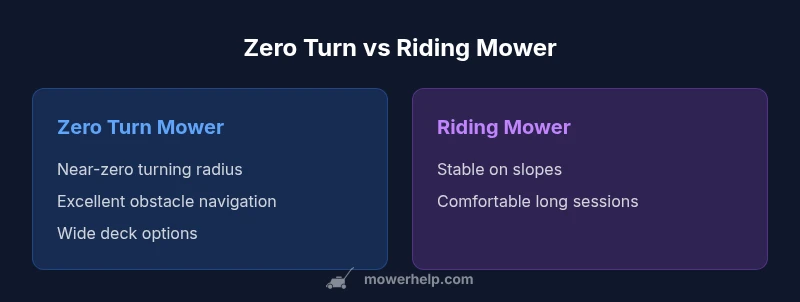
When comparing zero turn lawn mower vs riding mower, the most consequential differences fall into five categories: turning/inclusion, throughputs, comfort and safety, maintenance, and cost. Turning radius is the most obvious. ZTRs eliminate most obstacles by turning on a dime, while riding mowers require wider sweeps. Deck width and blade configuration affect cut quality and time. Operator experience matters: zero-turns require manual control coordination; riding mowers are easier for beginners. Maintenance considerations include belt life, transmissions, and hydrostatic systems, which can vary by brand. Finally, total cost of ownership includes purchase price, fuel economy, maintenance, and resale value. The best choice depends on your yard layout, terrain, and how much time you’re willing to invest in upkeep. For many homeowners, the decision is a balance between productivity and long-term savings.
Yard Type and Terrain: Open Lawns vs Irregular Surfaces
Your yard shape defines the winner. A flat, obstacle-dense property benefits from a ZTR’s tight turning and compact footprint, which reduces trimming and back-and-forth. If your lawn contains gentle hills, irregular contours, or rough ground, a riding mower can offer more stability, plush seating, and simpler traction management. On large estates with long straightaways, a riding mower might deliver a comfortable, uninterrupted ride; conversely, a ZTR can still deliver impressive mowing speed if there are long open runs between obstacles. In all cases, ensure your chosen deck width matches the mowing width you prefer, and consider tire tread and chassis strength for your terrain.
Turning Radius and Terrain Handling
Returning to the core metric, turning radius matters more on smaller lots with many landscape features. A zero-turn mower’s near-zero radius allows you to edge along fence lines and around trees with minimal edging passes. Terrain handling depends on drive systems; hydrostatic transmissions ease speed changes, while belt-driven units may be less responsive. For hills, a riding mower generally maintains better stability thanks to a seated operator position and wider wheels. If your lawn features slopes, evaluate slope ratings for each model and follow manufacturer guidelines. In practice, test a model’s ability to navigate tight corners, fetch edges, and maintain traction on uneven slabs or mulch beds.
Deck Size, Power, and Drive Systems
Deck width directly affects cutting time and the number of passes you’ll need. Most models in both categories offer deck sizes from about 42 inches up to 60 inches; wider decks can cut more area per pass but require broader mowing space. Power varies by engine displacement and horsepower rating, with ZTRs often pairing higher mowing speeds with compact footprints; riding mowers emphasize steady, reliable power for comfortable long sessions. Drive systems differ too: ZTRs use dual independent hydrostatic drives for precise steering, while riding mowers rely on a traditional steering wheel and single drive system. Weight, balance, and suspension also influence how comfortable each option feels over time.
Operator Comfort, Safety, and Usability
Because you spend time seated or standing during mowing, comfort matters. Riding mowers typically have larger, plush seats and smoother ride quality; controls are familiar to anyone who has driven a car. Zero-turns are often more compact and aggressive, with controls that demand attention but reward agility; many models include anti-scalp wheels, improved seat cushions, and vibration-reducing components. Safety considerations include rollover risk on slopes, blade engagement controls, and emergency shutoffs. Always read the manual and wear appropriate PPE. In any case, prioritize ergonomic controls and easy access to the blade engagement lever or switch, especially if you plan long mowing sessions.
Maintenance, Durability, and Long-Term Costs
Maintenance for ZTRs and riding mowers shares some common elements, such as air filters, oil changes, spark plugs, and blade sharpening, but there are important differences. ZTRs feature more complex decks and drives; you may encounter belt wear on the deck, hydrostatic components, and hydraulic lines. Riding mowers tend to be simpler mechanically, with more straightforward service intervals. Both benefit from regular blade sharpening, tire pressure checks, and safe storage. Expect to replace belts, pulleys, and cables less often on quality, mid-range models, but be prepared for potential transmission or hydraulic service with higher-end ZTRs. A warranty and dealer support can significantly influence ownership costs.
Price Range and Ownership Costs
Price is often the decisive factor for many buyers. Zero turn mowers generally command higher upfront prices than comparable riding mowers, especially when you factor in larger deck options and advanced drive systems. However, you can find reliable models in mid-range price bands, and used units can offer substantial savings with proper maintenance. Riding mowers typically start at mid-range prices and go up for premium features like wide decks, seat comfort, and enhanced trimming accessories. Ongoing costs include fuel, oil, blade replacements, and occasional tune-ups. When budgeting, also factor in potential attachments such as bagging systems or mulching kits, which add to total ownership costs but improve mowing efficiency.
Real-World Scenarios: When to Choose Each
Consider a 1–2 acre lot with 60 percent open turf and 40 percent landscaped beds. A zero-turn mower will maximize cutting speed around obstacles and reduce the time spent trimming around trees and flower beds. A riding mower would handle a longer mowing path with more comfortable seating and stability on modest slopes. On a 3–4 acre property with hills and uneven ground, a riding mower might offer better traction and operator comfort, while a zero-turn may still work if you segment the property into flat sections. For urban backyards under an acre, a compact zero-turn may prove ideal for tight spaces and edge-to-edge performance; if space is limited, consider a riding mower with tight turning radius.
Common Myths and Pitfalls
Common myths include the belief that a zero-turn is always faster or that all riders struggle on slopes. In reality, the best choice depends on yard layout. A ZTR can be excellent on obstacle-rich spaces, but may be less forgiving on side slopes where a riding mower offers stability and control. Another pitfall is assuming bigger decks always equal better results; deck width must align with the mowing area and landscape features. Finally, some buyers underestimate maintenance needs; both types require routine service, blade care, and winterization.
Buying Guide: How to Pick the Right Model
Start with yard size and terrain. If your property is mostly flat with obstacles, a zero turn with a mid-to-wide deck can cut more efficiently. If you have frequent slopes or long mowing sessions on uneven ground, a riding mower with a comfortable seat and proper traction is often a better fit. Check transmission type, blade quality, and warranty coverage; confirm dealer support for maintenance and blades. Compare real-world user reviews and test-drive several models; ensure service availability in your area. Finally, budget for maintenance and attachments, then compare total cost of ownership across multiple options.
Practical Next Steps and Evaluation Checklist
Before you buy, write down yard features like obstruction density, slope range, and preferred mowing width. Visit local dealers to test-drive at least two models from each category, focusing on comfort, control, and ease of edge trimming. Bring a tape measure to verify deck width compatibility with your yard, and request a written maintenance plan and warranty terms. After your test drive, evaluate the balance between productivity and learning curve; the right choice should reduce your mowing time while providing reliable performance in your yard conditions.
Comparison
| Feature | Zero Turn Mower (ZTR) | Riding Mower |
|---|---|---|
| Turning radius | Near-zero turning radius for tight obstacle navigation | Moderate turning radius, good for longer straight lines |
| Deck width options | Commonly 42–60 in decks; wide range for various yards | Commonly 42–60 in decks; flexible options for size |
| Mowing speed and throughput | Faster cutting in open spaces; excellent edge-to-edge performance | Steadier pace with comfortable ride; efficient on longer runs |
| Terrain handling | Excellent around obstacles; less stable on steep slopes or uneven ground | More stable on slopes and rough terrain; easier traction control |
| Best for | Open yards with obstacles and tight corners | Larger, uneven, or hilly properties with long mowing paths |
| Maintenance complexity | More complex due to dual drives and deck mechanisms | Generally simpler maintenance with traditional drive systems |
Benefits
- Faster mowing on open lawns with many obstacles
- Exceptional maneuverability around trees and landscape features
- Wide availability of models and deck options for customization
- Produces precise stripe patterns on flat terrain
Cons
- Higher upfront cost on many models
- More complex maintenance and potentially higher repair costs
- Less stable on steep slopes and uneven ground without proper technique
Zero-turns win on flat, obstacle-dense yards; riding mowers win on slopes and for long, comfortable sessions.
If your yard is mostly flat with obstacles, choose a zero-turn; for hills or uneven terrain, a riding mower provides better stability and comfort. The Mower Help team recommends evaluating your yard layout and willingness to maintain a more complex drive system before deciding.
Got Questions?
What is the practical difference between a zero-turn mower and a riding mower?
The main difference is turning radius and maneuverability. Zero-turn mowers excel at tight turns around obstacles, while riding mowers offer smoother handling on slopes and longer straight passes. Your yard layout and maintenance willingness should guide the choice.
Zero-turns turn sharply around obstacles, whereas riding mowers feel smoother on slopes. Your yard shape and maintenance plan determine which is best.
Is a zero-turn mower better for small yards with lots of obstacles?
Yes. In tight spaces full of trees or garden beds, a zero-turn mower reduces trimming and shaves minutes off mowing. For hilly or uneven areas, evaluate stability and traction before deciding.
Yes, for small yards with many obstacles a zero-turn can save time; for slopes weigh stability too.
Can zero-turn mowers mow on slopes?
Zero-turn mowers can handle mild slopes, but most models have recommended slope limits. Riding mowers often perform better on steep hills due to seated operator stability and wider tires.
Zero-turns can handle mild slopes, but check the manufacturer’s slope guidelines. Riding mowers usually handle steeper hills more securely.
Which mower is safer for beginners?
Riding mowers are generally easier for beginners due to a familiar steering wheel and stable seating. Zero-turns require learning to manage two drives and edge navigation, so start with slow speeds and practice in open areas.
Riding mowers are typically easier for new users; zero-turns need practice with dual controls.
What should I look for in a buying guide?
Focus on yard size, terrain, deck width, transmission type, and warranty. Also consider maintenance support in your area and the availability of spare parts. Read user reviews to gauge reliability.
Look for yard size, terrain, deck width, transmission, warranty, and local support. Check reviews for reliability.
Do zero-turns require more maintenance?
Yes, they can require more complex maintenance due to dual drives and deck mechanisms. Typical upkeep includes belt checks, blade sharpening, and periodic hydraulic or transmission service depending on model.
Zero-turns can be more maintenance-heavy because of dual drives and decks; expect belt and hydraulic checks.
The Essentials
- Assess yard layout to determine turning needs
- Prioritize slope and terrain handling in your decision
- Budget for maintenance and total ownership costs
- Test-drive both types before buying
- Plan for attachments that improve efficiency