Blade Lawn Mower Blade Care: Sharpen, Balance, and Maintain
Learn how to sharpen, balance, and maintain blade lawn mower blades for a clean cut, safer operation, and longer blade life. This practical DIY guide from Mower Help covers tools, steps, and safety for blade care.


In this guide you will learn how to inspect, sharpen, balance, and reinstall mower blades to keep your blade lawn mower cutting cleanly and safely. We cover safety checks, sharpening angles, balancing techniques, and when a blade should be replaced. Following these steps helps maintain peak mowing performance and reduces wear on your mower.
Why blade lawn mower blades matter
A sharp, well-balanced blade is essential for a clean cut, healthy turf, and efficient mowing. When the edge is dull, the blade tears grass rather than cleanly slicing it, leading to ragged edges, increased friction, and higher engine load. This not only dulls the blade faster but also stresses the mower’s powertrain and can shorten engine life. According to Mower Help, blade sharpness directly affects cutting quality and overall mower performance, especially when dealing with tall grass or damp conditions. In this section, we cover the core reasons blade condition matters and how proper care translates to a healthier lawn and longer blade life. By understanding the impact of edge geometry, homeowners can plan regular maintenance that minimizes downtime and ensures a top-notch cut.
Understanding blade types and compatibility
There are several blade designs tailored to different mowing goals. Mulching blades are shaped to chop clippings into finer pieces and help recycling of clippings, while high-lift blades maximize air flow for a stronger lift and bagging. Side-discharge blades emphasize straight, efficient cuts with robust edge angles. Each mower model has specific mounting patterns and bevel angles, so compatibility is crucial. Always match a blade to your mower’s manual and model. If you’re unsure, consult a trusted source like Mower Help for compatibility guidance. Using an incorrect blade can reduce cut quality, cause vibration, and stress belts or spindles. The goal is to maintain the original bevel angle, edge geometry, and mounting hole pattern to ensure safe operation and optimal performance.
Tools and safety before sharpening or replacing blades
Before you touch a blade, lay out PPE: cut-resistant gloves, safety glasses, and sturdy footwear. Clear the area of bystanders and pets, and ensure the mower is powered off. For gas-powered models, disconnect the spark plug wire to prevent accidental starts; if possible, drain fuel to minimize spills. Use a bench vise or clamps to hold the blade steady during sharpening, never balancing on your hand. Work in a well-ventilated space and keep a fire extinguisher nearby. Remember blades are extremely sharp even when not spinning—treat them with respect and handle with care. Check the blade for cracks, bends, or excessive corrosion, which warrant replacement rather than sharpening.
Step-by-step: remove, inspect, and set blade condition
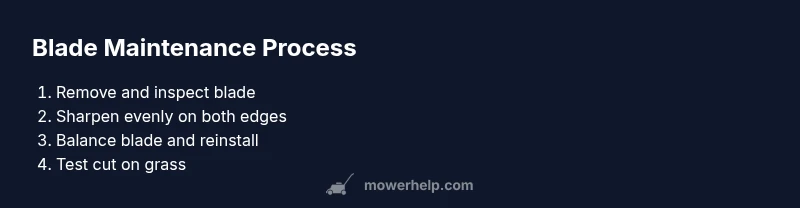
To begin, power down the mower and ensure all safety precautions are in place. If your model has a safety switch or blade brake, disengage it according to the manual. Remove the blade bolt with an appropriate socket or wrench, and carefully lift the blade away from the spindle. Inspect the blade for nicks, cracks, or bends; measure thickness if you have a caliper, and compare against the manufacturer’s specs. If damage is visible or the edge cannot be restored without compromising the blade’s integrity, replace it. If the blade shows minor wear near the edge, you can proceed to sharpening, keeping the entire edge uniform and true.
How to sharpen blade: methods and techniques
There are two common approaches: file sharpening and grinder sharpening. A flat mill file or round file lets you control the edge, maintain the bevel, and reduce heat buildup. When using a file, set the blade flat on a stable surface and drag the file along the edge in smooth, sustained strokes at a consistent angle. For grinders, use a silicon carbide wheel and set a moderate speed, moving gradually to avoid overheating. Whatever method you choose, keep the blade cool with light strokes and occasional quenching in water to prevent warping. After sharpening, inspect the edge for uniformity and symmetry on both sides; uneven edges can cause tugging and vibration.
Balancing the blade after sharpening
Balanced blades rotate evenly around the center; an imbalanced blade can cause vibration, belt wear, and uneven cuts. Use a blade balancer or place the blade on a vertical axis to test for heavy spots. If one side dips, remove a little material from the heavier edge using controlled strokes and test again. Rebalanced blades run smoother and also reduce stress on the spindle and deck. If balancing seems difficult, consider rotating the blade 180 degrees and rechecking, as many blades have a slight asymmetry that can be corrected by proper mounting. A well-balanced blade improves cut quality and prolongs the life of mower components.
Replacing a dull or damaged blade
If the blade is cracked, bent, or has significant nicks beyond reasonable repair, replacement is the safer option. When selecting a replacement, match the blade type (mulching, high-lift, or standard) and verify compatibility with your mower model. Install the new blade by aligning the mounting holes and tightening the bolt to the manufacturer’s specified torque. Recheck the blade orientation to ensure the bevel faces the correct direction for cutting. After installation, rotate the blade by hand to confirm it moves freely without contacting the deck or pulley.
Reinstalling and testing safely
With the blade in good condition, reinstall by mounting the blade onto the spindle with the bevel facing the correct direction and using the appropriate torque. Reattach any blade cover or safety guard and ensure all fasteners are snug. Before mowing, perform a safety check: clear debris from the deck, confirm blade clearance, and perform a short test cut on a level strip of grass. Listen for abnormal noises or vibrations; if you notice any, stop and recheck installation. Regularly inspect the blade after a few mowing sessions to catch wear early and maintain best performance.
Tools & Materials
- cut-resistant gloves(Leather or synthetic; snug fit; avoid loose cuffs)
- safety glasses(ANSI Z87.1 rated; impact resistant)
- socket/wrench set(Metric and SAE sizes as needed)
- bench vise or clamps(Secures blade during sharpening)
- angle grinder or sharpening file(Grinder for heavy sharpening; file for precise bevel)
- metal file(Fine-to-medium for edge cleanup)
- blade balancer or nail on a dowel method(Balance check ensures even rotation)
- replacement blade (optional)(Have a compatible spare on hand)
Steps
Estimated time: 90-120 minutes
- 1
Power down and prep safety
Turn the mower off, remove the key or switch, and disconnect the spark plug wire if gas-powered. Put on PPE and clear the work area. This step protects you from unexpected starts and ensures a stable workspace.
Tip: Never work with the blade engaged or with the engine hot. - 2
Disconnect and secure
If you must work on a gas mower, drain fuel if practical and store fuel in approved containers. Use a bench vise or clamps to secure the blade so it cannot move while you loosen the bolt.
Tip: Loosen the blade bolt while the blade is still tight on the spindle; this prevents spinning. - 3
Remove the blade
With the blade secured, remove the mounting bolt and carefully lift the blade away. Note the orientation to ensure correct reinstallation.
Tip: Place the blade flat on a work surface to avoid bending. - 4
Inspect the blade
Check for cracks, bends, deep nicks, or excessive wear. If any of these are present, replace the blade rather than attempting to repair it.
Tip: If unsure, compare to a known-good blade from a compatible model. - 5
Sharpen evenly
Use a file or grinder to restore a uniform edge on both sides. Maintain the original bevel angle and avoid removing material from one side only.
Tip: Avoid overheating; cool the blade with water during sharpening. - 6
Balance the blade
Place the blade on a balancer or a vertical axis to identify heavy spots. Remove material from heavy edges as needed until it rotates evenly.
Tip: A balanced blade reduces vibration and extends deck life. - 7
Reinstall and test
Mount the blade with correct orientation and torque the bolt to the recommended spec. Reattach guards and test with a light cut on flat ground.
Tip: Do a quick visual check for clearance before starting.
Got Questions?
How often should I sharpen my mower blade?
Sharpen when you notice dull edges or ragged cuts. Frequency depends on mowing conditions and usage; inspect regularly and sharpen as needed.
Sharpen when you see dull cuts or ragged edges, based on how often you mow and the conditions.
Is it necessary to balance a blade after sharpening?
Yes. Balancing reduces vibration, protects the spindle, and improves cut quality. Use a blade balancer or a simple balancing method.
Yes. Balance it after sharpening to avoid vibration and damage.
Can I sharpen blades with the mower still attached?
No. Always remove the blade and disconnect ignition components before sharpening to prevent accidental starts.
No—remove the blade and disconnect the ignition first.
What angle should I use when sharpening?
Keep the original bevel angle, typically between 30 and 45 degrees, and maintain a consistent angle on both sides.
Keep the same bevel; usually between 30 and 45 degrees, and stay consistent.
When should I replace a blade instead of sharpening?
Replace if the blade is cracked, bent, or severely worn. Sharpness alone is not a safe justification for a damaged blade.
Replace when damaged or bent; don’t sharpen a compromised blade.
Watch Video
The Essentials
- Inspect blades before each season.
- Sharpen with proper angle and equal effort on both sides.
- Balance blade after sharpening for smooth operation.
- Replace damaged blades promptly to protect mower and turf.
- Follow safety procedures for a DIY blade care routine.