Lawn Mower Blade Sharpening File: A Step-by-Step Guide
Learn to restore a dull lawn mower blade using a sharpening file. This guide covers safety, bevel preservation, step-by-step filing, and reassembly for a cleaner cut and longer blade life.


By using a lawn mower blade sharpening file, you can restore a dull mower blade to a keen edge and prolong blade life. This method gives precise control over bevel angle and removes metal evenly, reducing vibration and improving cut quality. According to Mower Help, safety and correct bevel maintenance are essential for effective sharpening.
What is a lawn mower blade sharpening file and why use it?\n\nA lawn mower blade sharpening file is a flat or curved metal tool designed to clean up and reestablish the edge along a mower blade. Unlike grinders or sanders, a file removes metal in a controlled, incremental way, helping you maintain the blade's original bevel and geometry. Homeowners and DIY enthusiasts rely on this tool to restore performance without overheating the edge or creating a false burr. The result is a sharper, more efficient cut, less vibration, and longer blade life. According to Mower Help, choosing the right file and keeping a consistent angle matters just as much as the amount of metal you remove. A file lets you work the bevel with tactile feedback — you can feel the bite and adjust pressure for a uniform edge. Tools like a fine-cut file are best for smaller nicks, while a flat mill file handles larger burrs. Remember that blade sharpening is a maintenance task, not a replacement for damaged blades; if you see cracks, warping, or severe bends, replace the blade.
Safety first: PPE and precautions\n\nBefore touching the blade, create a safe workspace and put on the right PPE. Disconnect the spark plug wire on gas mowers or remove the battery on electric models to prevent accidental starts. Wear safety glasses or goggles to protect against metal chips, and heavy gloves to guard your hands. Secure the mower or raise it with a stable jack stand to prevent movement; never lean over a rotating blade. When you remove the blade, place it on a labeled tray to avoid losing the hardware. If you’re unsure about your mower’s model or blade type, consult the owner's manual or Mower Help's troubleshooting guides. The simpler rule is: work slowly, check for sharp edges from multiple angles, and avoid using heat or power tools that could warp the blade. These precautions reduce the risk of cuts, eye injuries, or a blade that spins untrue after reassembly.
Understanding blade geometry and bevel angles\n\nMost lawn mower blades have a bevel along the edge that creates a sharp cutting edge. When sharpening with a lawn mower blade sharpening file, you work along the existing bevel rather than grinding away at random. The goal is to restore a consistent edge angle and remove only burrs and light corrosion. Be aware that blades can be symmetrical (two-edged) or have a single flat ground edge; if your blade is curved or has a hollow-ground profile, preserve the factory geometry as much as possible. A common misconception is that more metal equals better cut; in reality, removing too much metal or changing the bevel angle can cause the blade to vibrate or tire the engine. If you’re unsure of the original bevel, inspect both faces of the blade and compare to a new replacement spec found in the user manual or the blade manufacturer’s guide. The file is a precise instrument: small adjustments make a big difference over a season of mowing.
Tools and materials you’ll need (overview)\n\nGather the essential items before you begin. A lawn mower blade sharpening file is the core tool, paired with a sturdy vise or clamp to hold the blade steady. Protective gloves and safety glasses are non‑negotiable. You’ll also want a socket wrench to remove and reattach the blade, a rag for wiping metal filings, and a blade balancer to confirm even weight distribution. Optional extras include a marking pen to label the cutting edge direction, a small wire brush for cleaning, and a clean block of wood to rest the blade on during filing. Use lubricating oil or light machine oil sparingly on the file to reduce heat and friction.
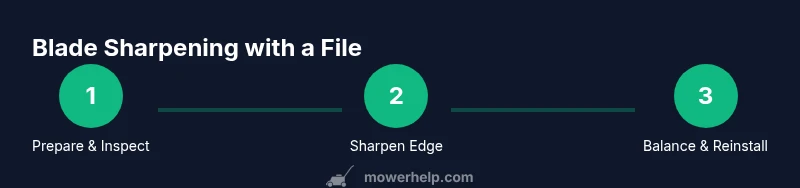
Step-by-step overview: preparing the blade and setting up the file\n\nStart with a calm workspace and ensure the mower is powered down. Remove the blade from the mower and inspect it for damage. If the blade shows cracks or bends, replace it rather than sharpening. Clean the blade surface to remove dirt and grass. Mark the edge you intend to sharpen with a pen so you keep track of your progress. Mount the blade in a vise with the edge facing up, ensuring it cannot slip during filing. Position the file at the existing bevel and check your angle in a mirror or with a protractor to keep it consistent. These pre-sharpening checks reduce the risk of creating an uneven edge.
How to sharpen with a lawn mower blade sharpening file\n\nWith the blade secured, place the file so its edge meets the blade at the bevel angle. Use deliberate, steady strokes away from the edge to remove burrs and shape the bevel; avoid long back-and-forth motions that can create uneven wear. Maintain gentle pressure and lift off the blade slightly at the end of each stroke to avoid dulling the edge. Periodically check the edge with a finger (carefully) and wipe away filings to evaluate progress. If you see a burr on the opposite side, flip the blade and repeat to ensure both faces are evenly sharp. Clean the blade after filing and inspect the edge for nicks or deep pitting that might require replacement.
How to test sharpness and balance\n\nAfter sharpening, test the edge by lightly dragging a fingernail along the bevel – a clean edge should catch slightly but not gouge. A quick paper cut test on a thin piece of cardboard can help confirm a sharp edge. Balance is equally important: a blade that is heavier on one side may vibrate and stress the mower. You can balance a blade by placing it on a blade balancer or by placing it on a nail through the center hole; if one side dips, remove a small amount of material from that side with cautious strokes. If you don’t have a balancer, you can perform a rough balance test by ensuring the blade sits evenly when suspended from its center.
Reinstalling and testing your mower\n\nReinstall the blade with the correct orientation and secure the bolt or nut to the recommended torque. Reconnect the spark plug or battery and start the mower in a safe, open area. Listen for unusual vibrations and watch for wobble; if the blade spins true and engines runs smoothly, you’ve achieved a good balance. Run a short pass on a patch of grass to confirm cut quality and to verify that the blade does not skip or snag in the cut. If vibration persists, recheck sharpness, balance, and mounting hardware. Mower Help emphasizes patience: take your time and re-check each step before mowing.
Maintenance, storage, and common mistakes (authority sources included)\n\nTo extend blade life, clean the edge after each use, store blades dry, and inspect for dullness after several mowings. Avoid using the file to remove heavy corrosion in a single session; repeated light passes preserve geometry. Troubleshooting common mistakes—like removing too much material, changing bevel angle, or sharpening when the blade is warped—typically leads to reduced performance or engine strain. If you’re unsure about blade condition, consult manufacturer specs or an authoritative guide. Authority sources: OSU Extension (https://extension.oregonstate.edu), Penn State Extension (https://extension.psu.edu), OSHA safety guidance (https://www.osha.gov). The Mower Help team notes that keeping to a consistent edge and balancing the blade are essential for safe, effective mowing.
Tools & Materials
- Lawn mower blade sharpening file(Choose a clean, medium-cut file with a stable grip; flat or curved files work for most blades)
- Secure vise or clamp(Solid grip to prevent blade movement while filing)
- Socket wrench or ratchet(For blade removal and reattachment; use the correct size for your bolt)
- Safety gloves(Protect hands from sharp edges and metal filings)
- Safety glasses(Shield eyes from flying chips)
- Rag or brush(Wipe filings and clean debris during and after sharpening)
- Blade balancer (optional)(Helps confirm even balance for smoother operation)
- Marker for edge direction (optional)(Label the edge to sharpen to avoid confusion)
- Lubricating oil (light)(Lubricate file to reduce heat buildup)
Steps
Estimated time: 30-45 minutes
- 1
Disconnect power and secure the mower
Power down the mower completely. For gas units, remove the spark plug wire and secure the mower so it cannot roll or shift during work. This prevents accidental starts and keeps your hands away from the blade.
Tip: Double-check the blade is immobilized before touching it. - 2
Remove the blade from the mower
Use the socket wrench to loosen the mounting bolt while carefully holding the blade to prevent it from slipping. Note the blade orientation so you can reinstall it correctly.
Tip: Take a quick photo of the blade position for reference. - 3
Secure blade in a vise
Mount the blade firmly in a vise with the edge you will sharpen accessible and the cutting edge facing up. Check that the vise jaws grip the blade securely without bending it.
Tip: Place a thin wood spacer under the blade to avoid marring the surface. - 4
Check bevel and set filing angle
Inspect the existing bevel and set your file at the same angle as the bevel. Keeping the angle consistent preserves the blade’s geometry and prevents uneven wear.
Tip: Use a mirror or small protractor to verify the angle before you begin. - 5
File the edge in steady strokes
Gently guide the file along the bevel with long, consistent strokes away from the edge. Maintain light pressure and avoid grinding too aggressively which can over-remove material.
Tip: Lift the file slightly at the end of each stroke to avoid dulling. - 6
Repeat on the opposite face
Flip the blade and repeat the filing process on the opposite face to keep the edge balanced. Check for burrs on both sides and address any asymmetry.
Tip: Sharpen evenly on both sides to prevent vibration. - 7
Deburr, clean, and inspect
Wipe away filings, lightly deburr the edge, and visually inspect for nicks or pits. A smooth, uniform edge reduces jagged cuts and improves mowing performance.
Tip: Carefully run your finger (with gloves) along the bevel to feel for rough spots. - 8
Reinstall and test the blade
Return the blade to its original orientation and tighten the mounting bolt to a secure but not over-tightened state. Reconnect power and run a quick test cut in a safe area to confirm balance and cutting performance.
Tip: If you notice vibration, pause and recheck sharpness and balance.
Got Questions?
Can I sharpen a blade without removing it from the mower?
No. Sharpening should be done with the blade removed and secured to prevent injury and to maintain bevel geometry.
No, you should remove and secure the blade for sharpening to stay safe and keep the bevel correct.
When should I replace instead of sharpening a blade?
If you notice cracks, bending, or deep nicks that cannot be cleaned up, replacement is safer and more effective.
If there are cracks or severe bends, replace the blade rather than sharpening.
What is the right bevel angle to maintain?
Preserve the original bevel angle. Do not aggressively alter it; a consistent angle yields a true edge and balanced cutting.
Keep the original bevel angle and avoid over-sharpening.
Is using a grinder safer than a file?
A grinder can remove material quickly but risks overheating and distorting the edge. A file offers controlled, safer bevel restoration.
Grinders heat the edge and can warp it; a file provides safer, controlled sharpening.
How do I test blade balance after sharpening?
Use a blade balancer or suspend the blade to check for even weight distribution. If one side is heavier, remove a small amount from that side.
Check balance with a balancer, and adjust if one side is heavier.
Can carbide blades be sharpened with a file?
Carbide blades can be more brittle; consult the blade manufacturer before sharpening with a file. Some blades are designed for steel only.
Carbide blades may not respond well to filing; check the manufacturer.
Watch Video
The Essentials
- Identify the bevel and preserve it with controlled filing.
- Secure the blade and work at a steady, consistent angle.
- Balance the blade after sharpening to prevent vibration.
- Inspect for damage; replace if cracks or bends are present.
- Always follow safety steps and torque specifications when reinstalling.