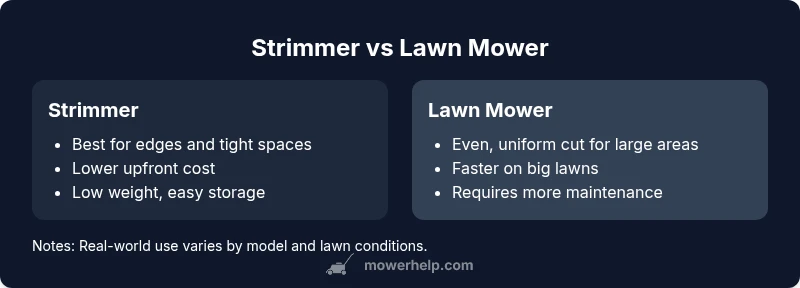
Strimmer vs Lawn Mower: A Practical Guide for Homeowners
Explore when a strimmer can substitute a lawn mower, covering efficiency, lawn size, safety, and maintenance. This buying guide helps homeowners choose the right tool for each mowing task and outlines a practical hybrid approach.


Using a strimmer can substitute for mowing in small or edges-only tasks, but for a full lawn, a dedicated lawn mower is generally more efficient. This comparison clarifies when a strimmer makes sense and when you’ll benefit from a mower. Read on to see performance, safety, and maintenance implications of choosing between the two.
Can You Replace a Lawn Mower with a Strimmer? Practical Distinctions
The everyday mowing task often prompts the question: can you use a strimmer instead of a lawn mower? A strimmer, also known as a weed eater or line trimmer, excels at edging, trimming around borders, and clearing tall grass in compact areas. It is not designed to cover large, flat areas with an even finish. The answer depends on lawn size, terrain, and how much time you’re willing to invest. According to Mower Help, many homeowners ask this question when they evaluate their tool kits for seasonal chores. This article compares the two tools on practical criteria: cutting method, speed, maintenance, safety, and cost, to help you decide what to own. The best choice often comes down to size and texture: small patches and tricky corners respond well to a strimmer, while a mower remains essential for full lawns. Throughout this piece, we’ll use can you use a strimmer instead of a lawn mower as a reference point to illustrate typical trade-offs and get you closer to a confident purchase decision.
Core Differences in Design, Cutting Mechanism, and Output
Two tools, two design philosophies. A lawn mower uses a blade rotating in a deck to shear grass at a fixed height, delivering an even, level cut across an entire area. A strimmer spins a lightweight cord to fling string and cut vegetation, mostly along edges or irregular shapes. Because of this, output quality varies: mowers create uniform density and color, while strimmers require multiple passes for neat edges and may leave uneven patches if the ground is bumpy or the grass is thick. In practice, the cutting mechanism also influences durability and maintenance. Blades in mowers are subject to dulling from small stones, but string lines in strimmers wear out and must be replaced more frequently. Power sources differ too: many gas-powered mowers offer sustained speed, while electric and battery strimmers depend on battery life. For can you use a strimmer instead of a lawn mower, these technical contrasts define core suitability and the effort required in daily use.
Suitability by Lawn Size and Terrain
Lawn size is a primary determinant. For compact urban plots, a strimmer can replace several edging tasks and reduce the number of corners to trim. For mid-sized lawns with flat terrain, a mower will cover ground more efficiently and produce a consistent finish with less time spent on adjustments. For large, irregular landscapes, a mower is generally more scalable, though you may still rely on a strimmer to reach narrow borders or under fences. Terrain matters as well: slopes, rocky patches, or uneven ground can slow any tool; a strimmer's lightweight head can be easier to maneuver on gentle slopes, but risk of uneven cutting increases in rough terrain. Seasonal weather can also impact performance; damp grass can affect traction for a mower, whereas a strimmer is typically less sensitive to moisture but can throw clippings and debris unpredictably.
Time, Cost, and Maintenance Implications
From a time perspective, a mower typically mows larger areas faster with a consistent finish, reducing overall labor on bigger lots. A strimmer shines for trimming around obstacles and edging, but it usually takes longer to achieve the same area coverage on flat grass. In terms of cost, you’ll often see lower upfront costs for basic strimmers and potentially higher long-term costs for certain mowers due to fuel, blades, and repairs. Maintenance-wise, strimmers require line replacements and occasional head service, while a mower needs blade sharpening, oil changes for gas models, and seasonal maintenance. For many households, the question of can you use a strimmer instead of a lawn mower becomes a trade-off between monthly upkeep and time spent mowing. Mower Help analysis suggests that owners who diversify with both tools often achieve the best balance between upfront outlay and long-term usability.
Safety Considerations and Best Practices
Regardless of tool choice, safety matters. Always wear eye and hearing protection, sturdy footwear, and gloves. Strimmers kick debris and can strike stones, so keep bystanders out of the arc and secure pets indoors. When using a mower, blades rotate at high speed and can cause injury if the guard or housing is damaged. Check the machine for loose parts, secure tightening points, and ensure the handle is comfortable. For can you use a strimmer instead of a lawn mower, remember that strimmer lines can pose a snag risk on uneven ground and near fences; keep the spool shield in place, replace worn lines promptly, and clean the head after use to prevent jamming. Always read the operator manual for the correct height settings and safety protocols specific to your model.
Practical Scenarios: When Each Tool Excels
- Edging and corners: Strimmer is excellent for crisp edges along sidewalks and fences.
- Small patches and irregular boundaries: A strimmer may suffice for light maintenance.
- Uniform lawns: A mower is often more efficient and produces a consistent cut with fewer passes.
- Wet grass and debris: Both tools have cautions, but a mower with a safe deck can handle damp conditions better in some cases; check local regulations about using gas tools in wet weather.
- Storage and space: If you have limited storage space, a high-quality strimmer can cover many trimming tasks with a single handle.
Decision Framework: Can You Use a Strimmer Instead of a Lawn Mower?
- Define the lawn size and shape, counting long straight runs versus irregular borders.
- Assess the time you’re willing to invest in mowing versus edging.
- Consider maintenance preferences: line replacement versus blade sharpening.
- Evaluate weather and ground conditions that influence traction and safety.
- Decide on a hybrid setup if you have multiple zones and a budget that accommodates both tools.
If you’re balancing these factors, you’ll have a clear sense of whether can you use a strimmer instead of a lawn mower for a portion of your yard tasks, or if a traditional mower remains the workhorse for the main mowing chores.
The Hybrid Approach: Maximizing Efficiency with Both Tools
The most practical path for many homeowners is to pair the two tools. Use the lawn mower for broad, even coverage of flat areas and a strimmer for edges, borders, and hard-to-reach spots. This approach minimizes time spent on tricky sections and reduces the risk of an uneven look. Budget-wise, you can optimize by selecting a mower that handles the bulk of the area and a lightweight or cordless strimmer for quick touch-ups. When using both tools, establish a routine: mow first, then trim edges, then sweep up clippings. The combined method often yields a professional finish without investing in a high-end, full-size mower for every yard.
Common Pitfalls and How to Avoid Them
- Overestimating the strimmer’s reach: It struggles on large open lawns.
- Ignoring ground conditions: Uneven terrain leads to inconsistent cuts.
- Skipping safety checks: Neglecting shields, guards, and PPE increases risk.
- Underestimating maintenance: Failing to replace line or sharpen blades reduces performance.
- Relying on one tool for all tasks: A hybrid approach typically delivers the best results.
Comparison
| Feature | Strimmer | Lawn Mower |
|---|---|---|
| Coverage area | Edges/small patches and borders | Whole-lawn mowing with even finish |
| Cutting method | Rotating string that trims vegetation | Rotating blade for shearing grass |
| Maintenance | Line replacements and head cleaning | Blade sharpening and periodic oil changes |
| Noise level | Typically loud with vibration, varies by model | Generally higher but depends on engine and deck |
| Safety concerns | Debris projection risk; PPE essential | Blades pose direct cut risk; guards crucial |
| Price range | $60-$350 | $150-$900 |
| Best for | Edges, borders, and quick touch-ups | Uniform lawns and larger flat areas |
Benefits
- Excellent for edging and fine-detail work
- Lower upfront cost for many models
- Versatile, multi-season tool with compact storage
- Lightweight and easy to maneuver in tight spaces
Cons
- Not efficient for large, uniform lawns
- Can be slower to cover big areas
- Line wear requires regular replacement
- Uneven cuts possible on uneven terrain
Strimmer is best as a specialized edge-tool or companion to a mower
Use a strimmer for edges and small patches, but rely on a mower for daily mowing of larger lawns. A hybrid setup often delivers the best overall result.
Got Questions?
Can you replace a lawn mower with a strimmer for mowing an entire lawn?
In most cases, a strimmer alone cannot match the efficiency and uniform finish of a dedicated lawn mower for large lawns. It’s ideal for edges and small patches, not full-area mowing.
A strimmer works for edges and small patches, but for large lawns you’ll usually want a mower.
What mowing tasks is a strimmer best suited for?
Strimmers excel at edging, trimming along fences, around obstacles, and clearing tall grass in tight spaces. They’re less efficient for uniform, wide-area mowing.
Great for edges and tight spots; not ideal for broad lawn zones.
How should I maintain a strimmer versus a lawn mower?
Maintain a strimmer by replacing line, cleaning the head, and checking the spool. For a mower, change oil (gas models), sharpen blades, and replace air filters as needed.
Keep the line stocked and the head clean for strimmers; service blades and oil for mowers.
Is it safe to use a strimmer on wet grass or uneven terrain?
Wet conditions increase the risk of slips and reduced control for any handheld mower tool. Use caution, maintain traction, and avoid aggressive use on steep or uneven ground.
Be extra careful in wet or uneven ground; reduce speed and keep bystanders away.
What are the cost considerations when choosing between a strimmer and a lawn mower?
Consider initial purchase, maintenance costs, and fuel or battery usage. Strimmers tend to be cheaper upfront, while mowers may require more maintenance but cover larger areas faster.
Strimmers are often cheaper upfront; mowers save time on big lawns.
Can I dethatch or bag clippings with a strimmer?
A strimmer is not designed to dethatch or bag clippings like a mower. You’ll typically need a dedicated mower or a collector-equipped unit for cleanup.
Strimmers don’t dethatch or bag efficiently; use a mower for cleanup.
The Essentials
- Assess lawn size before choosing tools
- Use a hybrid approach for most yards
- Prioritize safety gear and regular maintenance
- Plan edging and mowing routes to maximize efficiency
- Consider storage space when selecting tools