Lawn Mower or Whipper Snipper: A 2026 Buying Guide
Discover a rigorous, data-driven comparison of lawn mower vs whipper snipper to determine which tool fits your yard. Learn about terrain, edging, power sources, maintenance, costs, and how to decide between buying one or both for optimal results.


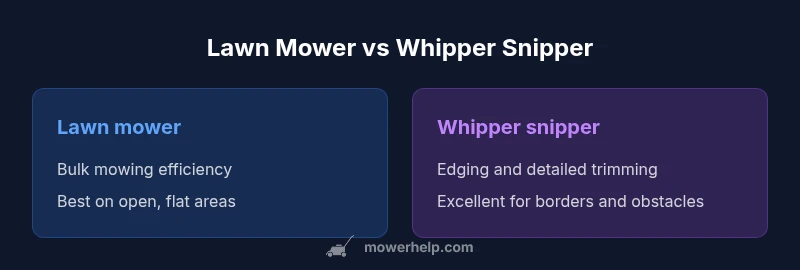
TL;DR: A lawn mower handles bulk cutting on open spaces, while a whipper snipper excels at edging and trimming around obstacles. This comparison helps you decide which tool—or both—fits your lawn size, terrain, and budget. The right choice is situational, and many yards benefit from using both tools as part of a complete system.
What you’re comparing: lawn mower or whipper snipper
Choosing between these two cornerstone yard tools is not about picking one perfect device; it's about matching your lawn's size, layout, and edging needs to the capabilities of each tool. The term lawn mower or whipper snipper frames two distinct approaches to lawn care: bulk cutting versus edge trimming and precision work. According to Mower Help, homeowners who plan ahead tend to adopt a hybrid approach: using a mower for the majority of the area and a snipper for edging, fence lines, and around obstacles. Understanding the difference helps you allocate budget, storage space, and maintenance effort more efficiently. In this article, we compare the tools across practical dimensions—terrain, performance, power and emissions, maintenance demands, and cost of ownership—so you can decide whether a mower, a snipper, or both best fits your yard. The guide also explains how to tailor a buying plan to your climate, grass type, and typical seasonal workload.
Key decision factors when comparing the two tools
When evaluating a lawn mower or whipper snipper setup, you should consider several consistent criteria. First, assess your yard’s size and shape: a large, flat area favors a mower, while irregular borders and tight gaps favor a snipper. Second, examine terrain and obstacles: slopes, rocks, and edging demand different approaches. Third, review power sources and emissions: electric options tend to be quieter and cleaner, while gas models deliver more raw torque for tough conditions. Fourth, think about maintenance: blades versus trimmer line, fuel storage, and battery care differ substantially. Fifth, plan for storage and portability: a bulky mower needs more space, a snipper is typically lighter to handle. Sixth, consider safety and noise: heavy equipment requires proper handling and protective gear. Finally, reflect on cost of ownership, including replacement parts, consumables, and service availability—all of which can swing the long-term value of either tool.
Terrain and lawn size: where each shines
Terrain and lawn size often determine the practical choice between tools. Large, open lawns with even ground are efficiently handled by a robust lawn mower, especially when you want to minimize edging time. For properties with irregular edges, fences, beds, or small side paths, a whipper snipper becomes indispensable for finishing touches. In hilly areas or zones with thick or tall grass, a mower with adequate power can reduce mowing time, but the snipper remains a critical follow-up for cut accuracy along borders. The lawn mower or whipper snipper decision should reflect how much of your total workload falls into bulk cutting versus edge refinement. A yard that blends both scenarios frequently benefits from owning both tools, or at least selecting a model with compatible accessories that extend its edge-trimming capacity.
Edge work, trimming, and precision: whipper snipper's forte
The whipper snipper, also known as a string trimmer, specializes in precision work that a mower cannot easily achieve. It excels at edges along sidewalks, fences, garden beds, and around trees. For complex layouts, the snipper enables you to follow curved borders and reach into tight corners, gullies, and irregular shapes. While a mower provides broad coverage, the snipper delivers the sharp, clean finish that gives a lawn its defined, manicured look. In the context of lawn mower or whipper snipper choices, this is the factor that often drives the decision: do you need detailed edging and trimming as a core capability, or is bulk cutting the primary requirement? If your answer is edging-heavy, prioritize a snipper or a mower with compatible edging attachments.
Power sources, emissions, and maintenance realities
Power choice drives costs, performance, and upkeep. Electric models (corded or cordless) are generally cleaner and quieter, with simpler maintenance and fewer emissions, making them attractive for small to medium yards. Gas-powered options offer higher torque and consistent performance in challenging conditions but require more ongoing maintenance and regular fuel handling. Battery technology has advanced, enabling longer runtimes and faster charging, yet it may still constrain very large properties. Maintenance for the mower typically centers on blade sharpness, belt tension, and air or filter cleanliness; for the whipper snipper, maintenance focuses on line replacement, head upkeep, and trimmer compatibility. When evaluating the lawn mower or whipper snipper, align your power choice with your climate, typical mowing duration, and tolerance for maintenance tasks.
Cost of ownership and value proposition
Understanding cost of ownership helps separate initial price from long-term value. A lawn mower generally has a higher upfront cost, but it can deliver significant time savings on large lawns. A whipper snipper tends to be cheaper upfront and offers exceptional value for trimming accuracy, yet you may end up running multiple rounds to complete edging. In mixed yards, the combined use of both tools typically yields the best results, but you should consider the total cost of consumables (blades vs. line), battery replacements, and potential service needs. The ultimate value hinges on your yard size, terrain complexity, and how frequently you perform maintenance tasks. As you budget, account for accessories, spare parts availability, and regional pricing variability.
Real-world usage patterns and case studies
Consider two typical scenarios to illustrate how homeowners navigate the lawn mower or whipper snipper decision. Scenario A involves a 600–800 square meter yard with several straightaways and a few flower beds. The bulk of the work is mowing, with edging along borders; a reliable mower delivers quick coverage, while a snipper completes touches. Scenario B covers a small, irregular lot with a sloped back area and some tight corners near a fence. In this case, the whipper snipper is the star for finishing jobs and navigating around obstacles. While these examples are simplified, they demonstrate that the best setup often combines both tools. According to Mower Help analyses in 2026, homeowners who tailor tool choices to yard geometry report higher satisfaction and lower fatigue during peak seasons.
Accessories and hybrids: expanding capabilities
Another way to optimize the lawn mower or whipper snipper equation is through accessories and practical hybrids. Some lawn mowers offer edge-trim attachments, bagging options for easy waste management, or mulching capabilities that reduce clippings. Whipper snippers support a range of heads and line materials optimized for tough grass, weedier patches, or delicate edging near ornamentals. There are even conversion kits that pair a compact mower-duties interface with a trimming head, enabling a more flexible single-tool workflow in small to mid-sized yards. When assessing options, consider compatibility with existing spare parts, ease of upgrading, and how attachments affect weight and balance during operation.
Maintenance routines to extend life
A clear maintenance routine extends the life of both tools and preserves performance. For mowers, perform regular blade sharpening, check the air filter or spark plug, clean the undercarriage to prevent grass buildup, and inspect belts and pulleys for wear. For whipper snippers, replace the trimmer line before heavy projects, inspect the head for wear, and clean cooling vents to prevent overheating. Seasonal maintenance calendars help ensure readiness for peak mowing periods. A practical habit is to perform a quick inspection before each use—check for loose bolts, ensure guards are in place, and verify that fuel or battery systems are in good condition. Keeping a small toolkit and spare trimmer line on hand can reduce downtime and keep you moving smoothly.
A decision framework you can apply today
A practical framework starts with yard profiling. Measure your lawn area and identify the proportion of bulk cutting to edging tasks. If bulk mowing dominates, prioritize a mower with enough cutting width and dependable power. If edging and tight spots dominate, prioritize a snipper with good balance and ergonomic design. For mixed workloads, plan for both tools or purchase a versatile model with compatible attachments. Finally, consider your preferred power source, noise tolerance, and maintenance willingness. This framework aligns with a data-driven approach to the lawn mower or whipper snipper decision and can guide you toward a sustainable, efficient setup.
Practical buying considerations
When you’re buying, examine warranty terms, service availability in your region, and parts support for both the mower and the snipper. Compare operating costs across models, including fuel, replacement blades or lines, battery life, and potential repairs. Consider storage space and portability—especially if you have a multi-story home or a small shed. Look for safety features like blade guards, automatic shut-off, and reverse operation safeguards. Finally, evaluate the availability of accessories that can extend the tool's lifespan and broaden its capabilities, such as edging attachments for mowers or rugged heads for snippers. A well-planned purchase that accounts for maintenance, attachments, and service will deliver the best long-term value for your specific yard.
Common mistakes and how to avoid them
Avoid assuming one tool alone will cover all yard tasks. The lawn mower or whipper snipper decision is strongest when you recognize the distinct strengths of each device. Don’t rush the buying decision; test comfort, weight, and balance in your typical mowing posture. Skipping maintenance can reduce performance and shorten lifespan, so schedule regular blade checks and line replacements. Underestimating storage needs can also cause clutter and inefficiency. Finally, avoid purchasing the wrong power option for your climate or intended workload; choose models with reliable battery life or straightforward fueling and starting procedures.
Expert tips from the Mower Help Team
From the Mower Help Team: for best outcomes, assess your yard with a simple two-step plan. Step one, map the layout to identify how much edging you’ll need. Step two, list the most challenging areas (slopes, beds, and fences). Then, decide whether to rely primarily on a mower, primarily on a snipper, or use both. Insist on ergonomic design and consider models with easy maintenance access, solid warranty terms, and available spare parts. Finally, stay safe by wearing eye protection, hearing protection, and sturdy gloves, especially during mid-season peak workloads.
AUTHORITY SOURCES: For further reading and official guidance, refer to trusted extension services and safety resources. • https://extension.illinois.edu/lawn-care • https://extension.umn.edu/lawn-care • https://www.osha.gov/
mainTopicQuery
Comparison
| Feature | Lawn mower | Whipper snipper |
|---|---|---|
| Terrain suitability | Large flat lawns and open areas | Edges, borders, and irregular shapes |
| Edge trimming capabilities | Limited; requires manual edging or attachments | Excellent; primary strength |
| Power options | Gas, electric corded, or battery-powered | Gas, corded, or battery-powered (head-driven) |
| Maintenance needs | Blade care, bagging systems, belt and deck checks | Line replacement, head maintenance, spool or reel care |
| Storage footprint | Typically larger and heavier | Typically lighter and more portable |
| Emissions and noise | Higher emissions (gas) and louder | Lower emissions with electric options; noise varies by model |
| Best for | Bulk mowing of large/open areas | Precision trimming and edging around obstacles |
Benefits
- Clarifies when to use each tool for efficiency
- Helps manage budget and maintenance planning
- Addresses safety and operation considerations
- Encourages a practical, hybrid approach when needed
Cons
- May oversimplify lawns with highly irregular shapes
- Does not provide exact price points due to market variability
- Requires storage space and possibly multiple tools
Lawn mower is typically best for bulk cutting on open spaces; whipper snipper excels at edges and tight corners.
For most homeowners, a mower handles the bulk work while a snipper handles edges. In mixed yards, using both tools yields the best results and efficiency.
Got Questions?
What is the primary difference between a lawn mower and a whipper snipper?
A lawn mower is designed for cutting large, flat areas efficiently, while a whipper snipper (string trimmer) is for edging and trimming around obstacles. Both tools serve complementary roles in a well-rounded lawn care routine.
The mower handles bulk cutting; the snipper handles edges and tight spots.
Can I use a whipper snipper on a lawn, or is it strictly for edges?
A whipper snipper can cut some lawn areas, but it is not as efficient for bulk mowing as a mower. It is best used for edges and trimming along borders or hard-to-reach spots.
Use the snipper mainly for edges and tight areas; reserve mowing to a mower.
Are there hybrid tools or attachments that combine mowing and trimming?
There are tools and attachments designed to extend similar platforms, but true hybrid machines that perform both bulk mowing and trimming on a single platform are rare. Many users rely on complementary devices or modular accessories.
Hybrid setups exist as modular options, not true single-tool hybrids.
What maintenance is required for each tool?
Mowers require blade care, deck cleaning, and periodic part checks; whipper snippers need line replacement and head maintenance. Regular checks keep both tools performing well and extend their lifespans.
Keep blades sharp and the head clean; replace lines as needed.
Should I rent or buy a mower or snipper for a small yard?
For a small, occasional yard, renting can be cost-effective, especially if you only mow infrequently. If you maintain a yard regularly, owning a mower or snipper—or both—often provides better long-term value and readiness.
Rent if you mow rarely; buy for frequent use.
What power source is best for most suburban yards?
Electric models (corded or battery) are popular for quiet operation and lower upkeep in suburban settings, while gas options offer power for larger, tougher jobs. Choose based on yard size and tolerance for maintenance.
Electric is quiet and easy; gas is powerful for big jobs.
How do I choose between a mower and snipper if my yard has both open areas and edges?
For mixed yards, many homeowners select both tools or a mower with edging capabilities and a compatible snipper. Start with bulk mowing, then finish with trimming for a clean look.
Use both: mow the bulk, trim the edges.
Are there safety considerations to keep in mind?
Yes. Wear protective gear, follow manufacturer instructions, and check guards and blades before use. Keep bystanders clear, and store fuel or batteries safely away from heat sources.
Always wear protection and follow safety guidelines.
The Essentials
- Assess lawn size and terrain before choosing tools
- Prioritize mower for bulk mowing and snipper for edging
- Plan for maintenance and spare parts from the start
- Consider power source and noise for your setting
- Most yards benefit from a two-tool approach when feasible