Difference Between Lawn Mower and Grass Cutter: A Practical Guide
Understand the difference between lawn mower and grass cutter to choose the right tool for your yard. This guide covers purpose, power, maintenance, and best-use scenarios for homeowners and DIY enthusiasts.


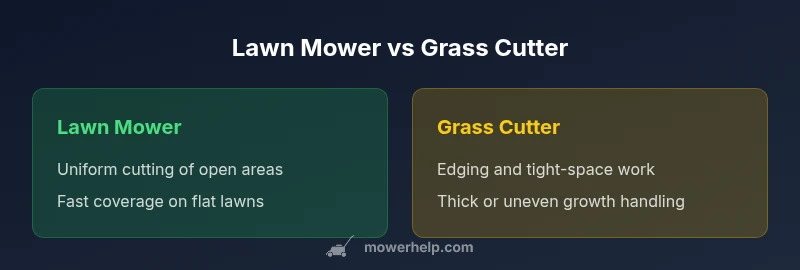
The difference between lawn mower and grass cutter revolves around purpose and design: a lawn mower is built for uniform, wide-area cutting of a grassy lawn, while a grass cutter (often a trimmer or brush cutter) excels at edging, thick growth, and hard-to-reach spots. For most yards, start with a mower for the main area and add a grass cutter for edges and overgrowth. This combination offers efficiency and versatility.
Understanding the difference between lawn mower and grass cutter
The difference between lawn mower and grass cutter is more than a naming nuance; it defines how you approach yard care. For homeowners evaluating small to medium lawns, selecting the right tool means aligning your yard size, terrain, and maintenance willingness with the machine's design. According to Mower Help, the best way to start is by distinguishing core roles: a lawn mower is optimized for uniform cutting across open areas, while a grass cutter (often a weed-eater or brush cutter) excels at edging, slopes, and dense growth. In this guide, we unpack the practical implications of that difference between lawn mower and grass cutter, with a clear framework to help you decide what to buy, what to rent, and how to use each tool safely.
Throughout the guide, you’ll see how power type, cutting system, and maintenance needs shape total cost and user effort. The goal is to help homeowners pick a tool that matches their yard, rather than forcing a single solution on all properties. We’ll also cover safety considerations, attachments, and common scenarios where using both tools together yields the best results. By the end, you’ll understand which tool is best for your space, and how to use them effectively to keep your lawn healthy and tidy.
Core definitions and roles
At its core, a lawn mower is a powered cutting device that shaves the entire lawn area with a blade or blades rotating beneath a deck. A grass cutter, in contrast, is a handheld or wheeled tool that uses a line or blade to trim around borders, edges, and areas the mower can't reach. While some machines blur the line (e.g., mower-plus-attachments), the distinction remains helpful for planning.
Key roles:
- Lawn mower: Ideal for large, open spaces, achieving a uniform height across a broad area.
- Grass cutter: Ideal for edging, clearing dense growth, and tackling tight spots along borders.
Power sources vary by model, with options ranging from corded electric to gas-powered and cordless battery systems. The choice affects run-time, weight, noise, and maintenance considerations. When thinking about the difference between lawn mower and grass cutter, remember that most homeowners find value in owning both tools for a complete yard-care solution.
Power sources and fuel types
Power source choices heavily influence operation, maintenance, and daily use. Lawn mowers come in gas, electric corded, or cordless battery variations. Grass cutters (often represented by string trimmers or brush cutters) similarly span gas, corded, and battery formats, but their design emphasizes portability and reach rather than broad-area coverage.
Electric and battery-powered options generally start more reliably, run quieter, and require less ongoing maintenance than gas units. Gas models offer more raw power for thick growth or tough edging and are less limited by battery life. When evaluating the difference between lawn mower and grass cutter, consider runtime needs, storage space for fuel or batteries, and your tolerance for maintenance tasks like spark plug or air-filter servicing.
Cutting systems and capabilities
A lawn mower uses spinning blades under a deck to achieve a uniform cut across the entire mowing area. Modern units may offer mulch, bagging, or side-discharge options, and some come with height-adjustment settings to control cut depth. A grass cutter uses a different cutting approach, either a blade attached to a head or a nylon line that whips through grass. This makes grass cutters more versatile for edging along sidewalks, clearing overgrown edges, and approaching dense vegetation.
- Lawn mower cutting system: Deck-mounted blade(s), adjustable height, wide reach across the lawn.
- Grass cutter cutting system: Head-mounted blade or line, flexible reach, better for irregular surfaces and obstacles.
In practice, homeowners often pair the two: a mower for the main lawn and a grass cutter for borders and hard-to-reach spots. This combination reduces fatigue and increases efficiency for mixed terrain.
Terrain, ground conditions, and yard size
Lawn mowing excels on flat to gently rolling lawns with consistent growth. For properties with uneven terrain, dips, or irregular borders, a grass cutter can help by accessing hillside edges, steep banks, and narrow spaces along fences. Yard size also guides the tool mix: larger, well-kept properties benefit from the speed of a mower, while smaller lots with intricate landscaping may rely more on edging and detail work with a grass cutter.
When you evaluate the difference between lawn mower and grass cutter, assess the proportion of open space versus edges and rough areas. If most of your yard is flat and regularly maintained, a mower might be enough; if your yard includes inadequate edging or uneven terrain, a grass cutter becomes a valuable companion.
Maintenance and upkeep considerations
Maintenance needs differ by model and power source. Lawn mowers require blade sharpening, deck cleaning, and periodic engine or motor servicing. Electric models generally demand less routine maintenance than gas units but still benefit from air-filter and spark-plug checks (if applicable). Grass cutters focus on maintaining the cutting head, replacing line or sharpening the blade, and checking the drive components if using a powered head.
Safety is a maintenance issue, too. Regularly inspect guards, shields, and safety switches. Use the correct fuel and oil types when applicable, store equipment properly, and follow a maintenance schedule aligned with your brand’s recommendations. Remember that the difference between lawn mower and grass cutter extends to upkeep: the mower’s deck and blade system tend to require more frequent servicing than a lightweight grass cutter head.
Size, weight, and maneuverability
Weight and size influence how you move and store the equipment, especially in small yards or tight spaces. Lawn mowers are typically larger and heavier, which helps with stability on open lawns but can hinder turning in narrow areas. Grass cutters are usually lighter and easier to maneuver in tight corners, along fences, and near landscaping features. This makes them well-suited for edging and precision work where a mower would feel bulky.
Consider storage space, wheel configuration, and handle design. A model with adjustable handles and easy-access control levers reduces fatigue and improves precision—critical for achieving clean, professional-looking edges when you use a grass cutter in tandem with a mower.
Costs, value, and buying strategy
Purchase decisions should reflect the overall value you gain, not just the sticker price. Lawn mowers can range from compact, low-cost electric models to higher-priced gas or battery-powered units with advanced features. Grass cutters vary in price based on head type, attachment ecosystem, and whether the head is line-based or blade-based. Broadly, a mower delivers speed and coverage for open spaces, while a grass cutter provides precision and reach for edges and rough patches.
Instead of chasing a single tool to do everything, many homeowners find the best value in combining a mower with a dedicated grass cutter. This pairing can reduce fatigue, improve lawn quality, and extend the life of each tool with proper use and maintenance.
Safety basics and best practices
Outdoor power equipment requires careful safety practices. Wear eye and hearing protection, read the operator’s manual, and keep children and pets away during operation. Check for loose fasteners, avoid mowing wet turf, and never operate equipment on unstable ground. With both lawn mowers and grass cutters, ensure you’re using appropriate guards, cutting heads, and protective gear. The difference between lawn mower and grass cutter also entails safe handling: keep the grass cutter head away from hard surfaces and be cautious around obstructions when edging.
A systematic safety routine—pre-operation checks, proper storage, and routine maintenance—helps prevent accidents and extends the useful life of your tools.
Quick-start buying checklist and decision framework
- Define your yard’s size, terrain, and edging needs.
- List tasks you perform most: broad mowing, edging, or clearing tall growth.
- Decide on power preference: electric for quiet, gas for power and runtime flexibility.
- Consider attachment options and maintenance commitments.
- Plan a two-tool strategy if your property has a mix of open lawn and edges.
- Check safety features, warranty, and service availability in your area.
This practical checklist helps you move from the broad concept (difference between lawn mower and grass cutter) to concrete buying decisions that align with your yard and lifestyle.
Real-world scenarios and decision trees
Scenario A: You own a 0.25-acre, flat lot with a neat, multi-season lawn. A mid-range electric mower offers quiet operation, easy startup, and quick mowing for most sessions. You can rely on a grass cutter mainly for edging along sidewalks and around flower beds.
Scenario B: You manage a hillside property with tall grasses and dense edges around a fence line. A robust gas-powered mower handles regular mowing, while a gas-powered grass cutter or a blade-based head tackles thick growth and rough borders. The two-tool approach often yields the best results.
These scenarios illustrate how the difference between lawn mower and grass cutter translates into practical choices, especially when property layout, terrain, and maintenance preferences come into play.
Practical next steps: testing and trial use
Whenever possible, test both device types in real yard conditions. Check balance, weight, and control on slopes. Assess ease of blade or line replacement, availability of spare parts, and the ease of switching between cutting modes or attachments. A cautious, methodical test helps confirm the practical value of owning both a mower and a grass cutter for your space. Remember to follow safety protocols during demos and read manufacturer guidelines for optimal results.
Comparison
| Feature | Lawn Mower | Grass Cutter |
|---|---|---|
| Primary use | Uniform cutting of open lawn areas | Edge trimming and dense growth clearance |
| Cutting method | Rotating blades under a deck | Rotating blade or line on a cutting head |
| Power source | Gas, electric, or battery options | Gas, corded, or battery options depending on model |
| Best environment | Flat to gently sloped lawns | Edges, rough terrain, and tight spots |
| Maintenance focus | Deck and blade maintenance; bagging/collection | Line or blade replacement; occasional engine checks |
| Cost/value context | Typically varies by size and power; generally lower upfront for small electric models | Often higher upfront and maintenance for robust gas or multi-attachment units |
| Best for | Large, uniform lawns or zones | Areas requiring precision edging and heavy growth clearance |
Benefits
- Delivers a fast, uniform cut over open lawns
- Excellent for large properties with flat terrain
- Electric models offer quiet operation and easy startup
- Attachments can expand functionality (mulch, bag, or side discharge)
- Lifecycle costs can be favorable with proper maintenance
Cons
- Less effective on edges, slopes, or dense growth
- Heavier units can be difficult to maneuver in tight spaces
- Gas engines require more maintenance and fuel management
- Attachment ecosystems can add initial cost and complexity
Lawn mower is the go-to for speed and uniformity; grass cutter excels at edging and tackling hard-to-reach growth
If your yard is mostly open and flat, prioritize a reliable mower for the bulk of the work. Add a grass cutter for precise edging and tough patches. For many homeowners, using both tools in tandem yields the best results and the most efficient maintenance routine.
Got Questions?
What is the difference between lawn mower and grass cutter?
The lawn mower is designed for broad, uniform cuts across open lawn areas, while a grass cutter (typically a trimmer or brush cutter) handles edging, slopes, and dense growth. They are complementary tools rather than interchangeable. Understanding this distinction helps you plan a practical, efficient yard-care setup.
Lawn mowers cut large areas evenly; grass cutters edge and clear tough growth. They work best together for a complete yard.
Can I use a grass cutter to mow an entire lawn?
While a grass cutter can handle some mowing tasks, it is generally not optimized for large, uniform cuts across an entire lawn. Using a mower for the main area and reserving the grass cutter for edges and heavy growth provides the best balance of speed and precision.
You can, but it’s not ideal for the whole yard.
Which is better for a small yard: electric mower or gas grass cutter?
For a small yard, an electric mower offers quiet operation and low maintenance, making it a practical choice for regular mowing. A gas grass cutter can still be useful for edging and precise work around borders. The best setup may combine both depending on your needs.
Electric mower is convenient for small spaces; add a grass cutter for edges.
What maintenance is common to both tools?
Both tools require blade or line maintenance, regular cleaning, and safe storage. Engine-based models need oil changes, air filter checks, and spark plug servicing. Always follow the manufacturer’s maintenance schedule to maximize life and performance.
Keep blades sharp, clean, and well-maintained for best results.
Is safety the same for mower and grass cutter?
Yes, safety concepts are similar: wear PPE, keep bystanders away, and inspect guards and cutting heads. However, grass cutters may pose more risk to eyes and ankles due to edge work, so extra caution is advised when trimming near hard surfaces.
Safety basics apply to both; stay aware of surroundings and guards.
The Essentials
- Choose a mower for speed on open lawns
- Add a grass cutter for edges and tough growth
- Balance power needs with maintenance capacity
- Consider a two-tool setup for versatile yards