Lawn Mower Size Calculator: Pick the Ideal Deck Width for Your Yard
Discover how a lawn mower size calculator helps homeowners select the ideal deck width based on yard size, grass height, and terrain. Expert guidance from Mower Help to inform buying decisions and improve mowing efficiency.


What is a lawn mower size calculator?
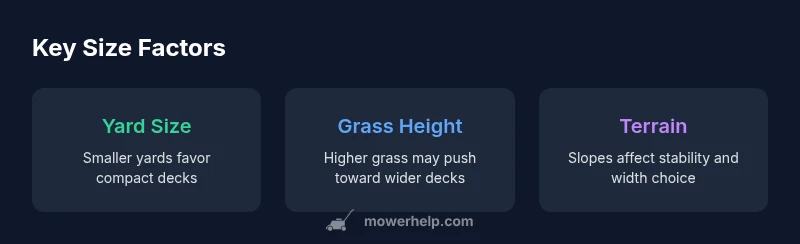
According to Mower Help, a lawn mower size calculator is a planning tool that translates yard size, grass height, and terrain into a recommended mower deck width. It helps homeowners predict cutting efficiency, turn radius needs, and overall mowing time. The calculator uses a simple mapping: larger yards and higher grass often push toward wider decks, while compact spaces favor narrower decks. By understanding these dynamics, you can narrow your buying options and avoid over- or under-sizing a mower. In practice, the tool serves as an educational guide to set expectations before you shop, so you don’t rely on guesswork alone.
The core idea is straightforward: yard size, grass height, and terrain shape how a mower works in real-world mowing sessions. With this context, you can compare models more efficiently and choose a size that aligns with how you actually cut your lawn.
Why deck width matters for mowing efficiency
Deck width directly influences how much area you can cover per pass, your turning radius, and the intervals between refuels or recharges. A wider deck can reduce the number of passes on large, flat sections but may struggle in tight spaces or along intricate landscaping. Conversely, a narrower deck offers excellent maneuverability in irregular yards and along borders but increases the total number of passes needed for the same area. The balance is to select a width that complements your yard geometry, mowing frequency, and preferred cutting pattern. By using a size calculator, you gain a data-informed starting point rather than guessing based on a single yard feature.
Practical thinking includes recognizing that most residential yards perform best with a deck width in a middle range when the layout is mixed: flat open zones and tighter edges. The goal is to maximize efficiency without compromising your ability to navigate obstacles or steep sections.
Inputs to the calculator and how to set them
A reliable lawn mower size calculator uses three core inputs: Yard Size, Average Grass Height, and Terrain Slope. Set Yard Size to reflect your property’s usable mowing area, not just the entire lot. Enter Grass Height in inches to reflect how tall your lawn grows between mowings. Finally, input Terrain Slope as a percentage to account for hills or uneven ground that affect stability and turning. Realistic defaults help you start with a reasonable estimate, and you can adjust values as your yard changes with the seasons. Keeping units consistent avoids misinterpretation when you compare different mower options.
Tips for setting inputs:
- Use the current season’s grass height rather than the peak growth period.
- If your yard has multiple slopes, average them to a single slope value for the calculator.
- When in doubt, start with mid-range values and refine after testing a few mowing sessions.
How the calculator works: a simple formula
The calculator combines yard size, grass height, and terrain slope into a single deck-width recommendation. A representative formula uses:
round(min(max((yardSizeAcres * 40) + (grassHeightInches * 4) - (terrainSlopePercent * 1.5) + pow(yardSizeAcres, 0.5) * 8, 16), 60))
- yardSizeAcres scales the base width.
- grassHeightInches adds width for taller grass to maintain cutting efficiency.
- terrainSlopePercent accounts for steering and safety on hills.
- The sqrt term (pow with exponent 0.5) introduces a nonlinear boost for larger yards while keeping the result bounded.
The output is a recommended deck width in inches, clamped between a minimum and maximum to reflect practical mower sizes. Remember, this is a guide—manufacturer specifications and turning radius still drive final choices.
Example walkthroughs for different yard sizes
Consider three scenarios to illustrate how inputs map to deck width.
- Small yard (0.15 acres), low grass height (1.5 inches), flat terrain (0% slope): the calculator might suggest a smaller deck around 42 inches. This size emphasizes nimble mowing with minimal space challenges.
- Medium yard (0.5 acres), moderate grass height (3 inches), gentle slope (6%): expect a mid-range deck, approximately 48–54 inches, balancing efficiency and maneuverability on gentle hills.
- Large yard (1.2 acres), taller grass (4 inches), steeper slope (12%): the tool could push toward wider decks (54–60 inches) to cover more area despite terrain, while respecting stability on slopes.
Keep in mind these are illustrative figures to demonstrate the logic. Your actual recommended width will depend on the calculator’s inputs and the underlying policy within your preferred mower brand.
How to use the results when buying a mower
Turning a deck-width recommendation into a concrete model choice involves a few practical steps. First, compare recommended widths to the cutting widths listed by manufacturers, ensuring the model’s deck width aligns with the guidance. Second, consider turning radius and weight; wider decks can increase the effort required to navigate tight corners. Third, map your yard layout to typical mowing patterns—open stretches benefit from larger decks, while edges and slopes may demand more precise control. Finally, verify engine power or battery capacity to maintain consistent performance under your usual grass height and mowing frequency. Using the calculator as a starting point helps streamline your browsing and shortlisting process.
Real-world scenarios: small to large yards and practical takeaways
Let’s translate the calculator output into shopping actions. For a small yard of roughly 0.2 acres with low grass, you’ll likely be happier with a compact mower around 42–46 inches. If your yard grows and grass height increases, a mid-range deck around 46–54 inches can preserve efficiency while keeping turning tightness acceptable. For multi-acre properties or yards with moderate to steep slopes, consider 54–60 inches, but verify that your mowing patterns won’t clash with edge work or narrow gates. Always check manufacturer recommended uses for your terrain and double-check that you can physically maneuver the mower in your fencing layout and gate openings. The goal is to connect the calculator’s logic with practical constraints you encounter on your property.