Push Lawn Mower vs Electric: A Comprehensive Comparison
A practical, evidence-based guide comparing push lawn mowers and electric mowers to help homeowners choose based on lawn size, terrain, and maintenance preferences.


When you compare a push lawn mower vs electric options, the decision comes down to effort, lawn size, and maintenance preferences. A push mower usually offers the lowest upfront cost, zero emissions at the point of use, and great exercise. An electric mower delivers consistent power with less physical exertion and quieter operation, but may require charging or a cord management plan.
What is being compared: push lawn mower vs electric
In this guide we compare two popular mowing approaches: the traditional push lawn mower and electric-powered mowers. A push lawn mower is a manual, non-motorized device that uses your physical effort to rotate blades and cut grass. It’s simple, reliable, and often the most affordable option. An electric mower, by contrast, relies on electricity to drive its motor and blade, which means there are corded versions and cordless battery-powered models. Electric mowers reduce manual effort, particularly for longer sessions or thicker grass, but they introduce considerations such as battery life, cord management, charging time, and the need to keep a power source nearby.
Core mechanics: how each mower operates
A push lawn mower uses a manual, gravity-assisted or manual-pulled blade rotation system. There is no electrical source involved, so maintenance is typically limited to blade sharpening and occasional wheel checks. An electric mower uses a motor that drives the blade; corded models draw power from an outlet, while cordless versions rely on a rechargeable battery. Cordless models provide mobility, but runtime depends on battery capacity and cutting conditions. Regardless of type, blade sharpness, height adjustment, and proper bagging or mulching setup are key for a clean cut and healthy turf.
Key differences at a glance
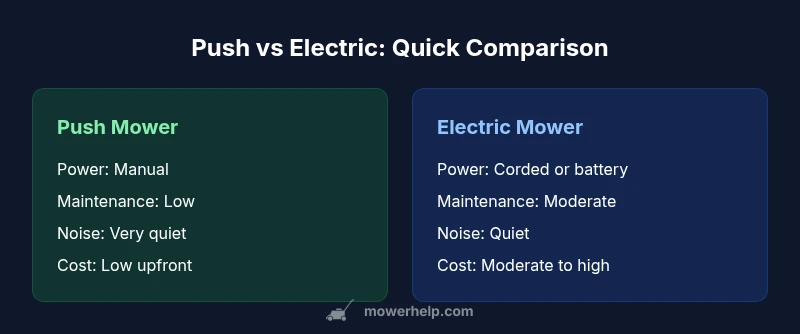
- Power source: manual human power vs electric motor (corded or battery).
- Upfront cost: typically lower for push mowers; higher for electric models with batteries.
- Maintenance: push mowers are simple; electric mowers require battery care, motor checks, and occasional electronics maintenance.
- Noise and emissions: push mowers are very quiet and emission-free at use; electric mowers are also quiet and emit no exhaust when running, though electricity has its own footprint.
- Performance on thick grass: electric mowers can maintain consistent power, while a push mower depends on technique and blade sharpness.
- Storage: push mowers are often more compact; electric mowers can be larger due to battery and wiring.
- Ideal for: small, simple lawns with minimal hills vs moderate to larger yards where convenience and reduced effort matter more.
Cost and long-term value considerations
Push lawn mowers generally offer the lowest upfront cost and the simplest maintenance, which translates to excellent long-term value for very small yards or homeowners prioritizing exercise and minimal fuel or battery management. Electric mowers carry a higher initial price but reduce physical strain, speed up mowing sessions, and can offer features like mulching and side discharge. Over time, costs include battery replacements (for cordless models) and potential cord wear for corded versions. For larger properties, the energy and time savings of electric models may justify the higher price, particularly if you prioritize consistency of cut and reduced fatigue.
Maintenance and care
Maintenance needs differ: push mowers require blade sharpening, occasional lubrication, and wheel alignment. Electric mowers demand battery care (charging cycles, storage, and occasional battery replacement), along with motor and electronics checks. Regardless of type, keep blades sharp, clean the deck after use, and inspect safety features like blade guards and safety switches. A well-maintained mower lasts longer and cuts more evenly. When you store them for off-season, dry storage and battery maintenance routines help prevent corrosion and battery degradation. The choice between the two also depends on how often you mow and how you store equipment.
Performance across lawns and grass types
On flat, well-maintained lawns, a push mower can deliver excellent results with proper technique and blade sharpness. For uneven terrain or thicker, taller grass, electric mowers often deliver more consistent results with less physical effort. Corded options require proximity to an outlet and a safe cord-management plan, while battery-powered options offer flexibility but may show reduced runtime in very tall or damp conditions. For soft, damp mornings, both types may struggle without proper mowing height settings; always adjust blade height to optimize clippings and turf health.
Noise, emissions, and environmental considerations
Push mowers operate with minimal noise and no motor emissions, making them ideal for early-morning use near neighbors and wildlife. Electric mowers produce little noise compared with gas engines and have no on-site emissions, which improves neighborhood air quality and reduces maintenance related to fuel. Electricity’s environmental impact depends on the local grid mix, so consider your region’s energy sources when evaluating overall footprint. For homeowners aiming to minimize both noise and maintenance, electric mowers are often a favorable compromise.
Ergonomics, comfort, and storage
Ergonomics matters: push mowers rely on your stride and stance, which can be tiring for large properties or steep hills. Electric mowers reduce physical effort and enable longer sessions without fatigue but may weigh more due to the battery. Storage considerations include blade protection, safe battery storage if cordless, and convenient cord management for corded options. If you have garage or shed space with dedicated mower storage, choose a model that fits through doors and shelves without requiring awkward maneuvers.
Cord management, charging, and runtime tradeoffs
Corded electric mowers require a power outlet and careful cord routing to avoid tangling or cutting the cord. Cordless mowers eliminate cords but depend on battery capacity and charging cycles; higher-capacity batteries extend runtimes but add weight and price. For larger lawns, a corded option with a long outdoor-rated extension cord or a robust battery system can be more practical. Plan charging times so you aren’t left mid-mow with a fading battery, and consider spare batteries for longer sessions.
Real-world yard scenarios and buying flow
Small urban lots benefit from a lightweight push mower for its simplicity and quiet operation. Suburban lawns with moderate area often balance convenience with cost by choosing an electric mower with good clipping performance. Large rural properties may favor electric mowers with extra runtime or even a hybrid approach combining a push mower for tight spots and an electric mower for larger patches. In all cases, assess your typical mowing time, storage space, and tolerance for cords or batteries. A clear decision flow—lawn size, terrain, and preferred power source—helps determine the best fit.
Authority sources and further reading
To support your decision, consult credible sources on lawn mower safety and performance. For safety guidelines and best practices, see OSHA and CDC resources on machinery safety, and explore university extension articles on mower maintenance and mowing height. These sources provide neutral guidance that complements hands-on testing and local conditions.
How to decide: quick buying checklist
- Define lawn size and terrain: flat, hilly, or uneven?
- Prioritize effort vs cost: exercise value, upfront price, or long-term maintenance?
- Choose power source: corded, battery, or purely manual?
- Consider storage and maneuverability: door width, shed space, and weight limits.
- Evaluate maintenance needs: blade care, battery care, and fuel considerations.
- Factor noise and emissions: quiet operation for neighbors and environmental goals.
- Decide on features: bagging, mulching, and discharge options.
- Plan for future maintenance: blade sharpening, battery replacement, and wheel alignment.
Comparison
| Feature | Push lawn mower | Electric mower |
|---|---|---|
| Power source | Manual (human-powered) | Corded or battery-powered electric |
| Typical upfront cost range | Low | Moderate to high |
| Maintenance needs | Low (simple blade care) | Moderate (battery/motor/electronics) |
| Noise level | Low to moderate (very quiet) | Low to moderate (very quiet; depends on motor) |
| Emissions | Zero emissions on-site | Zero exhaust emissions; electricity source varies |
| Storage footprint | Compact, simple storage | Can require more space for battery + cord management |
| Performance on tall/thick grass | Depends on technique; best with sharp blade | Generally better with consistent power |
Benefits
- Low upfront cost and simple design
- Excellent exercise and direct control
- Zero on-site emissions and minimal maintenance
Cons
- Requires physical effort, especially on large or uneven lawns
- Less consistent in very tall or thick grass without proper technique
- Push mowers may struggle with long grass or heavy dew
Electric mower wins for convenience and consistency; push mower wins for extreme simplicity and cost control
Choose electric if you want easier, quicker mow sessions and minimal fatigue. Choose push if you have concise, small spaces and prioritize lowest ongoing costs and a straightforward, maintenance-light setup.
Got Questions?
What is the main difference between a push mower and an electric mower?
The push mower is manual and relies on your physical effort, while an electric mower uses electricity (cord or battery) to power the blade. The choice affects cost, effort, and maintenance demands.
The main difference is power: manual versus electric. Push mowers rely on you, while electric mowers use a motor powered by cord or battery.
Is a push mower better for small lawns?
Yes, for very small or simple lawns a push mower can be the most economical and easiest to maintain. It also provides light exercise and is quiet. For any regular mowing beyond a few hundred square feet, consider electric options for efficiency.
Yes, small lawns are often best served by a push mower for cost and simplicity.
Do electric mowers require much maintenance?
Electric mowers require some maintenance, including battery care (for cordless models), keeping the deck clean, blade sharpening, and occasional motor checks. Regular maintenance improves longevity and performance.
They do need battery and motor care, but generally less frequent fuel-related maintenance than gas mowers.
Which mower is better on hills or uneven terrain?
Push mowers can handle mild slopes with proper technique but require more effort. Electric mowers offer consistent power on hills, especially cordless models, but weight and wheel design matter for uneven terrain.
On hills, electric models usually feel easier due to consistent power, but weight matters.
Are electric mowers louder than push mowers?
Compared to many gas mowers, both push and electric mowers are quiet. Electric mowers are typically quieter than gas engines, while push mowers have no engine noise but may require more effort.
Electric mowers are generally quiet, and push mowers are very quiet since there’s no motor.
What should I consider before buying push vs electric?
Assess lawn size, terrain, preferred maintenance level, budget, and whether you value exercise or convenience. Also consider storage space and whether you want mulch or bagging options.
Think about your lawn, how much effort you want to invest, and your storage space before buying.
The Essentials
- Consider lawn size and terrain before choosing
- Electric mowers reduce effort but may require battery/cord management
- Push mowers offer low cost and simple maintenance
- Plan for storage needs and maintenance routines
- Balance noise, emissions, and convenience in your decision