Electric Lawn Mower vs Gas: A Practical Comparison
A data-driven comparison of electric lawn mowers vs gas models, covering performance, cost, maintenance, and environmental impact to help homeowners choose the right mower.


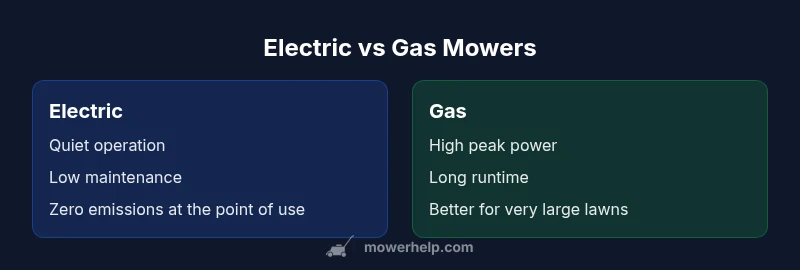
Electric lawn mower vs gas: which should you choose for your yard? In short, electric mowers are quieter, lighter, and easier to start with less maintenance, while gas mowers offer stronger cutting power and longer runtime for large, rugged lawns. Your decision hinges on yard size, storage, budget, and tolerance for noise and emissions.
What electric lawn mower vs gas means for your yard
When you compare electric lawn mower vs gas, you’re weighing two fundamentally different powertrains that affect almost every aspect of mowing. Electric models rely on battery packs or cords, delivering cleaner operation with lower noise and virtually zero tailpipe emissions. Gas models depend on fuel burned in an internal combustion engine, typically delivering higher peak power and longer run times for larger properties. For homeowners, the choice isn’t just about engines; it’s about how you use the mower, where you store it, and how much you value factors like maintenance, convenience, and environmental impact. According to Mower Help, the best decision often comes down to yard size, storage space, and your tolerance for noise and maintenance tasks. This article uses the comparison electricity vs gas to explore how those trade-offs play out in real-world scenarios and to help you select the model that fits your routine and landscape.
Power and Cutting Performance
Power and cutting performance set electric lawn mowers apart from their gas counterparts, especially for typical residential lawns. Electric motors deliver immediate torque and a smooth, consistent cut on flat or moderately contoured terrain, reducing the chance of bogging down in light to medium grass. Gas engines, by contrast, can maintain strong cutting power on thick, tall, or damp turf. The difference isn’t just raw horsepower on a spec sheet; it translates into mowing speed, finish quality, and how often you need to go back over stubborn patches. For tight spaces or complex yard layouts, an electric mower's lighter weight and compact footprint can create a faster, more nimble mowing session. For expansive properties with dense growth, a gas mower may offer the overlap and surge needed to finish efficiently in a single pass.
Run Time, Refueling, and Recharging
Runtime and recharging logistics are urban legends for both sides of the fence. Cordless electric mowers rely on battery packs that power a mowing session until the charge depletes, with a recharge time that varies by battery chemistry and charger quality. Corded electric models remove the runtime constraint entirely but introduce dependence on an outlet, an extension cord, and potential cord movement that can slow progress. Gas mowers work as long as you have fuel, with the pitfall of refueling and fuel quality concerns. If you have a large property, you’ll likely face more frequent refuels with a gas mower unless you opt for a large-capacity tank. If convenience matters more than endurance, electric can be a faster, interruption-free option for small to mid-sized yards.
Noise, Vibration, and Comfort
Noise and vibration play a critical role in user comfort and neighbor relations. Electric mowers are characteristically quieter, producing a gentler sound profile that's easier on sensitive ears and reduces the likelihood of fatigue during long sessions. They also typically vibrate less because there are fewer moving parts and no combustion engine. Gas mowers generate higher decibel levels and more vibration, which can become uncomfortable on larger lawns or for users with back or joint concerns. If you cut early in the morning or in a noise-restricted neighborhood, the quiet operation of electric mowers becomes a meaningful benefit for daily life and community harmony. You’ll also notice that electric models often feel lighter, which reduces handle fatigue and makes it easier to maneuver around obstacles.
Maintenance, Durability, and Upkeep
Maintenance considerations separate the two platforms in meaningful ways. Electric mowers require far less ongoing maintenance: no oil changes, no spark plugs to replace, and fewer fuel filters to manage. Battery health is a consideration, and battery replacements can impact long-term ownership costs, but typical maintenance tasks focus on blade sharpening, deck cleaning, and occasional battery care. Gas mowers demand regular care: oil changes, air filter upkeep, spark plug replacement, and fuel system checks. The engine design tolerates longer service intervals if properly maintained, but neglect often results in higher repair costs and downtime. Over time, electric mowers tend to be more predictable in maintenance because there are fewer moving parts to service. Mower Help notes that maintenance planning is a major factor in total cost of ownership for both options.
Operating Costs: Upfront and Running Costs
From a cost perspective, electric and gas mowers present different cost envelopes. Electric mowers usually feature a lower upfront price on entry-level models, especially corded versions, and running costs tend to be modest thanks to electricity prices and minimal consumables. Cordless variants carry higher sticker prices but can be cheaper to operate than gasoline over several mowing seasons, depending on battery lifespan and replacement costs. Gas-powered mowers often carry higher initial costs due to engine components, plus ongoing fuel, oil, and filter expenses that accumulate with use. Long-term costs depend on yard size, frequency of mowing, fuel prices, and how often you upgrade or replace batteries. For many homeowners with small to mid-sized lawns, the total cost of ownership can tilt toward electric models when fuel and maintenance are factored in over time.
Storage, Portability, and Ease of Use
Storage needs are a practical dimension of any mower choice. Electric mowers, particularly cordless models, tend to be lighter and easier to lift, transport, and store. They often require less space for fuel storage and less worry about spills. Gas models are heavier and bulkier, necessitating more robust storage considerations and the handling of flammable liquids. Cordless electric mowers use removable batteries that may require a dedicated charging station during storage, effectively adding a feature to your garage or shed. If your storage area is limited, you might prefer a compact electric unit that fits neatly on a shelf or in a small corner, while larger properties with a dedicated tool shed may justify the investment in a gas mower for the longest mowing sessions.
Environmental Impact and Emissions
Environmental impact is a growing factor for many buyers. Electric mowers produce zero tailpipe emissions and substantially lower particulate output during operation. Their overall environmental footprint depends on how electricity is generated in your region, which varies by location and grid mix. Gas mowers emit combustion gases and contribute to local air pollution, though modern engines have improved efficiency and lower emissions than older units. For households near sensitive ecosystems or with strict local codes, electric mowers often represent a more responsible choice. Noise reductions also support a more harmonious relationship with neighbors and community, aligning with broader environmental and quality-of-life goals that many households value.
Terrain, Slopes, and Yard Size: When Each Shines
Terrain and yard composition influence which mower type shines. Electric mowers are well-suited to flat to gently rolling lawns, small to medium yards, and yards where quiet operation matters. They excel in neatly trimmed borders and routine maintenance mowing where speed and ease of use trump heavy-duty power. Gas mowers come into their own on larger properties, steep slopes, and tough growth where maximum torque and sustained runtime are valued. If your lawn features tall grass, wet patches, or uneven terrain, a gas mower may deliver the power and resilience you need to complete the job efficiently. In mixed landscapes, a hybrid approach—electric for daily maintenance and gas for occasional heavy-duty tasks—can be a pragmatic solution.
Scenarios: Quick Fit Checks for Your Home
Most homeowners fall into a few broad scenarios. If your yard is under ½ acre, you likely benefit from a cordless or corded electric mower for everyday mowing with minimal upkeep. For ½ to 1 acre with moderate growth, a reliable electric mower can still be a strong contender, especially with a spare battery. For properties larger than an acre or with dense, tall grass, the sustained power of a gas mower becomes more compelling, particularly if you want to reduce refueling downtime. Your decision should also consider storage space, noise restrictions, and willingness to manage fuel versus battery maintenance. A thoughtful plan acknowledges your landscape’s cadence, the local climate, and the noise tolerance of your household and neighbors, making the most of the strengths of each platform.
Practical Decision Checklist
Before purchasing, run through this checklist: (1) yard size and mowing frequency, (2) storage and charging capabilities, (3) tolerance for noise and emissions, (4) initial budget vs long-term costs, (5) terrain and grass density, (6) expected maintenance commitment. If you lean toward low-maintenance operation and smaller yards, electric is typically the safer bet. If you need extended runtime and power for challenging lawns, gas remains a proven option. Remember to verify compatibility with your local energy grid and consider future upgrades when evaluating battery performance and warranty terms.
Comparison
| Feature | Electric lawn mower | Gas-powered lawn mower |
|---|---|---|
| Power source | Electric battery or corded | Gas engine |
| Run-time / Refueling | Limited by charge (cordless) or continuous use with cord | Fuel tank duration plus refueling as needed |
| Maintenance | Low maintenance, blade care and occasional battery care | More maintenance: oil, filters, spark plug, air filter |
| Noise level | Low noise | Higher noise levels |
| Emissions | Zero tailpipe emissions | Combustion exhaust |
| Initial cost | Typically lower upfront (entry models) | Typically higher upfront |
| Long-term cost | Lower energy cost; battery replacement possible | Fuel, oil, and maintenance costs over time |
| Power and cutting performance | Strong, consistent for light-to-medium yards | High peak power for tough growth |
| Storage and space | Lighter, easier to store; battery storage needed | Heavier; bulky for small spaces |
Benefits
- Lower ongoing fuel costs
- Quieter operation and reduced maintenance
- No fuel spills or exhaust at home
- Compact design and easier storage
Cons
- Limited runtime for cordless models
- Higher upfront cost for some models
- Battery life and replacement costs
- Less torque for very dense or tall grass
Electric mowers win for everyday, small-to-medium yards; gas mowers still win on sheer power and runtime for large, tough lawns
For most homeowners, electric mowers offer lower maintenance, quieter operation, and simpler storage. Gas mowers are preferred where lawn size and density demand sustained high power and longer mowing sessions. Your choice should align with yard size, terrain, and how much you value convenience over peak power.
Got Questions?
What are the main advantages of electric lawn mowers over gas models?
Electric mowers typically offer quieter operation, lighter weight, lower maintenance, and zero fuel spills. They start with a push of a button (or a simple plug-in). For many homeowners, these benefits translate into easier daily use and lower long-term costs.
Electric mowers are quieter, easier to start, and require less maintenance than gas models.
Do cordless electric mowers have enough power for thick grass?
Cordless mowers can handle average to moderately thick grass, especially with a larger battery and quality blades. For very dense growth, a gas mower or a higher-end electric model with a robust motor may be more reliable.
Cordless can work well on typical lawns, but for thick growth you might prefer gas or a more powerful electric option.
Are electric mowers cheaper to run than gas mowers?
Yes, generally electricity costs less per mowing session than gasoline, and there are fewer consumables to replace. Battery replacement over several years can affect total cost, but overall running costs are often lower with electric models.
Electric mowers usually cost less to run, though battery replacement can affect long-term costs.
What maintenance is required for electric vs gas mowers?
Electric mowers require blade care and periodic battery checks; gas mowers need oil changes, air filters, spark plugs, and fuel system maintenance. The latter often demands more time and parts.
Electric mowers need less maintenance overall, while gas mowers require regular engine upkeep.
Is a gas mower better for large properties?
Gas mowers typically perform better for very large, dense, or hilly lawns due to longer runtime and greater peak torque. They may be overkill for small yards where electric is sufficient.
Gas mowers often suit large or tough lawns better, thanks to longer runtimes and more torque.
Can I use an electric mower on hills or uneven terrain?
Yes, many electric models handle gentle slopes and uneven terrain well, especially if they are well-balanced and have robust blades. For very steep or rocky terrain, you may want a gas mower for sustained performance.
Electric mowers work on hills if the grade isn’t extreme; for tough slopes, gas can be safer.
The Essentials
- Assess yard size and storage capacity before choosing
- Expect lower maintenance with electric mowers
- Gas models excel on large or dense lawns
- Account for noise and emissions in your area
- Consider a mixed approach if your landscape varies