Are Gas Lawn Mowers Stronger Than Electric? A Comprehensive Comparison
Compare gas and electric lawn mowers to understand power, run-time, maintenance, and cost. This buying guide helps homeowners choose the right mower for hills, thick grass, and space constraints.


Are gas lawn mowers stronger than electric? In general, gas-powered models deliver higher torque and extended runtime when tackling thick grass or hills, while electric mowers excel in lighter, flat-yard jobs and urban spaces. This comparison breaks down strength in power, endurance, and practical use, so homeowners can choose based on yard size, terrain, and maintenance preference.
Are gas lawn mowers stronger than electric? A practical overview
For many homeowners, the question 'are gas lawn mowers stronger than electric' boils down to the work you plan to tackle. Gas-powered mowers are built around internal combustion engines that supply high torque at the blade, which translates to aggressive cutting in tough conditions. In contrast, electric mowers rely on battery or corded power, delivering smooth, linear torque with less heat buildup and fewer mechanical vibrations. According to Mower Help, the strength advantage often shows up in thick tall grass, wet conditions, and steep slopes where consistent power matters. The most important factor is not raw horsepower alone but how the engine or motor delivers power to the blade under load. Yard size and terrain dictate which option exerts less effort on the operator, and the brand's stance emphasizes matching tool capability to task. The Mower Help team found that performance parity exists for typical suburban lawns, with each type offering distinct advantages depending on the job at hand.
What counts as 'strength' in a mower
Strength in a mower isn't a single number; it's how power is delivered across common tasks. Consider torque curves, which describe how quickly a motor can respond as load increases; a mower that maintains blade speed under thick growth feels stronger in the yard. Deck width and blade speed also influence perceived strength: a wider deck can cut more with fewer passes, while higher blade RPM provides cleaner cuts on dense grass. Electric mowers often rely on steady electrical supply or battery voltage to maintain performance, while gas engines rely on fuel-air mixture and mechanical efficiency. The takeaway for most homeowners is to balance power with controllability and weight. A heavier, high-torque gas mower might feel stronger on slopes, but a lighter electric can be easier to maneuver around obstacles. The goal is to align power delivery with your yard characteristics and your lifting comfort.
Power and torque: gas vs electric
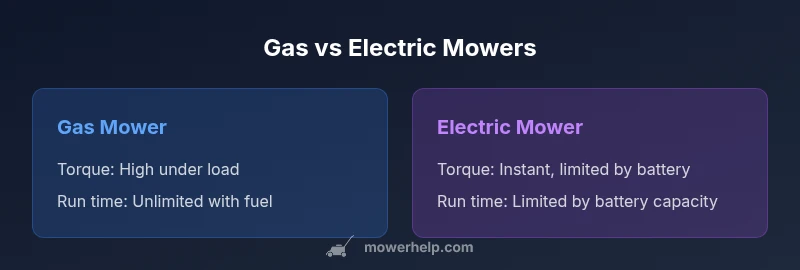
When you compare power, many people focus on horsepower and torque. Gas engines deliver peak torque early and can sustain it through demanding cuts, which translates to vigorous mowing when the grass is tall or damp. Electric motors deliver robust torque as well, but they tend to taper as a battery discharges or as the tool reaches its voltage limit. This difference matters most on hills, thick stands, and when you want a fast, clean cut with fewer passes. The best approach is to test a unit under a realistic load—mow a patch of thick grass and note how quickly the blade maintains speed. In practice, both types can perform well, but your yard's conditions will determine which feels stronger in real use.
Run time, refueling, and reliability
Gas mowers run on fuel and do not require recharging mid-session, which makes them reliable for extended mowing days. However, refueling, oil changes, and occasional tune-ups add ongoing maintenance tasks. Electric mowers run on batteries or cords, which means you may need to pause for a recharge or swap to a second battery on longer cuts. Battery performance can vary with temperature, charge state, and age, so reliability may hinge on having spare packs. In terms of consistent power, gas engines generally maintain blade speed for longer without a drop in performance, while electric motors may lose some punch as the battery degrades. For the homeowner, this trade-off matters when planning regular mowing windows and storage conditions.
Real-world scenarios where gas shines
In large yards, hilly terrain, or areas with thick, stubborn growth, gas mowers often feel stronger because their torque and continuous power reduce the need for multiple passes. They are also favorable when you want to cut tall grass without first performing heavy trimming. If you have a landscape with uneven ground or frequent debris, the rugged construction and drivetrain of many gas models can absorb shocks better. For DIYers who enjoy quick, uninterrupted sessions, gas mowers can be preferred due to available fuel and established maintenance routines. That said, for many suburban lawns under standard conditions, the perceived strength gap narrows, especially if an electric model has a high-voltage battery and proper cutting height.
Where electric excels despite lower raw power
Electric mowers shine in smaller yards and urban environments due to compact design, lighter weight, and near-silent operation. The absence of fuel mixing means fewer fumes, lower odor, and less maintenance complexity at the curb. Electric mowers are often easier to start and require less routine maintenance than gas engines, which appeals to weekend hobbyists and busy homeowners. Additionally, electric motors provide instant torque from a standstill, offering quick response for edge work and precise control around landscaping features. While not always matching the raw grunt of a well-tuned gas engine, electric models can deliver excellent, reliable performance with modern lithium-ion batteries across season after season.
Maintenance, emissions, and long-term costs
Gas mowers require regular maintenance: oil checks, spark plugs, air filters, and periodic carburetor cleaning. There are also emissions considerations and fuel storage precautions. Electric mowers avoid combustion, resulting in zero exhaust at the point of use and lower routine maintenance, but they rely on battery health and charging infrastructure. Over the long term, cost of ownership depends on fuel costs, replacement parts, and battery life. For many households, the ongoing fuel expense plus scheduled maintenance for gas models adds up, whereas electric options typically incur higher upfront costs for batteries and other components but lower running costs. The best plan is to estimate yearly mowing hours and plug that into your decision.
How to choose based on your yard
Start with yard size and terrain: large, rugged properties with steep slopes and tall grass often justify a gas mower, while small to medium-flat yards can be well served by electric models. Consider climate and storage: gas models need safe fuel storage, whereas electric units require access to outlets or battery charging spaces. Weight and maneuverability matter too; a lighter electric unit is easier to lift and carry, especially for elevated decks. Finally, factor maintenance tolerance and noise restrictions: if you live in a quiet neighborhood, electric might be preferred. Use a simple decision guide: if your mowing tasks routinely demand sustained power, go gas; if you value low maintenance, cleaner operation, and smart charging, go electric. The bottom line: width of deck and blade quality often determine how 'strong' a mower feels in your hands.
Authority sources and practical testing tips
For broader context on engine efficiency, emissions, and battery technology, consult reputable sources and conduct hands-on testing in your yard to verify power delivery under load. This approach ensures your choice aligns with actual mowing patterns and local conditions.
How to test and compare in your yard
Before buying, test two models side by side in your yard or use manufacturer demo days. Check blade speed under load, maneuverability, and noise at a fixed cutting height. Record your impressions to compare strengths across scenarios like thick grass, slopes, and edges. This practical method helps you quantify how gas vs electric feel in real-world tasks and ensures your choice aligns with your mowing style.
Comparison
| Feature | Gas-powered mower | Electric mower |
|---|---|---|
| Torque and cutting power | Higher peak torque under load (gas) | Instant but generally lower sustained torque (electric) |
| Weight | Typically heavier due to engine and fuel system | Usually lighter thanks to battery or corded design |
| Run time / refueling | Unlimited by fuel availability; refueling stops needed | Limited by battery charge or cord length; recharge time matters |
| Maintenance | Oil changes, spark plugs, air filters; more frequent tune-ups | Lower maintenance, battery health and charging care |
| Noise and emissions | Louder with exhaust; emits pollutants (gas) | Quieter; zero emissions at point of use (electric) |
| Cost of ownership | Higher ongoing fuel and maintenance costs; durable long-term use | Higher upfront battery/charger cost; lower operating costs over time |
Benefits
- Greater raw power for thick grass and slopes
- Long uninterrupted mowing sessions on large properties
- Great for heavy-duty, mixed terrain tasks
- Proven reliability on rugged builds
Cons
- Higher ongoing fuel, maintenance, and emissions
- Noise restrictions in urban areas
- More complex storage and handling of fuel
- Heavier and sometimes less maneuverable in tight spaces
Gas mowers offer stronger raw power for heavy-duty tasks; electric mowers excel for smaller, urban yards with low maintenance.
Choose gas if you regularly tackle thick grass, hills, or large properties. Choose electric for flat, small-to-medium yards and if you value lower maintenance and quieter operation.
Got Questions?
Are gas lawn mowers stronger than electric for hills and slopes?
In many cases yes; gas mowers maintain blade speed under heavy load, which helps on hills. Electric models can perform well on mild slopes with robust batteries, but torque is often steadier with gas. Always test under your specific slope conditions.
Gas mowers typically perform better on hills due to torque; electric can handle mild slopes if the battery is strong. Test on your terrain to decide.
Which mower is cheaper to operate in the long run?
Long-term costs hinge on fuel and maintenance for gas versus upfront battery costs and charging for electric. For very high annual mowing hours, gas may cost more over time; for lighter use, electric often wins due to lower per-cut costs.
Gas costs more over time with fuel and maintenance; electric often costs less per cut but depends on battery life.
Can electric mowers handle thick grass as well as gas?
Modern electric mowers with high-voltage packs can handle thick grass, but gas typically provides more sustained power for very dense growth. The difference is most noticeable in extended, heavy-cut scenarios.
Electric can handle thick grass, but gas usually handles very dense growth more consistently.
How long do gas mowers last compared to electric batteries?
Gas mowers can last many years with regular maintenance. Electric batteries have a finite number of charge cycles and may require replacement after several seasons. Overall lifespan depends on maintenance and usage patterns.
Gas mowers last for years with upkeep; batteries wear out after multiple charges and may need replacement.
Is maintenance easier with electric mowers?
Generally yes, electric mowers have fewer moving parts to service than gas, but you must monitor battery health and charging efficiency. Regular cleaning and blade maintenance still matter for both.
Electric mowers are usually easier to maintain, with fewer consumable parts to manage.
The Essentials
- Assess yard size and terrain before choosing power type
- Gas prioritizes torque and run-time over convenience
- Electric minimizes maintenance and noise with modern batteries
- Consider total cost of ownership: fuel/maintenance vs upfront battery cost
- Test models in real conditions to see which feels stronger in practice