How Long Do Electric Lawn Mowers Last: Lifespan, Care, and Tips
Learn how long electric lawn mowers typically last, what affects their lifespan, and how to maximize longevity with smart maintenance, battery care, storage, and use tips from the Mower Help team.


How long does an electric lawn mower last? On average, electric mowers deliver about 6-10 years of regular use, with cordless battery packs typically offering 3-5 years of solid runtime before noticeable degradation. Longevity hinges on battery health, blade maintenance, storage conditions, and overall build quality; with proper care, you can push toward the upper end of this range.
Lifespan basics: what affects longevity
The lifespan of an electric lawn mower is driven by several interacting factors: the type of power system (corded vs. cordless), motor design, blade quality, overall build, how the unit is stored, and how consistently you perform routine maintenance. According to Mower Help, battery health is a key determinant for cordless models, while mechanical wear on the deck, pulleys, and blades also governs long-term performance. Owners who run a tight maintenance schedule—keeping blades sharp, cleaning the deck, and checking connections after mowing—tend to see longer usable life. In practical terms, most homeowners can expect a solid decade from a well-made corded model, while cordless mowers rely heavily on battery management to reach the upper end of that span.
Corded vs cordless: longevity implications
Corded electric mowers have the advantage of constant power supply, which means fewer battery degradation concerns and often lower ownership complexity. This can translate to steadier performance over time, assuming you maintain the motor and blade. Cordless models, by contrast, hinge on the health of their lithium-ion packs. Battery cells lose capacity with each cycle, and performance can drop when stored in extreme temperatures or left uncharged for extended periods. The trade-off is greater mobility and typically lighter weight, which can influence how you use the mower and, ultimately, its longevity. Mower Help analysis notes that battery management is the biggest variable for cordless lifespan, so thoughtful charging practices matter as much as hardware quality.
Battery health: how to care for lithium-ion packs
Battery longevity starts with charge management. Keep lithium-ion packs around a mid-to-high state of charge when storing for extended periods—generally ~40-60% is recommended for long-term storage. Avoid deep discharges, extreme heat, and freezing conditions, which accelerate capacity loss. Use the original charger and avoid daisy-chaining multiple chargers. Regularly inspect the battery terminals for corrosion, clean with a dry cloth, and store in a cool, dry place. For cordless models, consider replacing the pack after several seasons if runtime noticeably declines. As a data point, Mower Help analysis shows that cordless batteries typically lose peak capacity after multiple annual cycles, influencing practical lifespan.
Motor and drive components: what wears out first
Electric mowers rely on a few critical components that can wear over time: the motor windings, drive belts, pulleys, and the wheels or caster assemblies. If you mow on sloped terrain or with heavy loads (wet grass, thick turf), the motor may run hotter, accelerating wear. Listen for unusual noises, reduced RPM, or intermittent traction—these can be early indicators of motor or belt wear. Routine checks of the drive system and cleaning dust and grass clippings from the underdeck can prevent premature failures. Proper cooling and ventilation during operation also help preserve motor life.
Blades, belts, and deck wear: routine maintenance
Sharp blades are not only a performance issue but also a longevity factor: dull blades strain the motor and increase heat, shortening component life. Inspect blades monthly during mowing season; sharpen or replace as needed. Check the deck for dents or corrosion, and clean off grass buildup after each use to prevent rust and pivot friction. Belts, if present, should be checked for wear and replaced according to the manufacturer’s guidance. Lubricate moving parts sparingly with manufacturer-recommended lubricants to minimize friction and wear.
Storage and environmental factors
Where you store the mower matters. High humidity, salt air near coastal areas, or unventilated spaces can contribute to corrosion and degraded electrical components over time. If possible, store indoors in a dry area, or cover the unit to protect it from dust and moisture. Temperature swings can also affect battery health, so avoid leaving cordless packs in hot cars or freezing garages. Seasonal storage should include a thorough inspection of the battery, blades, and electrical connections before the next mowing cycle.
Maintenance routines to maximize lifespan
A practical maintenance schedule can dramatically extend mower life:
- Monthly: inspect blades for nicks or cracks; clean the underdeck; tighten loose bolts; check battery terminals (cordless).
- Seasonal: sharpen or replace blades; inspect belts and pulleys; test motor performance; clean or replace filters if applicable.
- Annual: service the charging system (cordless); replace worn parts; store battery at recommended levels.
- Safety steps: disconnect power before servicing; keep the safety chute and guards intact; never operate with damaged cords or cables.
These steps align with general best practices and are reinforced by Mower Help's guidance for battery health and blade care. Following them helps you avoid early wear and maximize each mowing season.
When to repair vs replace: a practical guide
If you notice significant drops in runtime, frequent overheating, or persistent odd noises despite maintenance, assess whether a targeted repair (blade replacement, belt, or connection fixes) can restore performance at a reasonable cost. If repairs start to approach or exceed replacement value, or if the battery shows a marked loss of capacity that limits daily use, replacement may be more economical in the long run. The decision should consider your local repair options, warranty status, and the mower’s overall condition.
Real-world timelines and expectations: scenarios
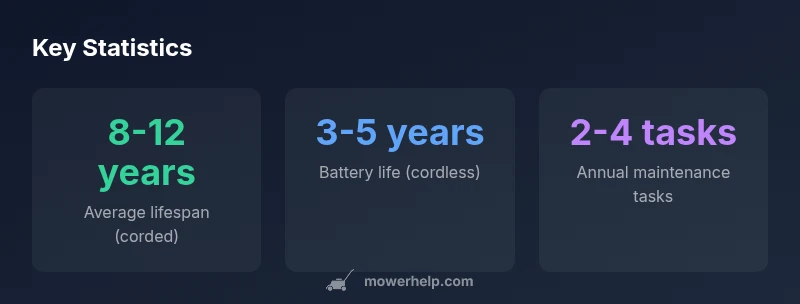
Consider common homeowner scenarios. A well-kept corded electric mower used for a small to mid-sized yard may approach the upper end of the 8-12 year corded lifespan with timely blade care and proper storage. A cordless model used frequently in summer, with proactive battery management and periodic pack replacement, can stay serviceable for roughly 4-6 years before noticeable runtime loss. For many households, this aligns with planning cycles that account for battery upgrades or mower replacements within a decade. The exact timeline varies with use intensity, climate, storage, and maintenance discipline, but the core principle remains: regular upkeep extends the usable life of both the motor and battery, delaying the need for early replacement.
Lifespan comparison by electric mower type
| Model Type | Typical Lifespan (years) | Battery/Power Notes |
|---|---|---|
| Corded Electric | 8-12 | Continuous power; no battery to replace |
| Cordless Battery-Powered | 3-5 | Battery health drives lifespan; manage charging |
| Robot Electric Mower | 5-8 | Recharge cycles; regular maintenance required |
Got Questions?
What factors most influence the lifespan of an electric lawn mower?
Lifespan is driven by power system (corded vs cordless), motor and drive quality, blade condition, deck integrity, storage conditions, and maintenance habits. Battery health dominates cordless longevity, while mechanical wear governs corded performance. Consistent blade care, clean storage, and regular checks help maximize life.
Lifespan depends on whether you use corded or cordless power, motor quality, blade upkeep, and how well you store and maintain the mower.
Do cordless mowers last as long as corded models?
Corded mowers typically avoid battery degradation, potentially extending usable life in some scenarios. Cordless models depend on battery health, which can shorten lifespan if not managed properly. Overall longevity also hinges on build quality and maintenance across both types.
Corded mowers often last longer because they don’t rely on batteries, but cordless mowers can last a long time with good battery care.
How can I extend the life of my mower's battery?
Store batteries at partial charge (around 40-60%), avoid extreme temperatures, use the provided charger, and avoid deep discharges. Regularly inspect terminals for corrosion, clean with a dry cloth, and consider battery replacement after several seasons if runtime drops noticeably.
Keep the battery in a moderate charge, store in a cool place, and avoid extreme temperatures to extend life.
Is it worth replacing parts instead of buying a new mower?
If a single component fixes the problem and cost is reasonable, repairing can be economical. When multiple components wear or repair costs approach a new mower’s price, replacement becomes more sensible.
Repair if it’s a single, affordable fix; otherwise, replacing may be the smarter long-term choice.
What maintenance should I perform monthly?
Check blades for sharpness, clean the deck, inspect drive components, and verify electrical connections. For cordless models, inspect battery contacts and ensure proper charging after each use.
Every month, sharpen blades, clean the deck, check belts and connections, and inspect the battery area.
How do I tell when it's time to replace an electric mower?
If runtime drops substantially, maintenance no longer restores performance, or repairs exceed the mower’s value, it’s time to replace. Warranty status and cost of replacement parts also influence the decision.
If it won’t hold a charge or perform as needed after maintenance, consider replacement.
“Regular maintenance is the best defense against premature wear. With proper blade care, battery management, and safe storage, an electric mower can stay efficient across many seasons.”
The Essentials
- Maximize lifespan with regular blade maintenance and clean storage.
- Corded models generally offer steadier longevity than cordless ones.
- Battery health is the primary life-limiting factor for cordless mowers.
- Establish a seasonal maintenance routine to push the upper end of the range.