How Many Volts Is a Lawn Mower Battery? A Practical Guide
Learn how many volts lawn mower batteries use, how to identify the correct voltage, and how to choose replacements for cordless, ride-on, and gas mowers. A practical, maintenance‑focused overview from Mower Help.


The voltage of a lawn mower battery is not a single fixed number; it depends on the mower type. Cordless electric mowers use packs rated at common voltages such as 20V, 24V, 40V, or 56V. Some heavier models and ride‑ons use 48V or higher. Gas‑powered mowers may have a small 12V auxiliary battery for starting.
Why voltage varies by mower type
Voltage isn’t a one-size-fits-all spec for lawn mowers. The same model line can drift between voltages because manufacturers tailor packs to runtime, weight, and power needs. According to Mower Help, the key factor isn’t just the voltage label on the battery but the entire system design, including the charger, battery chemistry, and motor controller. For homeowners, this means you should start by identifying your mower’s category—cordless walk-behind, riding model, or gas with electric start—and then verify the exact voltage in the manual or on the label. This initial check prevents incompatible replacements and ensures safe operation.
Common voltage ranges for cordless and gas mowers
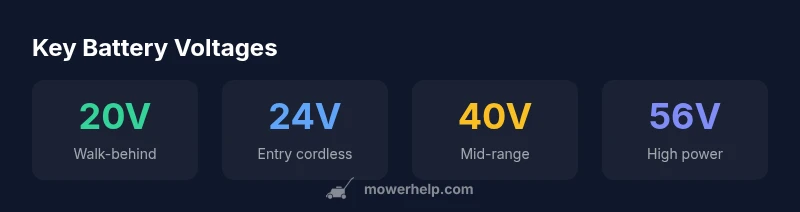
In modern cordless mowers, battery packs typically span a few standard voltages, with 20V, 24V, 40V, and 56V being the most common. Heavier or more capable cordless models may push toward 48V or even higher pack voltages. For ride-on and some commercial units, you’ll frequently see 48V to 60V systems. Gas-powered mowers occasionally rely on a small 12V auxiliary battery for electric starting or electronic features, though the engine itself runs on gasoline. The spread means that when you buy a replacement or upgrade a battery, you must match the voltage to the exact system your mower uses. The Mower Help team notes that voltage alignment is critical for safe charging and reliable performance.
How to identify the voltage on your mower battery
Start with the battery label: read the nominal voltage printed on the pack, often along with capacity (Ah) and chemistry. If the label is worn, consult the owner's manual or the manufacturer’s website. When in doubt, use a multimeter to measure the pack's nominal voltage when fully charged; do not measure while connected to the mower's hardware. Next, check the charger: it’s generally designed to deliver a set voltage compatible with the battery pack. If you’re replacing a pack, verify the voltage, physical connector type, and communication protocol (if any) before purchasing. The goal is a precise match, not a "close enough" estimate.
Understanding battery chemistry and its impact on voltage
Battery voltage is closely tied to chemistry. Lithium-ion packs, now common in most consumer cordless mowers, deliver higher energy density and different voltage behavior than traditional lead-acid packs. A lithium-ion cell has a nominal voltage around 3.6–3.7 V, and packs stack cells in series to achieve the system voltage (for example, 10 cells in series yield about 36 V). Lead-acid packs, often found in older or lower-cost units, maintain different voltage and charging curves. In practical terms, a 40V lithium pack is typically built from multiple cells in series and parallel to reach that nominal rating while delivering adequate current under load. Understanding this helps explain why a battery that seems fine in one model might not perform the same in another, even if the voltage label looks similar.
How to choose a replacement battery (voltage, capacity, compatibility)
When replacing a lawn mower battery, start with the voltage: choose a pack rated for the exact system voltage to avoid harming electronics or reducing runtime. Next, consider capacity (Ah or Wh) to estimate runtime; higher Ah means longer operation between charges. Check physical dimensions and connector type to ensure the new pack fits the mower’s slot and interfaces correctly. If you’re upgrading voltage (for example moving from 40V to 56V), consult the manufacturer’s guidance—some models simply aren’t compatible with higher voltage packs. Finally, pay attention to charging electronics: an older charger may not manage newer chemistries effectively. The most reliable approach is to select an OEM or brand‑approved replacement rather than third‑party packs, which reduces warranty risk and compatibility issues.
Safety and care to extend battery life
Protect your investment by following best practices: never store a deeply discharged battery, avoid exposing packs to extreme temperatures, and use a charger designed for your battery chemistry. Regularly inspect contacts for corrosion and clean them with a dry cloth. For Li-ion packs, avoid complete discharges and store at partial charge in a cool, dry place. If your mower sits idle for the season, charge the battery to about 50–70% before storage and disconnect it if possible. Keeping a spare battery stored properly can also prevent performance drops during peak cutting seasons.
Reading labels, datasheets, and compatibility notes
Clean data is your friend. Read voltage, capacity, chemistry, and cycle life on labels and datasheets. Verify the battery’s voltage is the same as the mower’s required system voltage. Some manufacturers use unique connector profiles or smart‑charging features; ensure the new pack supports the same communication or is compatible with your charger. When you’re shopping, collect model numbers and cross‑reference them against the official manuals and retailer pages. If you run into questions, contact customer support before buying. A mismatch could lead to poor performance or damaged electronics.
Practical tips for maintaining cordless mower performance (voltage stability)
Keep the battery at mid‑range charge whenever possible and avoid exposing it to heat and freezing temperatures. Use the original charger and never mix different brands’ packs or chargers. Calibrate the battery gauge if your mower provides a recalibration procedure. Regularly update the mower’s firmware (if equipped) to ensure voltage and power management are optimized. A stable voltage supply helps blades run smoothly and reduces stalling during tough patches.
Troubleshooting: what to do when voltage seems off
If you notice reduced runtime, sudden stalling, or inconsistent performance, voltage irregularities could be to blame. Start by verifying the battery voltage with a multimeter and comparing to the spec sheet. If the voltage reads correctly but performance is poor, the battery may be near end‑of‑life or have poor internal resistance; test with a known good pack if possible. Inspect connectors for corrosion and ensure there are no loose cables. If the voltage checks out but issues persist, consult the mower’s support resources or contact the manufacturer. Do not attempt to repair a high‑voltage battery yourself, as improper handling can cause injury.
Voltage ranges by mower type
| Mower Type | Typical Voltage | Battery Type | Notes |
|---|---|---|---|
| Cordless Walk-Behind | 20V–56V | Li-ion packs | Voltage varies by model; check label |
| Riding Mower | 48V–60V | Li-ion or lead-acid | Higher voltage for longer runtimes |
| Gas-Powered with Start Battery | 12V | Lead-acid or Li-ion (auxiliary) | Used for starting, not engine power |
| Non-Electric Push Mowers | N/A | N/A | No battery required |
Got Questions?
What does the voltage rating on a lawn mower battery mean?
Voltage is the electrical pressure the battery supplies. It must match the mower’s system rating; mismatched voltage can cause poor performance or damage.
Voltage is the electrical pressure your battery provides; it must match your mower’s required rating.
Can I mix batteries with different voltages in a cordless mower?
No. Use matched packs designed for your mower. Mixing voltages can cause safety risks and unreliable operation.
Don't mix voltages; it can be unsafe and damage the mower.
How do I know which voltage my mower needs?
Check the battery label, charger, or the owner's manual. The exact system voltage is specified by the manufacturer.
Look at the manual or the battery label to confirm your mower’s voltage.
What signs indicate a failing mower battery?
Short runtimes, sudden power loss, or inconsistent performance. Aging packs may show swelling or high resistance.
If it runs weak or dies early, it may be time to replace.
Is a higher voltage battery always better?
Not necessarily. Higher voltage must match the mower’s design. Using a higher voltage can damage electronics.
No — only use the voltage recommended by the manufacturer.
Where can I find the voltage rating if the label is worn?
Check the manual, manufacturer website, or contact support. Specs are typically listed in the model’s datasheet.
If the label is worn, check the manual or call support.
“Voltage compatibility is the first checklist you should complete before purchasing or swapping a lawn mower battery. Using the wrong voltage can reduce performance or damage electronics.”
The Essentials
- Match voltage exactly to your mower’s system.
- Know common voltages: 20V, 24V, 40V, 56V, 48V.
- Always check labels and manuals before replacing.
- Battery chemistry affects voltage behavior and charging.
- Store and charge properly to extend battery life.